


 Cart
Cart
 sales@molnova.com


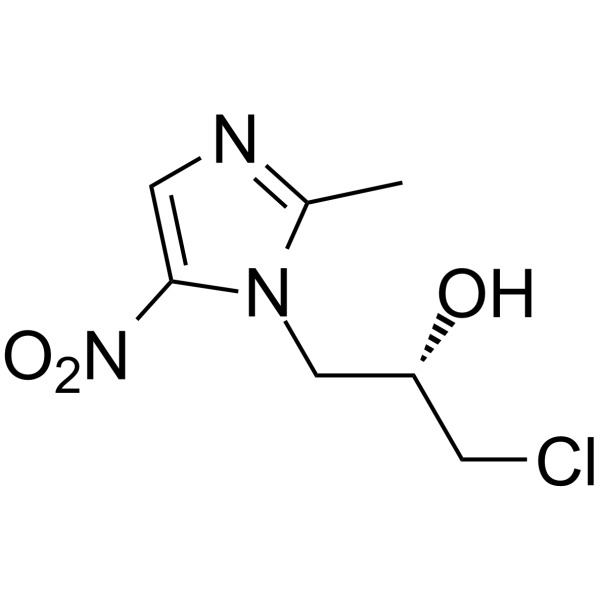
Ornidazole (Levo-)
CAS No. 166734-83-4
Ornidazole (Levo-)( (S)-Ornidazole | Levornidazole )
Catalog No. M26351 CAS No. 166734-83-4
Ornidazole Levo- is the levo-isomer of Ornidazole.
Purity : >98% (HPLC)
 COA
Datasheet
HNMR
HPLC
MSDS
Handing Instructions
COA
Datasheet
HNMR
HPLC
MSDS
Handing Instructions
| Size | Price / USD | Stock | Quantity |
| 1 mL x 10 mM in DMSO | 29 | In Stock |


|
| 25MG | 42 | In Stock |
|
| 50MG | 69 | In Stock |
|
| 100MG | 111 | In Stock |
|
| 200MG | 166 | In Stock |
|
| 500MG | Get Quote | In Stock |
|
| 1G | Get Quote | In Stock |
|
Biological Information
-
Product NameOrnidazole (Levo-)
-
NoteResearch use only, not for human use.
-
Brief DescriptionOrnidazole Levo- is the levo-isomer of Ornidazole.
-
DescriptionOrnidazole Levo- is the levo-isomer of Ornidazole.
-
In Vitro——
-
In Vivo——
-
Synonyms(S)-Ornidazole | Levornidazole
-
PathwayGPCR/G Protein
-
TargetAntibacterial
-
Recptorprotoporphyrinogen oxidase
-
Research Area——
-
Indication——
Chemical Information
-
CAS Number166734-83-4
-
Formula Weight219.63
-
Molecular FormulaC7H10ClN3O3
-
Purity>98% (HPLC)
-
SolubilityIn Vitro:?DMSO : 100 mg/mL (455.31 mM)
-
SMILESCc1ncc(n1C[C@H](O)CCl)[N+]([O-])=O
-
Chemical Name——
Shipping & Storage Information
-
Storage(-20℃)
-
ShippingWith Ice Pack
-
Stability≥ 2 years
Reference
1.Kaur N, Bhullar MS. Harvest time residues of pendimethalin and oxyfluorfen in vegetables and soil in sugarcane-based intercropping systems. Environ Monit Assess. 2015 May;187(5):221.
molnova catalog



related products
-
LL-37, Human
LL-37, Human is a 37-residue, amphipathic, cathelicidin-derived antimicrobial peptide, which exhibits a broad spectrum of antimicrobial activity.
-
Lethal toxin inhibit...
Lethal toxin inhibitor DN1 is a small molecule that reduces the cytotoxicity of anthrax lethal toxin (LT) an inhibitor of LT-induced pyroptosis.
-
QcrB inhibitor TB47
QcrB inhibitor TB47 (TB47) is a novel antimycobacterial agent that fuctions as a putative respiratory complex III (QcrB) inhibitor with MIC of 0.016-0.5 ug/mL against a panel of 56 M.
