


 Cart
Cart
 sales@molnova.com


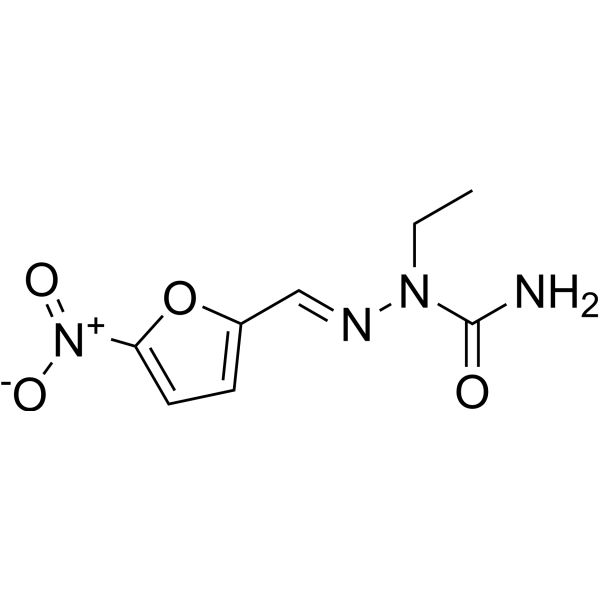
Nifursemizone
CAS No. 5579-89-5
Nifursemizone( Etafurazone | NF161 | 5-Nitro-2-furancarbaldehyde 2-ethyl semicarbazone )
Catalog No. M26333 CAS No. 5579-89-5
Nifursemizone is an agent with antiprotozoal.
Purity : >98% (HPLC)
 COA
Datasheet
HNMR
HPLC
MSDS
Handing Instructions
COA
Datasheet
HNMR
HPLC
MSDS
Handing Instructions
| Size | Price / USD | Stock | Quantity |
| 1 mL x 10 mM in DMSO | 67 | In Stock |


|
| 5MG | 70 | In Stock |
|
| 10MG | 112 | In Stock |
|
| 25MG | 226 | In Stock |
|
| 50MG | 323 | In Stock |
|
| 100MG | 461 | In Stock |
|
| 200MG | 631 | In Stock |
|
| 500MG | Get Quote | In Stock |
|
| 1G | Get Quote | In Stock |
|
Biological Information
-
Product NameNifursemizone
-
NoteResearch use only, not for human use.
-
Brief DescriptionNifursemizone is an agent with antiprotozoal.
-
DescriptionNifursemizone is an agent with antiprotozoal.
-
In Vitro——
-
In Vivo——
-
SynonymsEtafurazone | NF161 | 5-Nitro-2-furancarbaldehyde 2-ethyl semicarbazone
-
PathwayMicrobiology/Virology
-
TargetAntibiotic
-
RecptorCleavable
-
Research Area——
-
Indication——
Chemical Information
-
CAS Number5579-89-5
-
Formula Weight226.192
-
Molecular FormulaC8H10N4O4
-
Purity>98% (HPLC)
-
SolubilityIn Vitro:?DMSO : 20.83 mg/mL (92.09 mM)
-
SMILESCCN(\N=C\c1ccc(o1)[N+]([O-])=O)C(N)=O
-
Chemical Name——
Shipping & Storage Information
-
Storage(-20℃)
-
ShippingWith Ice Pack
-
Stability≥ 2 years
Reference
1.Chunguang Ren et al. A kind of reduction response type cancer target polypeptide drugs conjugate and its preparation method and application. CN110314237A
molnova catalog



related products
-
Piperacillin sodium ...
Piperacillin is a semisynthetic, broad-spectrum, ampicillin derived ureidopenicillin antibiotic proposed for pseudomonas infections.
-
8-Azaguanosine
8-Azaguanosine, a purine nucleoside analog, exhibits a broad spectrum of antitumor activity and is employed in the study of various tumor diseases.
-
Thioisonicotinamide
Isonicotinamide (pyridine-4-carboxamide) is a chemical based on the nicotinamide structure, but in which the amide is in the 4-position and not the 3-position.
