


 Cart
Cart
 sales@molnova.com


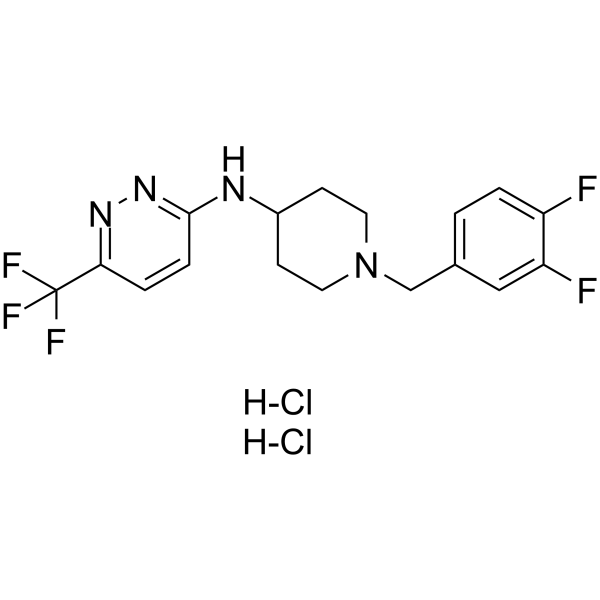
JNJ-37822681 dihydrochloride
CAS No. 2108806-02-4
JNJ-37822681 dihydrochloride( —— )
Catalog No. M26266 CAS No. 2108806-02-4
JNJ-37822681 dihydrochloride is a novel, highly selective dopamine D receptor antagonist characterized by a rapid dissociation rate from the dopamine D receptor.
Purity : >98% (HPLC)
 COA
Datasheet
HNMR
HPLC
MSDS
Handing Instructions
COA
Datasheet
HNMR
HPLC
MSDS
Handing Instructions
| Size | Price / USD | Stock | Quantity |
| 1 mL x 10 mM in DMSO | 33 | In Stock |


|
| 5MG | 29 | In Stock |
|
| 10MG | 46 | In Stock |
|
| 100MG | Get Quote | In Stock |
|
| 200MG | Get Quote | In Stock |
|
| 500MG | Get Quote | In Stock |
|
| 1G | Get Quote | In Stock |
|
Biological Information
-
Product NameJNJ-37822681 dihydrochloride
-
NoteResearch use only, not for human use.
-
Brief DescriptionJNJ-37822681 dihydrochloride is a novel, highly selective dopamine D receptor antagonist characterized by a rapid dissociation rate from the dopamine D receptor.
-
DescriptionJNJ-37822681 dihydrochloride is a novel, highly selective dopamine D receptor antagonist characterized by a rapid dissociation rate from the dopamine D receptor. JNJ-37822681 dihydrochloride shows a moderate binding affinity for the dopamine D2L receptor with a Ki of 158 nM.(In Vivo):JNJ-37822681 dihydrochloride occupied D2 receptors in rat brain at relatively low doses (ED50 = 0.39 mg/kg) and was effective in animal models of psychosis (e.g., inhibition of apomorphine-induced stereotypy or D-amphetamine/phencyclidine-induced hyperlocomotion).
-
In Vitro——
-
In VivoJNJ-37822681 (0.0025-40 mg/kg; i.h.; once) blocks D2 receptors in rat brain at relatively low doses with an ED50 value of 0.39 mg/kg and has effective in animal models of psychosis.JNJ-37822681 (0.01-2.5 mg/kg; i.h.; once) induces minimal prolactin release at the lowest doses required for central D2 receptor blockade. Animal Model:Female Sprague-Dawley rats with apomorphine-induced, d-amphetamine-induced, or phencyclidine-induced Dosage:0.0025-40 mg/kg Administration:Subcutaneous injection; onceResult:Inhibited of D-amphetamine-induced hyperlocomotion with an ED50 value of 1.0 mg/kg.Inhibited of apomorphine-induced stereotypy with an ED50 value of 0.19 mg/kg.Inhibited of phencyclidine-induced hyperlocomotion with an ED50 value of 4.7 mg/kg.Animal Model:Female Sprague-Dawley rats Dosage:0.01, 0.02, 0.04, 0.08, 0.16, 0.31, 0.63, 1.25, and 2.5 mg/kg Administration:Subcutaneous injection; onceResult:Increased prolactin release in a dose-dependent manner.
-
Synonyms——
-
PathwayGPCR/G Protein
-
TargetDopamine Receptor
-
RecptorHBV
-
Research Area——
-
Indication——
Chemical Information
-
CAS Number2108806-02-4
-
Formula Weight445.26
-
Molecular FormulaC17H19Cl2F5N4
-
Purity>98% (HPLC)
-
SolubilityIn Vitro:?DMSO : 33.33 mg/mL (74.86 mM)
-
SMILESCl.Cl.Fc1ccc(CN2CCC(CC2)Nc2ccc(nn2)C(F)(F)F)cc1F
-
Chemical Name——
Shipping & Storage Information
-
Storage(-20℃)
-
ShippingWith Ice Pack
-
Stability≥ 2 years
Reference
1.Danni Colledge, et al. The Novel Antiviral Agent Inarigivir Inhibits Both Nucleos(t)ide Analogue and Capsid Assembly Inhibitor Resistant HBV in vitro.
molnova catalog



related products
-
FAUC 346
FAUC 346 is a highly selective D3 partial agonist with EC50 of 1.5 nM, FAUC 346 with an inhibitory effect on cocaine-seeking behavior.
-
BP14979
BP14979 is a dopamine D3 receptor agonist that can be used to study neurological disorders.
-
Trifluoperazine
Trifluoperazine is a Dopamine D2 receptor inhibitor(IC50 : 1.2 nM) and Treatment of schizophrenia.
