


 Cart
Cart
 sales@molnova.com


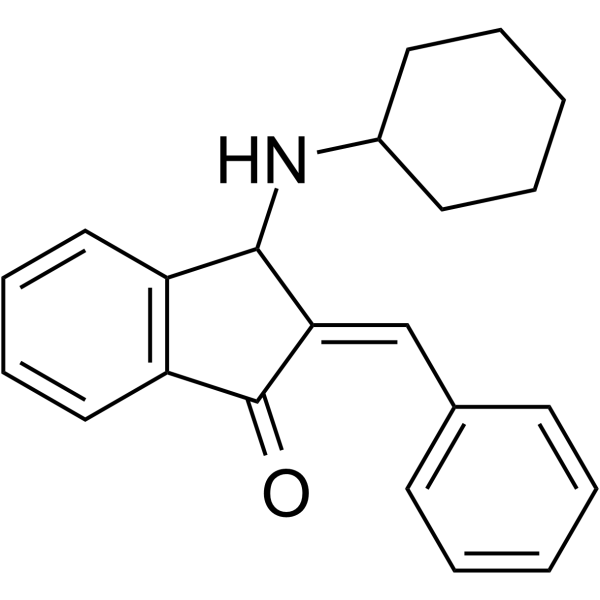
(E/Z)-BCI
CAS No. 15982-84-0
(E/Z)-BCI( NSC 150117 )
Catalog No. M26187 CAS No. 15982-84-0
(E/Z)-BCI attenuates LPS-induced inflammatory mediators and ROS production in macrophage cells via activating the Nrf2 signaling axis and inhibiting the NF-κB pathway. (E/Z)-BCI is a dual-specificity phosphatase 6 (DUSP6) inhibitor with anti-inflammatory activities.
Purity : >98% (HPLC)
 COA
Datasheet
HNMR
HPLC
MSDS
Handing Instructions
COA
Datasheet
HNMR
HPLC
MSDS
Handing Instructions
| Size | Price / USD | Stock | Quantity |
| 1 mL x 10 mM in DMSO | 164 | In Stock |


|
| 5MG | 149 | In Stock |
|
| 10MG | 282 | In Stock |
|
| 25MG | 451 | In Stock |
|
| 50MG | 625 | In Stock |
|
| 100MG | 830 | In Stock |
|
| 200MG | 1097 | In Stock |
|
| 500MG | Get Quote | In Stock |
|
| 1G | Get Quote | In Stock |
|
Biological Information
-
Product Name(E/Z)-BCI
-
NoteResearch use only, not for human use.
-
Brief Description(E/Z)-BCI attenuates LPS-induced inflammatory mediators and ROS production in macrophage cells via activating the Nrf2 signaling axis and inhibiting the NF-κB pathway. (E/Z)-BCI is a dual-specificity phosphatase 6 (DUSP6) inhibitor with anti-inflammatory activities.
-
Description(E/Z)-BCI attenuates LPS-induced inflammatory mediators and ROS production in macrophage cells via activating the Nrf2 signaling axis and inhibiting the NF-κB pathway. (E/Z)-BCI is a dual-specificity phosphatase 6 (DUSP6) inhibitor with anti-inflammatory activities.(In Vitro):(E/Z)-BCI hydrochloride (2-10 μM; 72 hours) significantly decreases cell viability in a time and dose-dependent manner in gastric epithelial cell GES1, GC cell lines, and AGS cell lines. (E/Z)-BCI hydrochloride (0.5-4 μM; 24 hours) significantly inhibits DUSP6 expression in LPS-activated macrophages. (E/Z)-BCI hydrochloride inhibits cell proliferation, migration, and invasion in a receptor-independent manner and enhances Cisplatin (CDDP) cytotoxicity (enhances CDDP-induced cell death and apoptosis) at pharmacological concentrations in gastric cancer (GC) cells. (E/Z)-BCI hydrochloride (0.5-2 μM; 24 hours) treatment significantly inhibits the expression of IL-1β, TNF-α, and IL-6 mRNA in LPS-activated macrophages. (E/Z)-BCI hydrochloride decreases ROS production and activates the Nrf2 pathway in LPS-activated macrophages. (In Vivo):(E/Z)-BCI hydrochloride treatment enhances cisplatin efficacy in PDX models.
-
In Vitro(E/Z)-BCI hydrochloride (2-10 μM; 72 hours) significantly decreases cell viability in a time and dose-dependent manner in gastric epithelial cell GES1, GC cell lines, and AGS cell lines.(E/Z)-BCI hydrochloride (0.5-4 μM; 24 hours) significantly inhibits DUSP6 expression in LPS-activated macrophages.(E/Z)-BCI hydrochloride (0.5-2 μM; 24 hours) treatment significantly inhibits the expression of IL-1β, TNF-α and IL-6 mRNA in LPS-activated macrophages.(E/Z)-BCI hydrochloride decreases ROS production and activates the Nrf2 pathway in LPS-activated macrophages.(E/Z)-BCI hydrochloride inhibits cell proliferation, migration and invasion in a receptor-independent manner and enhances Cisplatin (CDDP) cytotoxicity (enhances CDDP-induced cell death and apoptosis) at pharmacological concentrations in the gastric cancer (GC) cells. Cell Viability Assay Cell Line:Gastric epithelial cell GES1, GC cell lines (HGC27, SGC7901, MKN45, BGC823, MGC803, SNU216, NUGC4), AGS cell lines Concentration:2 μM, 4 μM, 6 μM, 8 μM, 10 μM Incubation Time:72 hours Result:Cell viability was significantly decreased in a time and dose-dependent manner.Western Blot Analysis Cell Line:RAW264.7 macrophage cells (by LPS-activated macrophages) Concentration:0.5 μM, 1 μM, 2 μM, 4 μMIncubation Time:24 hoursResult:DUSP6 protein was significantly downregulated in LPS-activated macrophages.
-
In Vivo(E/Z)-BCI hydrochloride (35 mg/kg; intraperitoneal injection; every 7 days; for four weeks; female BALB/c nude mice) treatment enhances cisplatin efficacy in PDX models. Animal Model:Patient-derived xenograft (PDX) models (4-5-week-old female BALB/c nude mice) Dosage:35 mg/kg Administration:Intraperitoneal injection; every 7 days; for four weeks Result:Tumor weights in the PDX models treated plus CDDP were significantly suppressed compared with tumors from PDX model mice treated with either agent alone.
-
SynonymsNSC 150117
-
PathwayApoptosis
-
TargetApoptosis
-
RecptorPEGs
-
Research Area——
-
Indication——
Chemical Information
-
CAS Number15982-84-0
-
Formula Weight317.432
-
Molecular FormulaC22H23NO
-
Purity>98% (HPLC)
-
Solubility——
-
SMILESO=C1\C(=C/c2ccccc2)C(NC2CCCCC2)c2ccccc12
-
Chemical Name——
Shipping & Storage Information
-
Storage(-20℃)
-
ShippingWith Ice Pack
-
Stability≥ 2 years
Reference
1.An S, et al. Small-molecule PROTACs:An emerging and promising approach for the development of targeted therapy drugs. EBioMedicine. 2018 Oct;36:553-562.
molnova catalog



related products
-
Bomedemstat ditosyla...
Bomedemstat ditosylate (IMG-7289 ditosylate) is an orally active lysine-specific demethylase 1 (LSD1) inhibitor with antitumor activity that potentiates the response to PD-1 inhibition in a homozygous model of SCLC, inhibits cancer cell proliferation, and induces apoptosis.
-
BiP inducer X
BiP inducer X is a selective inducer of immunoglobulin heavy chain binding protein (BiP)/GRP78 and an ER chaperone inducer. BiP inducer X prevents cell death in neurons and retinal cell lines.
-
Ganoderenic acid D
Ganoderenic acid D is a natural product isolated from the effective compounds of Ganoderma lucidum extract (GLE). Ganoderenic acid D induces cell cycle arrest and apoptosis and inhibits the proliferation of cancer cells.
