


 Cart
Cart
 sales@molnova.com


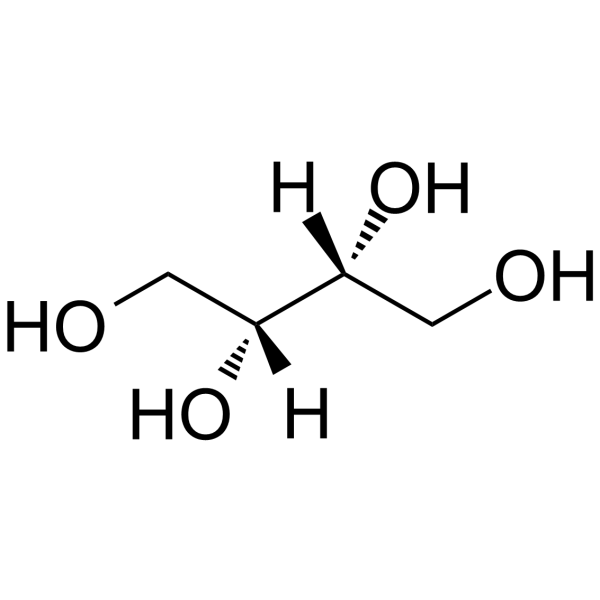
D-Threitol
CAS No. 2418-52-2
D-Threitol( —— )
Catalog No. M26141 CAS No. 2418-52-2
D-threitol is used as an antifreeze.
Purity : >98% (HPLC)
 COA
Datasheet
HNMR
HPLC
MSDS
Handing Instructions
COA
Datasheet
HNMR
HPLC
MSDS
Handing Instructions
| Size | Price / USD | Stock | Quantity |
| 1 mL x 10 mM in DMSO | 37 | In Stock |


|
| 25MG | 38 | In Stock |
|
| 50MG | 52 | In Stock |
|
| 100MG | 75 | In Stock |
|
| 200MG | Get Quote | In Stock |
|
| 500MG | Get Quote | In Stock |
|
| 1G | Get Quote | In Stock |
|
Biological Information
-
Product NameD-Threitol
-
NoteResearch use only, not for human use.
-
Brief DescriptionD-threitol is used as an antifreeze.
-
DescriptionD-threitol is used as an antifreeze.
-
In Vitro——
-
In Vivo——
-
Synonyms——
-
PathwayProteasome/Ubiquitin
-
TargetEndogenous Metabolite
-
RecptorAChE| Amyloid-β
-
Research Area——
-
Indication——
Chemical Information
-
CAS Number2418-52-2
-
Formula Weight122.12
-
Molecular FormulaC4H10O4
-
Purity>98% (HPLC)
-
SolubilityIn Vitro:?DMSO : 250 mg/mL (2047.17 mM)
-
SMILESOC[C@@H](O)[C@H](O)CO
-
Chemical Name——
Shipping & Storage Information
-
Storage(-20℃)
-
ShippingWith Ice Pack
-
Stability≥ 2 years
Reference
1.Lomarat P, et al. Bioactivity-guided Separation of the Active Compounds in Acacia pennata Responsible for the Prevention of Alzheimer's Disease. Nat Prod Commun. 2015;10(8):1431-1434.
molnova catalog



related products
-
Leukotriene C4
Leukotriene C4 (LTC4) is an arachidonate lipid mediator that regulates leukocyte recruitment and function at sites of inflammation.
-
L-Octanoylcarnitine
L-Octanoylcarnitine is the active octanoylcarnitine present in plasma and is a potential biomarker for breast cancer.
-
2,4-Dimethylacetophe...
2',4'-Dimethylacetophenone is a chemical that can be used in biological research. The compound can be used in gas chromatography to detect aldosterone aroma in tobacco compounds and can be used to protect food products.
