


 Cart
Cart
 sales@molnova.com


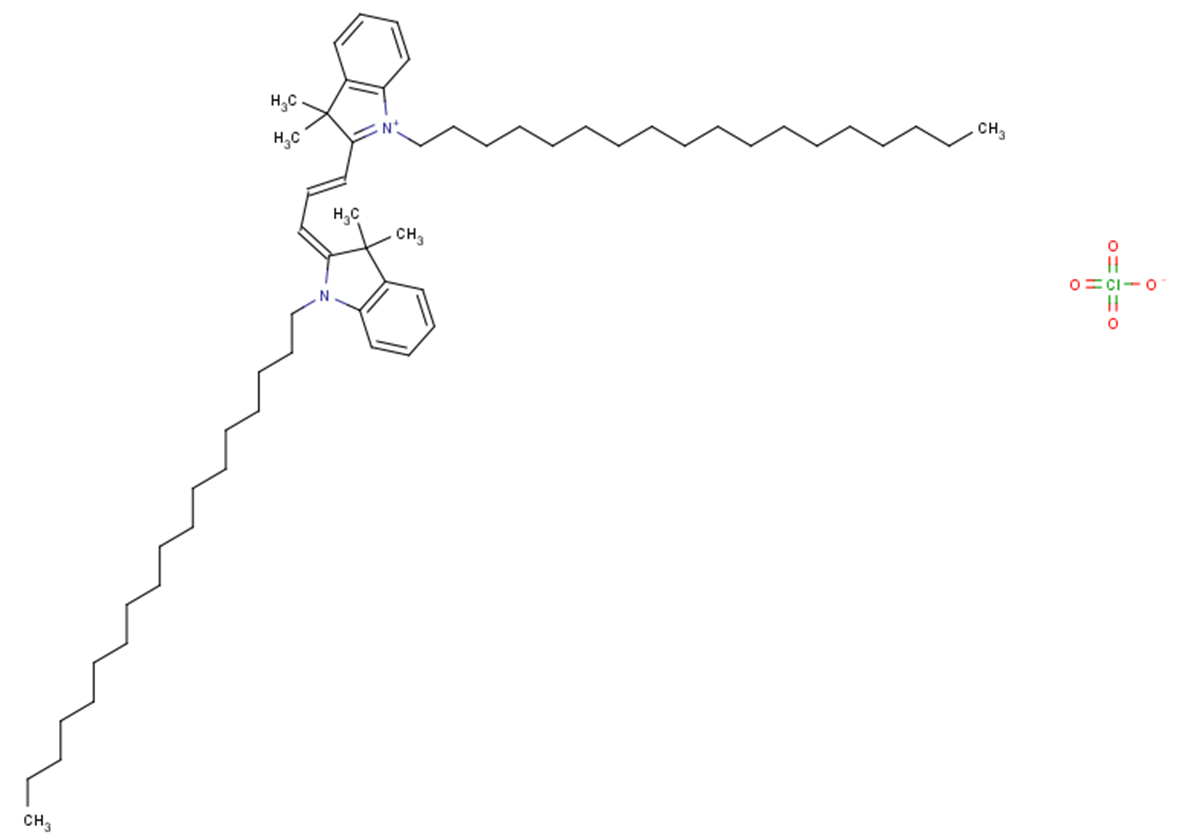
DiI
CAS No. 41085-99-8
DiI( DiIC18(3) )
Catalog No. M24373 CAS No. 41085-99-8
DiI is a lipophilic membrane dye. It diffuses laterally to stain the entire cell. DiI is excited to emit orange-red fluorescence which is weak in water but strong and photostable when incorporated into membranes.
Purity : >98% (HPLC)
 COA
Datasheet
HNMR
HPLC
MSDS
Handing Instructions
COA
Datasheet
HNMR
HPLC
MSDS
Handing Instructions
| Size | Price / USD | Stock | Quantity |
| 1 mL x 10 mM in DMSO | 29 | In Stock |


|
| 10MG | 28 | In Stock |
|
| 100MG | Get Quote | In Stock |
|
| 200MG | Get Quote | In Stock |
|
| 500MG | Get Quote | In Stock |
|
| 1G | Get Quote | In Stock |
|
Biological Information
-
Product NameDiI
-
NoteResearch use only, not for human use.
-
Brief DescriptionDiI is a lipophilic membrane dye. It diffuses laterally to stain the entire cell. DiI is excited to emit orange-red fluorescence which is weak in water but strong and photostable when incorporated into membranes.
-
DescriptionDiI is a lipophilic membrane dye. It diffuses laterally to stain the entire cell. DiI is excited to emit orange-red fluorescence which is weak in water but strong and photostable when incorporated into membranes.
-
In Vitro——
-
In Vivo——
-
SynonymsDiIC18(3)
-
PathwayOthers
-
TargetOther Targets
-
RecptorOthers
-
Research Area——
-
Indication——
Chemical Information
-
CAS Number41085-99-8
-
Formula Weight933.87
-
Molecular FormulaC59H97ClN2O4
-
Purity>98% (HPLC)
-
SolubilityDMSO:12.5 mg/mL (13.39 mM; ultrasonic and warming and heat to 80°C)
-
SMILESCCCCCCCCCCCCCCCCCCN1/C(C(C)(C)C2=C1C=CC=C2)=C\C=C\C3=[N+](CCCCCCCCCCCCCCCCCC)C4=C(C=CC=C4)C3(C)C.O=Cl(=O)([O-])=O
-
Chemical Name——
Shipping & Storage Information
-
Storage(-20℃)
-
ShippingWith Ice Pack
-
Stability≥ 2 years
Reference
molnova catalog



related products
-
Galanin Message Asso...
Galanin Message Associated Peptide (25-41) amide
-
Cathepsin G (77-83)
Cathepsin G (77-83)
-
DSPE-PEG 2000
DSPE-PEG 2000 is a non-toxic and biodegradable amphiphilic copolymer that can be used to form micelles to deliver nanoparticles.
