


 Cart
Cart
 sales@molnova.com


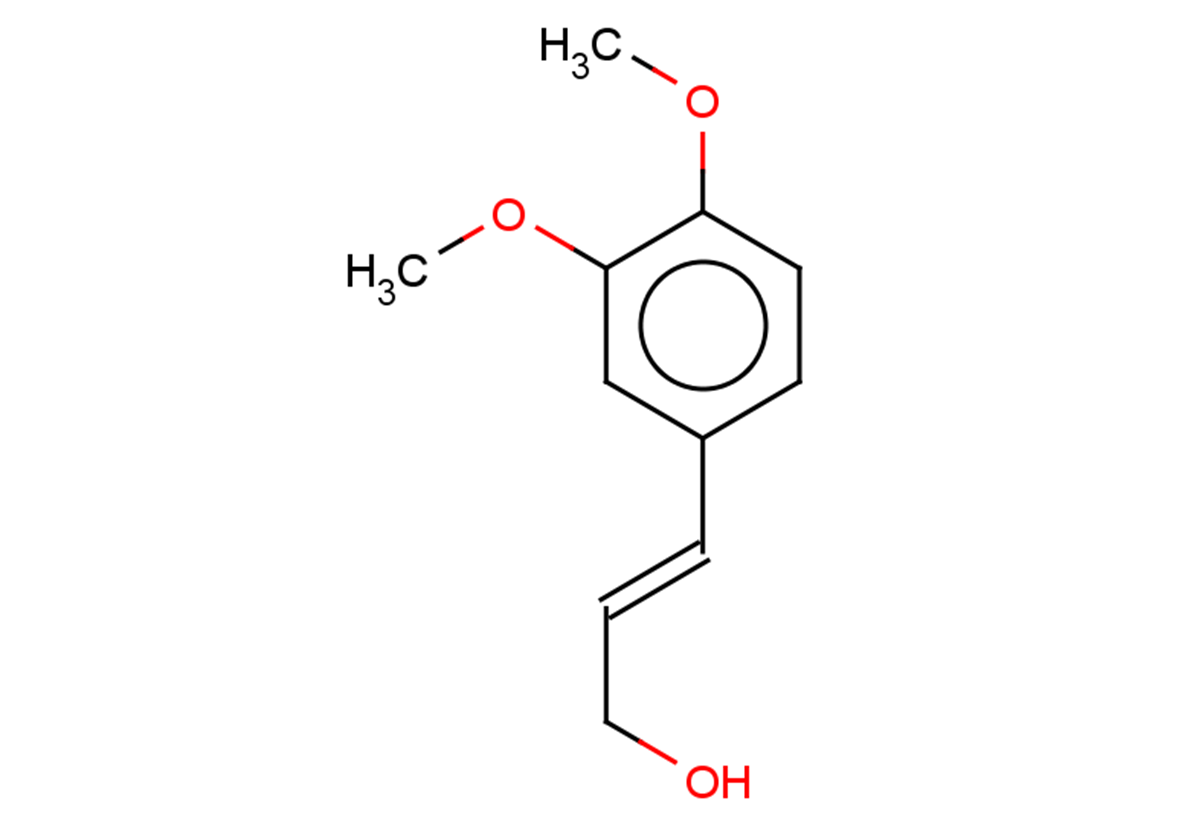
3,4-Dimethoxycinnamyl alcohol
CAS No. 40918-90-9
3,4-Dimethoxycinnamyl alcohol( (E)-3-(3,4-dimethoxyphenyl)prop-2-en-1-ol )
Catalog No. M24371 CAS No. 40918-90-9
3,4-Dimethoxycinnamyl alcohol shows significant antimicrobial and cytotoxic activities.
Purity : >98% (HPLC)
 COA
Datasheet
HNMR
HPLC
MSDS
Handing Instructions
COA
Datasheet
HNMR
HPLC
MSDS
Handing Instructions
| Size | Price / USD | Stock | Quantity |
| 1 mL x 10 mM in DMSO | 352 | In Stock |


|
| 5MG | 342 | In Stock |
|
| 10MG | 508 | In Stock |
|
| 25MG | 823 | In Stock |
|
| 50MG | 1107 | In Stock |
|
| 100MG | Get Quote | In Stock |
|
| 200MG | Get Quote | In Stock |
|
| 500MG | Get Quote | In Stock |
|
| 1G | Get Quote | In Stock |
|
Biological Information
-
Product Name3,4-Dimethoxycinnamyl alcohol
-
NoteResearch use only, not for human use.
-
Brief Description3,4-Dimethoxycinnamyl alcohol shows significant antimicrobial and cytotoxic activities.
-
Description3,4-Dimethoxycinnamyl alcohol shows significant antimicrobial and cytotoxic activities.
-
In Vitro——
-
In Vivo——
-
Synonyms(E)-3-(3,4-dimethoxyphenyl)prop-2-en-1-ol
-
PathwayOthers
-
TargetOther Targets
-
RecptorOthers
-
Research Area——
-
Indication——
Chemical Information
-
CAS Number40918-90-9
-
Formula Weight194.23
-
Molecular FormulaC11H14O3
-
Purity>98% (HPLC)
-
Solubility——
-
SMILESCOc(ccc(/C=C/CO)c1)c1OC
-
Chemical Name——
Shipping & Storage Information
-
Storage(-20℃)
-
ShippingWith Ice Pack
-
Stability≥ 2 years
Reference
1.Sadik G , Islam R , Rahman M M , et al. Antimicrobial and cytotoxic constituents of Loranthus globosus[J]. Fitoterapia, 2003, 74(3):308-311.
molnova catalog



related products
-
IM176OUT05
IM176OUT05 activates stem cell metabolism with hair regrowth-promoting effects.
-
VIR-165
VIR-165 is a modified form of virus inhibitory peptide (VIRIP), which corresponds to residues 353 to 372 of C-proximal region of human alpha1-antitrypsin, the most abundant circulating serine protease inhibitor. VIRIP inhibits a wide variety of human immunodeficiency virus type 1 (HIV-1) strains.
-
Dacomitinib Intermed...
Dacomitinib Intermediate 2 (N-(3-Chloro-4-fluorophenyl)-7-methoxy-6-nitroquinazolin-4-amine) has anticancer activity and can be used to study lung cancer.
