


 Cart
Cart
 sales@molnova.com


 Home -
Products -
Others -
GRK (GPCRK) -
1-(2,3-DIHYDRO-BENZO[1,4]DIOXIN-6-YL)-5-OXO-PYRROLIDINE-3-CARBOXYLIC ACID
Home -
Products -
Others -
GRK (GPCRK) -
1-(2,3-DIHYDRO-BENZO[1,4]DIOXIN-6-YL)-5-OXO-PYRROLIDINE-3-CARBOXYLIC ACID
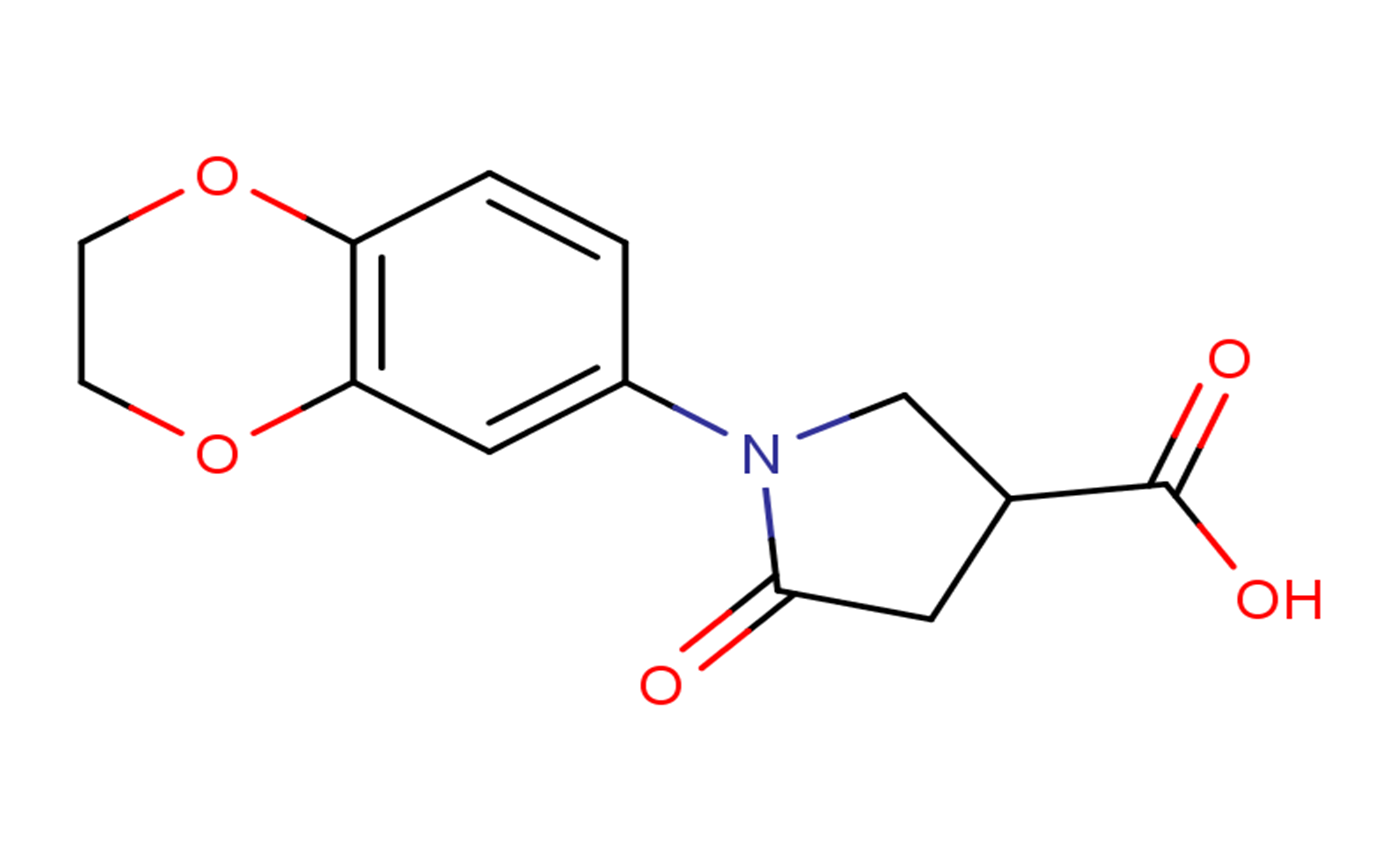
1-(2,3-DIHYDRO-BENZO[1,4]DIOXIN-6-YL)-5-OXO-PYRROLIDINE-3-CARBOXYLIC ACID
CAS No. 260555-42-8
1-(2,3-DIHYDRO-BENZO[1,4]DIOXIN-6-YL)-5-OXO-PYRROLIDINE-3-CARBOXYLIC ACID( —— )
Catalog No. M24166 CAS No. 260555-42-8
1-(2,3-DIHYDRO-BENZO[1,4]DIOXIN-6-YL)-5-OXO-PYRROLIDINE-3-CARBOXYLIC ACID targets GRK2.
Purity : >98% (HPLC)
 COA
Datasheet
HNMR
HPLC
MSDS
Handing Instructions
COA
Datasheet
HNMR
HPLC
MSDS
Handing Instructions
| Size | Price / USD | Stock | Quantity |
| 1 mL x 10 mM in DMSO | 28 | In Stock |


|
| 10MG | 29 | In Stock |
|
| 25MG | 51 | In Stock |
|
| 50MG | 75 | In Stock |
|
| 100MG | 112 | In Stock |
|
| 200MG | 168 | In Stock |
|
| 500MG | Get Quote | In Stock |
|
| 1G | Get Quote | In Stock |
|
Biological Information
-
Product Name1-(2,3-DIHYDRO-BENZO[1,4]DIOXIN-6-YL)-5-OXO-PYRROLIDINE-3-CARBOXYLIC ACID
-
NoteResearch use only, not for human use.
-
Brief Description1-(2,3-DIHYDRO-BENZO[1,4]DIOXIN-6-YL)-5-OXO-PYRROLIDINE-3-CARBOXYLIC ACID targets GRK2.
-
Description1-(2,3-DIHYDRO-BENZO[1,4]DIOXIN-6-YL)-5-OXO-PYRROLIDINE-3-CARBOXYLIC ACID targets GRK2.
-
In Vitro——
-
In Vivo——
-
Synonyms——
-
PathwayOthers
-
TargetGRK (GPCRK)
-
RecptorGRK2
-
Research Area——
-
Indication——
Chemical Information
-
CAS Number260555-42-8
-
Formula Weight263.25
-
Molecular FormulaC13H13NO5
-
Purity>98% (HPLC)
-
SolubilityDMSO:10 mM
-
SMILESC1COC2=C(O1)C=CC(=C2)N3CC(CC3=O)C(=O)O
-
Chemical Name——
Shipping & Storage Information
-
Storage(-20℃)
-
ShippingWith Ice Pack
-
Stability≥ 2 years
Reference
molnova catalog



related products
-
GRK6-IN-2
GRK6-IN-2 is a potent G protein-coupled receptor kinase 6 (GRK6) inhibitor with potential antitumor activity.GRK6-IN-2 has been studied in multiple myeloma.
-
Compound 101
Compound 101 (GRK2 inhibitor 101, Takeda compound 101, Cmpd101)?is a novel membrane-permeable, small-molecule inhibitor of GRK2 and GRK3.
-
PEN (human)
Endogenous peptide GPR83 agonist. ProSAAS-derived neuropeptide.
