


 Cart
Cart
 sales@molnova.com


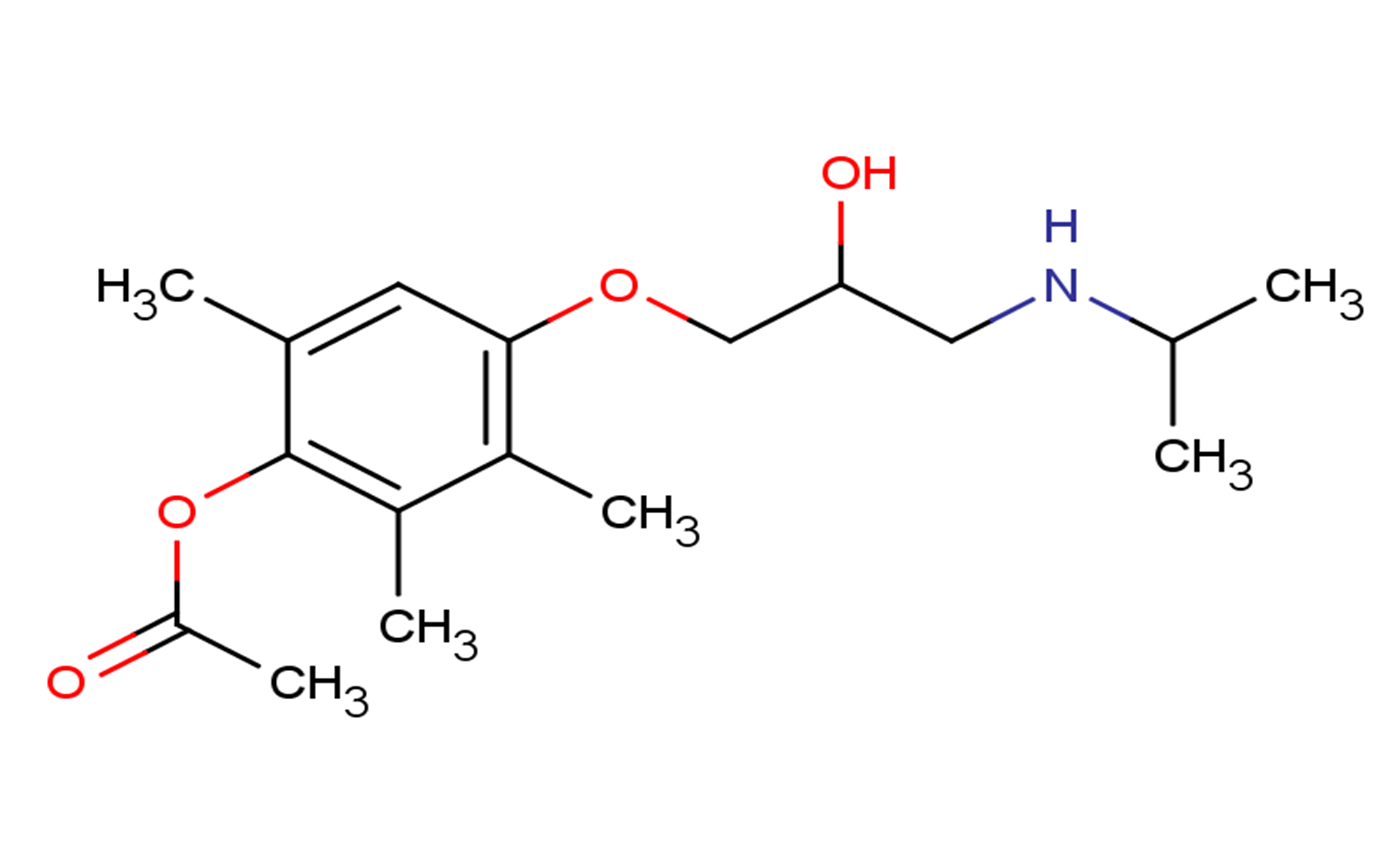
Metipranolol
CAS No. 22664-55-7
Metipranolol( —— )
Catalog No. M24030 CAS No. 22664-55-7
Metipranolol is a β-adrenergic receptor antagonist that is given orally for the treatment of hypertension and also applied topically to the cornea for treating glaucoma.
Purity : >98% (HPLC)
 COA
Datasheet
HNMR
HPLC
MSDS
Handing Instructions
COA
Datasheet
HNMR
HPLC
MSDS
Handing Instructions
| Size | Price / USD | Stock | Quantity |
| 1 mL x 10 mM in DMSO | 50 | In Stock |


|
| 2MG | 29 | In Stock |
|
| 5MG | 45 | In Stock |
|
| 10MG | 76 | In Stock |
|
| 25MG | 140 | In Stock |
|
| 50MG | 206 | In Stock |
|
| 100MG | Get Quote | In Stock |
|
| 200MG | Get Quote | In Stock |
|
| 500MG | Get Quote | In Stock |
|
| 1G | Get Quote | In Stock |
|
Biological Information
-
Product NameMetipranolol
-
NoteResearch use only, not for human use.
-
Brief DescriptionMetipranolol is a β-adrenergic receptor antagonist that is given orally for the treatment of hypertension and also applied topically to the cornea for treating glaucoma.
-
DescriptionMetipranolol is a β-adrenergic receptor antagonist that is given orally for the treatment of hypertension and also applied topically to the cornea for treating glaucoma.(In Vivo):At postnatal day 35 (P35), rd10 mice given daily subcutaneous injections of 40 mg/kg of Metipranolol has reduction in markers of nitrosative stress, fewer TUNEL-positive cells, increased outer nuclear layer thickness, and substantially more staining for rhodopsin. At P50, Metipranolol-treated rd10 mice has decreased 3-nitrotyrosine staining in the retina, increased immunostaining for cone arrestin, a marker for cone photoreceptors, and significantly higher scotopic and photopic b-wave amplitudes at the highest stimulus intensity. At P65, cone density is significantly higher in Metipranolol-treated versus vehicle-injected rd10 mice.
-
In VitroIn vitro β1- and β2-adrenoceptor antagonism is evaluated using the guinea pig atrium and the rat uterus, respectively. The respective pA2 values are 8.3 and 8.4. Metipranolol significantly reduces iron/ascorbate-induced lipid peroxidation in rat brain homogenates with an IC50 value of 6.9 μM . Metipranolol also concentration-dependently inhibits sodium nitroprusside-stimulated lipid peroxidation in rat brain homogenates, displaying an IC50 value of 25.1 μM.
-
In VivoAt postnatal day 35 (P35), rd10 mice given daily subcutaneous injections of 40 mg/kg of Metipranolol has reduction in markers of nitrosative stress, fewer TUNEL-positive cells, increased outer nuclear layer thickness, and substantially more staining for rhodopsin. At P50, Metipranolol-treated rd10 mice has decreased 3-nitrotyrosine staining in the retina, increased immunostaining for cone arrestin, a marker for cone photoreceptors, and significantly higher scotopic and photopic b-wave amplitudes at the highest stimulus intensity. At P65, cone density is significantly higher in Metipranolol-treated versus vehicle-injected rd10 mice.
-
Synonyms——
-
PathwayApoptosis
-
TargetAdenosine Receptor
-
Recptorβ-adrenergic receptor
-
Research Area——
-
Indication——
Chemical Information
-
CAS Number22664-55-7
-
Formula Weight309.4
-
Molecular FormulaC17H27NO4
-
Purity>98% (HPLC)
-
SolubilityDMSO:10 mM
-
SMILESCC1=CC(=C(C(=C1OC(=O)C)C)C)OCC(CNC(C)C)O
-
Chemical Name——
Shipping & Storage Information
-
Storage(-20℃)
-
ShippingWith Ice Pack
-
Stability≥ 2 years
Reference
1.Y Kanan, Khan M , Lorenc V E , et al. Metipranolol Promotes Structure and Function of Retinal Photoreceptors in the rd10 Mouse Model of Human Retinitis Pigmentosa[J]. Journal of Neurochemistry, 2018, 148.
molnova catalog



related products
-
N6-(2-Phenylethyl)ad...
N6-(2-Phenylethyl)adenosine is an adenosine derivative and an agonist of adenosine receptors with Ki values of 11.8 nM and 30.1 nM for rat and human A1.
-
KI-7
KI-7 is an adenosine A2B receptor positive allosteric modulator.
-
Rolofylline
A potent, selective and orally active adenosine A1 receptor antagonist with Ki of 1.3 nM.
