


 Cart
Cart
 sales@molnova.com


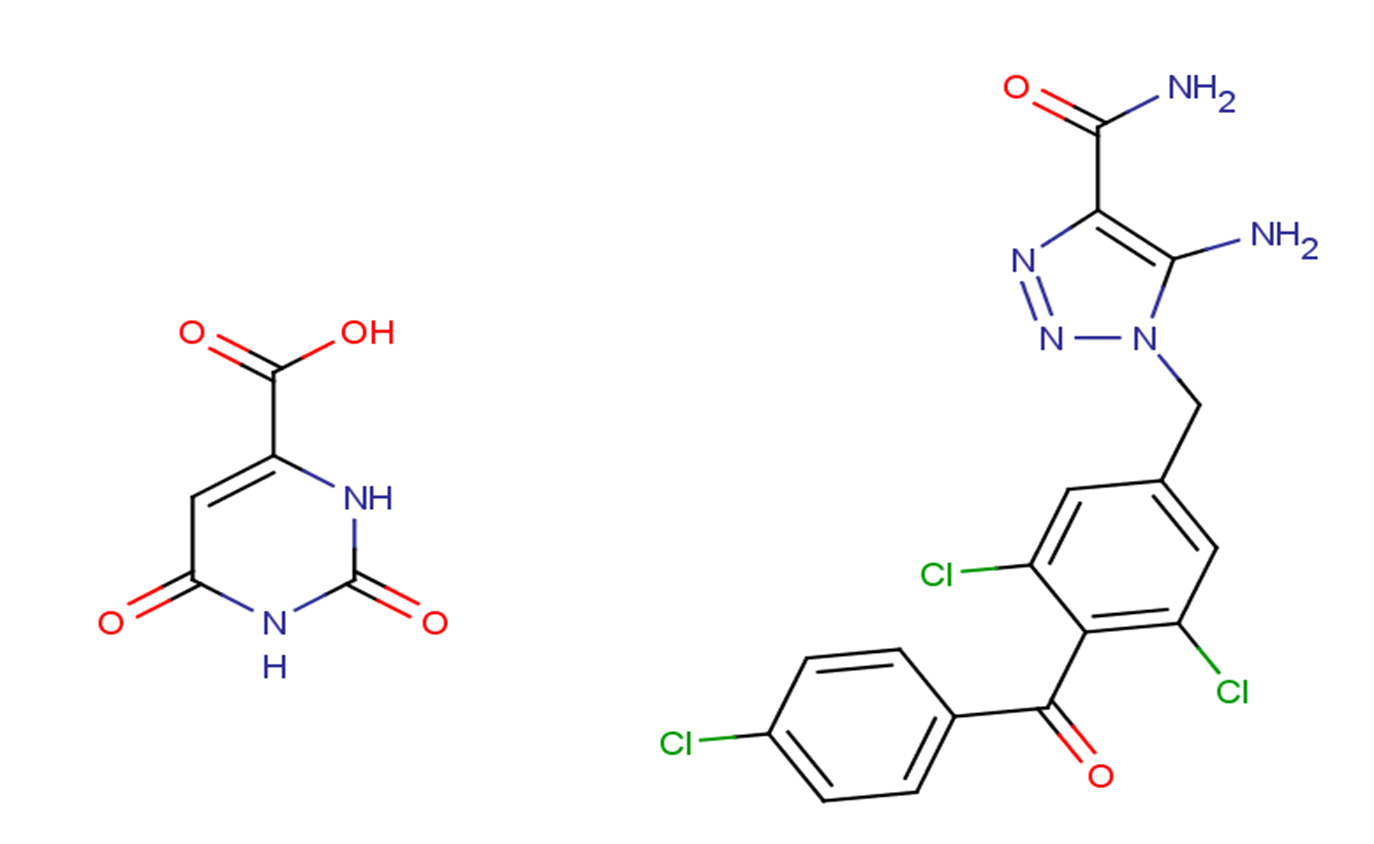
Carboxyamidotriazole Orotate
CAS No. 187739-60-2
Carboxyamidotriazole Orotate( L-651582 Orotate | CAI Orotate )
Catalog No. M23856 CAS No. 187739-60-2
Carboxyamidotriazole Orotate is a cytostatic inhibitor of nonvoltage-operated calcium channels and calcium channel-mediated signaling pathways.
Purity : >98% (HPLC)
 COA
Datasheet
HNMR
HPLC
MSDS
Handing Instructions
COA
Datasheet
HNMR
HPLC
MSDS
Handing Instructions
| Size | Price / USD | Stock | Quantity |
| 2MG | 30 | In Stock |


|
| 5MG | 51 | In Stock |
|
| 10MG | 79 | In Stock |
|
| 25MG | 135 | In Stock |
|
| 50MG | 187 | In Stock |
|
| 100MG | 261 | In Stock |
|
| 200MG | 370 | In Stock |
|
| 500MG | Get Quote | In Stock |
|
| 1G | Get Quote | In Stock |
|
Biological Information
-
Product NameCarboxyamidotriazole Orotate
-
NoteResearch use only, not for human use.
-
Brief DescriptionCarboxyamidotriazole Orotate is a cytostatic inhibitor of nonvoltage-operated calcium channels and calcium channel-mediated signaling pathways.
-
DescriptionCarboxyamidotriazole Orotate is a cytostatic inhibitor of nonvoltage-operated calcium channels and calcium channel-mediated signaling pathways. Carboxyamidotriazole Orotate (L-651582 Orotate) is the orotate salt form of Carboxyamidotriazole (CAI), an orally bioavailable signal transduction inhibitor. Carboxyamidotriazole Orotate shows anti-tumor, anti-inflammatory and antiangiogenic effects.(In Vitro):Carboxyamidotriazole Orotate (0.1-10 μM; 24-96 hours) inhibits cell proliferation of LAMA84R and K562R cell lines.Carboxyamidotriazole Orotate inhibits the phosphorylation of a selected target of Bcr-Abl kinase. Tyrosine phosphorylation of CrkL is reduced by 5 μM Carboxyamidotriazole Orotate treatment.(In Vivo):Carboxyamidotriazole Orotate (342, 513 mg/kg; i.p.; Q1D×5 for two rounds) displays antitumor activity on CML xenografts.
-
In VitroCarboxyamidotriazole Orotate (0.1-10 μM; 24-96 hours) inhibits cell proliferation of LAMA84R and K562R cell lines.Carboxyamidotriazole Orotate inhibits the phosphorylation of a selected target of Bcr-Abl kinase. Tyrosine phosphorylation of CrkL is reduced by 5 μM Carboxyamidotriazole Orotate treatment. Cell Viability Assay Cell Line:LAMA84R and K562R cell lines Concentration:0.1, 1, 5, 10 μM Incubation Time:24, 48, 72, 96 hours Result:Showed a 50% growth reduction of the chronic myelogenous leukaemia (CML) lines with 5 μM CTO at 96 h time point.Western Blot Analysis Cell Line:LAMA84R and K562R cell lines Concentration:0.1, 1, 5 μM Incubation Time:72 and 96 hours Result:A dose-dependent inhibition of both total and phosphorylated Bcr-Abl levels.
-
In VivoCarboxyamidotriazole Orotate (342, 513 mg/kg; i.p.; Q1D×5 for two rounds) displays antitumor activity on CML xenografts. Animal Model:Male NOD/SCID mice four-to-five week old Dosage:342, 513 mg/kg Administration:i.p.; Q1D×5 for two rounds Result:Increase survival.
-
SynonymsL-651582 Orotate | CAI Orotate
-
PathwayGPCR/G Protein
-
TargetCalcium Channel
-
RecptorCalcium Channel
-
Research Area——
-
Indication——
Chemical Information
-
CAS Number187739-60-2
-
Formula Weight580.76
-
Molecular FormulaC22H16Cl3N7O6
-
Purity>98% (HPLC)
-
SolubilityDMSO:5 mg/mL (8.61 mM; Need ultrasonic)
-
SMILESO=C(C(NC1=O)=CC(N1)=O)O.O=C(C2=C(N)N(CC3=CC(Cl)=C(C(C4=CC=C(Cl)C=C4)=O)C(Cl)=C3)N=N2)N
-
Chemical Name——
Shipping & Storage Information
-
Storage(-20℃)
-
ShippingWith Ice Pack
-
Stability≥ 2 years
Reference
1.Corrado C, et al. Carboxyamidotriazole-orotate inhibits the growth of imatinib-resistant chronic myeloid leukaemia cells and modulates exosomes-stimulated angiogenesis. PLoS One. 2012;7(8):e42310.
molnova catalog



related products
-
Z-944
Z-944 is a potent, highly selective and oral T-type calcium channel blocker with IC50 of 50-160 nM for human Cav3.1, Cav3.2, and Cav3.3 channels.
-
CDN1163
CDN1163 (CDN-1163) is a small molecule, allosteric activator of SERCA2.
-
Synta-66
A potent, selective CRAC channel Orai1 blocker with IC50 of 3 uM.
