


 Cart
Cart
 sales@molnova.com


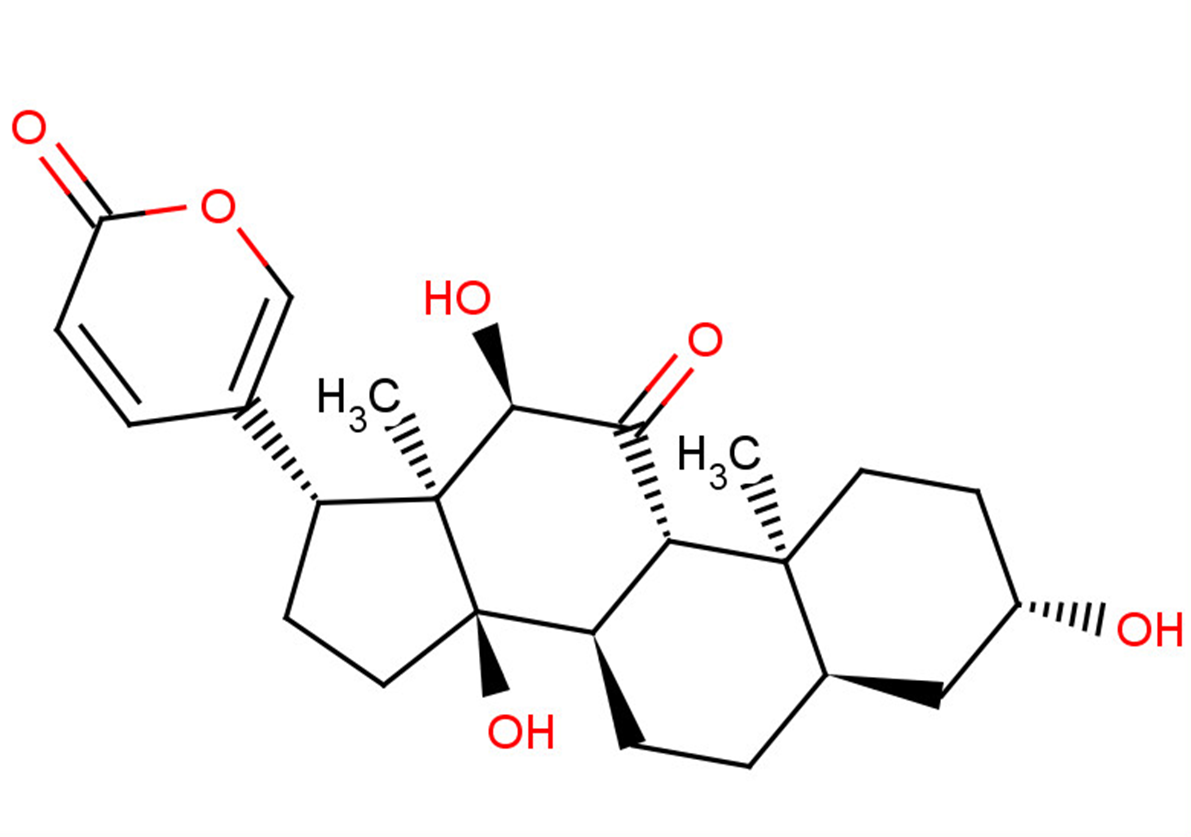
Pseudobufarenogin
CAS No. 17008-69-4
Pseudobufarenogin( ψ-Bufarenogin )
Catalog No. M23765 CAS No. 17008-69-4
Pseudobufarenogin, a novel anti-tumor compound, suppresses liver cancer growth by inhibiting receptor tyrosine kinase-mediated signaling.
Purity : >98% (HPLC)
 COA
Datasheet
HNMR
HPLC
MSDS
Handing Instructions
COA
Datasheet
HNMR
HPLC
MSDS
Handing Instructions
| Size | Price / USD | Stock | Quantity |
| 1 mL x 10 mM in DMSO | 215 | In Stock |


|
| 5MG | 188 | In Stock |
|
| 10MG | 282 | In Stock |
|
| 25MG | 489 | In Stock |
|
| 100MG | Get Quote | In Stock |
|
| 200MG | Get Quote | In Stock |
|
| 500MG | Get Quote | In Stock |
|
| 1G | Get Quote | In Stock |
|
Biological Information
-
Product NamePseudobufarenogin
-
NoteResearch use only, not for human use.
-
Brief DescriptionPseudobufarenogin, a novel anti-tumor compound, suppresses liver cancer growth by inhibiting receptor tyrosine kinase-mediated signaling.
-
DescriptionPseudobufarenogin, a novel anti-tumor compound, suppresses liver cancer growth by inhibiting receptor tyrosine kinase-mediated signaling.
-
In Vitro——
-
In Vivo——
-
Synonymsψ-Bufarenogin
-
PathwayOthers
-
TargetOther Targets
-
RecptorOthers
-
Research Area——
-
Indication——
Chemical Information
-
CAS Number17008-69-4
-
Formula Weight416.51
-
Molecular FormulaC24H30O6
-
Purity>98% (HPLC)
-
SolubilityDMSO:Soluble
-
SMILESC[C@]([C@H](CC1)C(C=C2)=COC2=O)([C@H](C([C@@H]([C@H]2CC3)[C@@](C)(CC4)[C@H]3C[C@H]4O)=O)O)[C@@]12O
-
Chemical Name——
Shipping & Storage Information
-
Storage(-20℃)
-
ShippingWith Ice Pack
-
Stability≥ 2 years
Reference
1.Ding J, et al. ψ-Bufarenogin, a novel anti-tumor compound, suppresses liver cancer growth by inhibiting receptor tyrosine kinase-mediated signaling. Oncotarget. 2015 May 10;6(13):11627-39.
molnova catalog



related products
-
Cyaonoside B
Cyaonoside B is isolated from S. simplex as a saponin and has a glucuronic acid attached to carbon C-3.
-
3,4,5-Trimethoxy-tra...
3,4,5-Trimethoxy-trans-cinnamic acid is a natural product from the roots and rhizomes of Notopterygium incisum.
-
Acetyl Dopamine Dime...
(E)-(-)-Aspongopusamide B (Compound 9) is a natural product that can be isolated from the insect Aspongopus chinensis.
