


 Cart
Cart
 sales@molnova.com


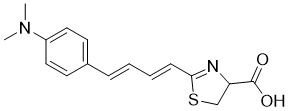
Aka Lumine
CAS No. 1176235-08-7
Aka Lumine( AkaLumine | Aka Lumine )
Catalog No. M23117 CAS No. 1176235-08-7
AkaLumine is a luciferin analogue.
Purity : >98% (HPLC)
 COA
Datasheet
HNMR
HPLC
MSDS
Handing Instructions
COA
Datasheet
HNMR
HPLC
MSDS
Handing Instructions
| Size | Price / USD | Stock | Quantity |
| 5MG | 207 | In Stock |


|
| 10MG | 309 | In Stock |
|
| 25MG | 588 | In Stock |
|
| 50MG | 918 | In Stock |
|
| 100MG | 1442 | In Stock |
|
| 200MG | Get Quote | In Stock |
|
| 500MG | Get Quote | In Stock |
|
| 1G | Get Quote | In Stock |
|
Biological Information
-
Product NameAka Lumine
-
NoteResearch use only, not for human use.
-
Brief DescriptionAkaLumine is a luciferin analogue.
-
DescriptionAkaLumine is a luciferin analogue. The bioluminescence produced by AkaLumine in reactions with native firefly luciferase is in the near-infrared wavelength ranges (λmax=677 nm), and yields significantly increased target-detection sensitivity from deep tissues with maximal signals attained at very low concentrations, as compared with D-luciferin and emerging synthetic luciferin CycLuc1.
-
In Vitro——
-
In Vivo——
-
SynonymsAkaLumine | Aka Lumine
-
PathwayOthers
-
TargetOther Targets
-
Recptor——
-
Research Area——
-
Indication——
Chemical Information
-
CAS Number1176235-08-7
-
Formula Weight302.39
-
Molecular FormulaC16H18N2O2S
-
Purity>98% (HPLC)
-
SolubilitySoluble in DMSO
-
SMILESO=C(C1N=C(/C=C/C=C/C2=CC=C(N(C)C)C=C2)SC1)O
-
Chemical Name——
Shipping & Storage Information
-
Storage(-20℃)
-
ShippingWith Ice Pack
-
Stability≥ 2 years
Reference
molnova catalog



related products
-
[D-Ala2]-GRF (1-29) ...
[D-Ala2]-GRF (1-29) amide (human)
-
2(1H)-Quinoxalinone
2(1H)-Quinoxalinone is a natural product extracted from edible flowers such as Clitoria ternatea and Hibiscus rosa sinensis.
-
[Arg8]-Vasotocin TFA...
[Arg8]-Vasotocin (TFA) is a nonmammalian vertebrate neurohypophyseal peptide.
