


 Cart
Cart
 sales@molnova.com


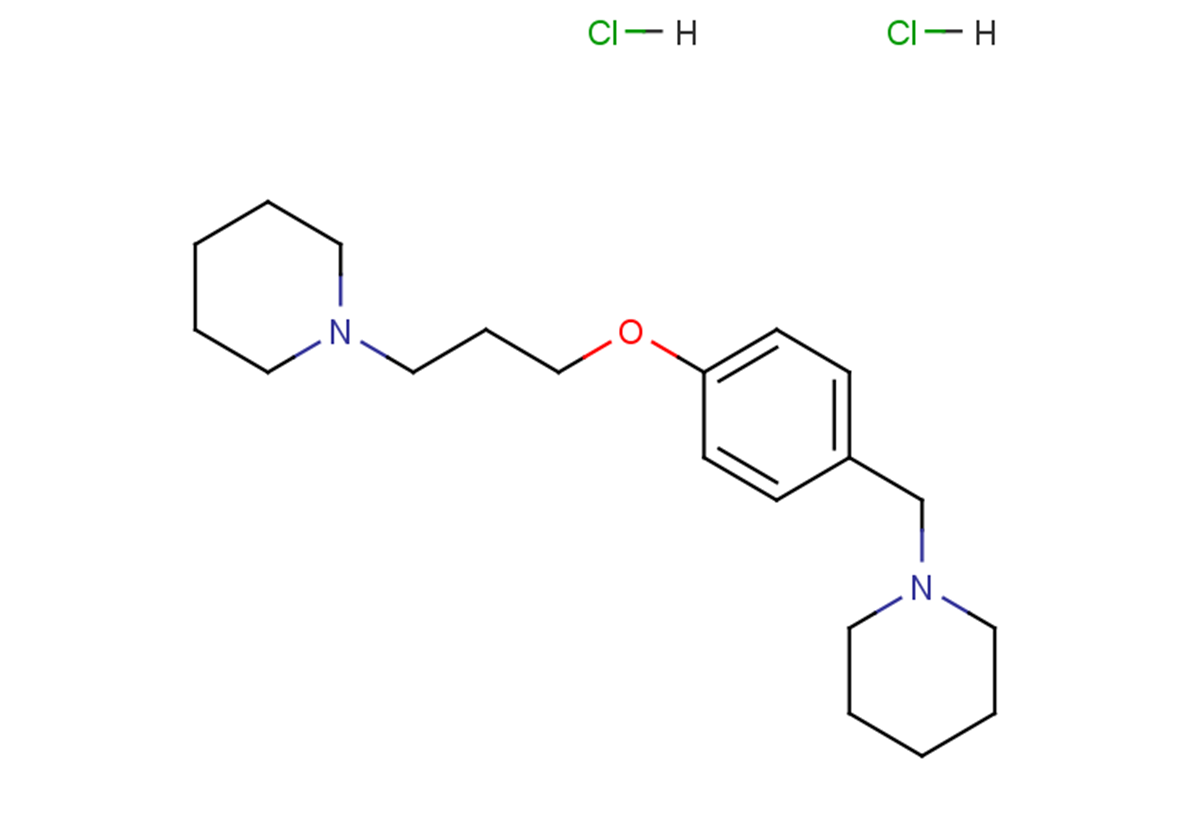
JNJ-5207852 dihydrochloride
CAS No. 1782228-76-5
JNJ-5207852 dihydrochloride( —— )
Catalog No. M22976 CAS No. 1782228-76-5
JNJ-5207852 is a novel, non-imidazole histamine H3 receptor antagonist, with high affinity at the rat (pKi=8.9) and human (pKi=9.24) H3 receptor. JNJ-5207852 is a potent dibasic amine antagonist that binds potently to rat H3 receptors (Ki=1.2 nm), and has good brain penetration. In ex vivo binding studies in mice, the compound had an ED50 of 0.13 mg kg 1, subcutaneously.
Purity : >98% (HPLC)
 COA
Datasheet
HNMR
HPLC
MSDS
Handing Instructions
COA
Datasheet
HNMR
HPLC
MSDS
Handing Instructions
| Size | Price / USD | Stock | Quantity |
| 2MG | 29 | In Stock |


|
| 5MG | 41 | In Stock |
|
| 10MG | 72 | In Stock |
|
| 25MG | 145 | In Stock |
|
| 50MG | 210 | In Stock |
|
| 100MG | 304 | In Stock |
|
| 200MG | 426 | In Stock |
|
| 500MG | Get Quote | In Stock |
|
| 1G | Get Quote | In Stock |
|
Biological Information
-
Product NameJNJ-5207852 dihydrochloride
-
NoteResearch use only, not for human use.
-
Brief DescriptionJNJ-5207852 is a novel, non-imidazole histamine H3 receptor antagonist, with high affinity at the rat (pKi=8.9) and human (pKi=9.24) H3 receptor. JNJ-5207852 is a potent dibasic amine antagonist that binds potently to rat H3 receptors (Ki=1.2 nm), and has good brain penetration. In ex vivo binding studies in mice, the compound had an ED50 of 0.13 mg kg 1, subcutaneously.
-
DescriptionJNJ-5207852 is a novel, non-imidazole histamine H3 receptor antagonist, with high affinity at the rat (pKi=8.9) and human (pKi=9.24) H3 receptor. JNJ-5207852 is a potent dibasic amine antagonist that binds potently to rat H3 receptors (Ki=1.2 nm), and has good brain penetration. In ex vivo binding studies in mice, the compound had an ED50 of 0.13 mg kg 1, subcutaneously. It promotes wakefulness in rodents at 10 mg kg 1 s.c. but not at 1 mg kg 1, and significantly, this effect was absent in H3 receptor KO mice. JNJ-10181457 is also a dibasic amine antagonist that exhibits high-affinity binding for the rat H3 receptor (Ki=7.1 nm), promoting wakefulness in rodents and reducing cataplectic attacks in narcoleptic dogs . JNJ-10181457 improved cognitive performance in SHR pups at 10 mg kg 1.
-
In Vitro——
-
In VivoJNJ-5207852 (1-10mg/kg s.c.) increases time spent awake and decreases REM sleep and slow-wave sleep, but fails to have an effect on wakefulness or sleep in H3 receptor knockout mice. The wake promoting effects of this H3 receptor antagonist are not associated with hypermotility. A 4-week daily treatment of mice with JNJ-5207852 (10 mg/kg i.p.) does not lead to a change in body weight. JNJ-5207852 is extensively absorbed after oral administration and reaches high brain levels. Animal Model:Male, Sprague-Dawley ratsweighing 282-334 g.Dosage:3, 10, 30 mg/kg.Administration:S.C. Result:Iincreased time spent awake and decreased REM sleep and slow-wave sleep.
-
Synonyms——
-
PathwayGPCR/G Protein
-
TargetHistamine Receptor
-
RecptorH3 receptor
-
Research Area——
-
Indication——
Chemical Information
-
CAS Number1782228-76-5
-
Formula Weight389.4
-
Molecular FormulaC20H34Cl2N2O?
-
Purity>98% (HPLC)
-
Solubility——
-
SMILES[H]Cl.[H]Cl.N1(CCCOC2=CC=C(CN3CCCCC3)C=C2)CCCCC1
-
Chemical Name——
Shipping & Storage Information
-
Storage(-20℃)
-
ShippingWith Ice Pack
-
Stability≥ 2 years
Reference
1. Esbenshade T A , Browman K E , Bitner R S , et al. The histamine H3 receptor: an attractive target for the treatment of cognitive disorders[J]. 2008, 154(6):1166-1181.
molnova catalog



related products
-
GSK-239512
GSK-239512 is an antagonist of H3 receptor and can be used in studies about the treatment of cognitive dysfunction in neurodegenerative disorders.
-
Desloratadine
Desloratadine is a potent antagonist for human histamine H1 receptor with IC50 of 51 nM.
-
2-Pyridylethylamine ...
2-Pyridylethylamine dihydrochloride is a Histamine H1 receptor agonist.
