


 Cart
Cart
 sales@molnova.com


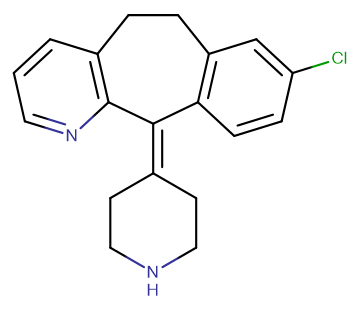
Desloratadine
CAS No. 100643-71-8
Desloratadine( Descarboethoxyloratadine | NSC 675447 | SCH 34117 )
Catalog No. M10053 CAS No. 100643-71-8
Desloratadine is a potent antagonist for human histamine H1 receptor with IC50 of 51 nM.
Purity : >98% (HPLC)
 COA
Datasheet
HNMR
HPLC
MSDS
Handing Instructions
COA
Datasheet
HNMR
HPLC
MSDS
Handing Instructions
| Size | Price / USD | Stock | Quantity |
| 1 mL x 10 mM in DMSO | 28 | In Stock |


|
| 50MG | 32 | In Stock |
|
| 100MG | 55 | In Stock |
|
| 200MG | Get Quote | In Stock |
|
| 500MG | Get Quote | In Stock |
|
| 1G | Get Quote | In Stock |
|
Biological Information
-
Product NameDesloratadine
-
NoteResearch use only, not for human use.
-
Brief DescriptionDesloratadine is a potent antagonist for human histamine H1 receptor with IC50 of 51 nM.
-
DescriptionDesloratadine is a potent antagonist for human histamine H1 receptor with IC50 of 51 nM.
-
In Vitro——
-
In Vivo——
-
SynonymsDescarboethoxyloratadine | NSC 675447 | SCH 34117
-
PathwayGPCR/G Protein
-
TargetHistamine Receptor
-
RecptorH1 receptor
-
Research AreaInflammation/Immunology
-
Indication——
Chemical Information
-
CAS Number100643-71-8
-
Formula Weight310.82
-
Molecular FormulaC19H19ClN2
-
Purity>98% (HPLC)
-
SolubilityEthanol: 62 mg/mL (199.47 mM); DMSO: 26 mg/mL (83.64 mM)
-
SMILESC1CC2=C(C=CC(=C2)Cl)C(=C3CCNCC3)C4=C1C=CC=N4
-
Chemical Name8-chloro-6,11-dihydro-11-(4-piperdinylidene)- 5h-benzo[5,6]cyclohepta[1,2-b]pyridine
Shipping & Storage Information
-
Storage(-20℃)
-
ShippingWith Ice Pack
-
Stability≥ 2 years
Reference
1. Geha RS, et al. J Allergy Clin Immunol, 2001, 107(4), 751-762.
molnova catalog



related products
-
Fexofenadine
Fexofenadine, an antihistamine pharmaceutical drug, is used to treat allergy symptoms, such as nasal congestion, hay fever, and urticaria.
-
Pitolisant hydrochlo...
A potent and selective antagonist of H3 receptor with Ki/EC50 of 0.16/1.5 nM.
-
Bicyclol
Bicyclol(SY 801) is an anti-hepatitis drug. Oral administration of bicyclol normalizes the elevated serum transaminases (ALT, AST) by 50% in chronic viral hepatitis B and C, and also has a certain level of inhibiting HBV and HCV replication.
