


 Cart
Cart
 sales@molnova.com


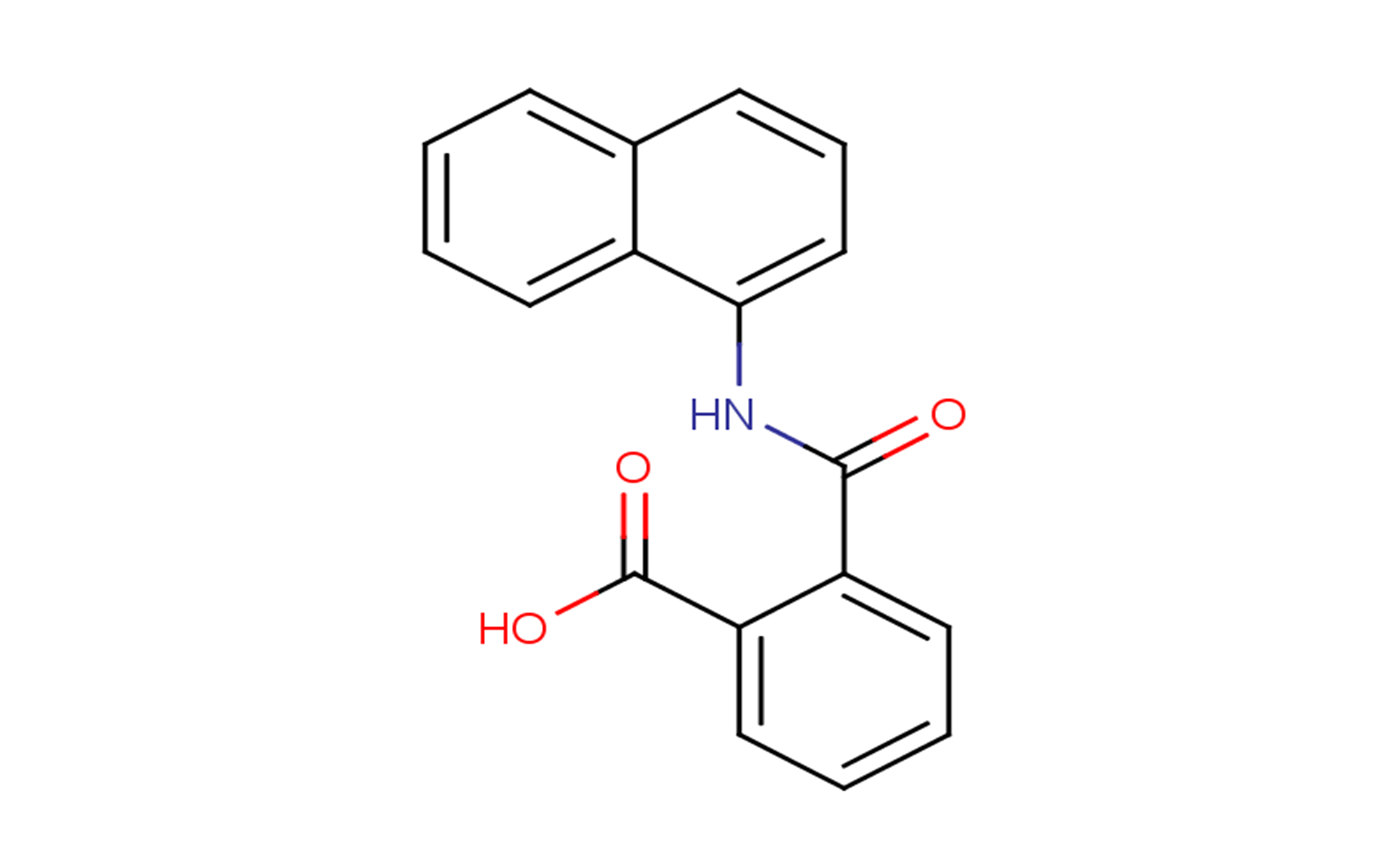
Naptalam
CAS No. 132-66-1
Naptalam( —— )
Catalog No. M22885 CAS No. 132-66-1
Naptalam is an herbicide.Naptalam is a dicarboxylic acid monoamide which results from addition of one equivalent of 1-naphthylamine to phthalic anhydride. It is a dicarboxylic acid monoamide, a carboxylic acid and a N-(1-naphthyl)carboxamide.
Purity : >98% (HPLC)
 COA
Datasheet
HNMR
HPLC
MSDS
Handing Instructions
COA
Datasheet
HNMR
HPLC
MSDS
Handing Instructions
| Size | Price / USD | Stock | Quantity |
| 1 mL x 10 mM in DMSO | 41 | In Stock |


|
| 50MG | 28 | In Stock |
|
| 100MG | 36 | In Stock |
|
| 200MG | 51 | In Stock |
|
| 500MG | Get Quote | In Stock |
|
| 1G | Get Quote | In Stock |
|
Biological Information
-
Product NameNaptalam
-
NoteResearch use only, not for human use.
-
Brief DescriptionNaptalam is an herbicide.Naptalam is a dicarboxylic acid monoamide which results from addition of one equivalent of 1-naphthylamine to phthalic anhydride. It is a dicarboxylic acid monoamide, a carboxylic acid and a N-(1-naphthyl)carboxamide.
-
DescriptionNaptalam is an herbicide.Naptalam is a dicarboxylic acid monoamide which results from addition of one equivalent of 1-naphthylamine to phthalic anhydride. It is a dicarboxylic acid monoamide, a carboxylic acid and a N-(1-naphthyl)carboxamide. It is a conjugate acid of a naptalamate.
-
In Vitro——
-
In VivoN-1-Naphthylphthalamic acid .
-
Synonyms——
-
PathwayOthers
-
TargetOther Targets
-
RecptorOthers
-
Research Area——
-
Indication——
Chemical Information
-
CAS Number132-66-1
-
Formula Weight291.31
-
Molecular FormulaC18H13NO3
-
Purity>98% (HPLC)
-
SolubilityIn Vitro:?DMSO : 33.33 mg/mL (114.42 mM)
-
SMILESC1=CC=C2C(=C1)C=CC=C2NC(=O)C3=CC=CC=C3C(=O)O
-
Chemical Name——
Shipping & Storage Information
-
Storage(-20℃)
-
ShippingWith Ice Pack
-
Stability≥ 2 years
Reference
molnova catalog



related products
-
Cys-CD36 (139-155)
CD36 Peptide P (139-155), Cys conjugated is a Cys labelled CD36 Peptide, and can inhibit the immunoadsorption of CD36 by OKM5.
-
KT-474
KT-474 (KYM-001) is a PROTAC degrader targeting interleukin-1 receptor-associated kinase 4 (IRAK4) with antitumor activity for the study of autoimmune, inflammatory, and cardiovascular disease disorders.
-
5,7-Dihydroxy-6,8-di...
5,6,7-Trihydroxyflavone-7-O-β-D-glucuronopyranoside is a natural product that can be isolated from the root of Scutellaria repens Buch.-Ham. ex D. Don.
