


 Cart
Cart
 sales@molnova.com


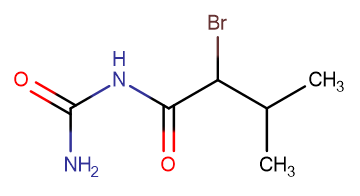
Bromisoval
CAS No. 496-67-3
Bromisoval( Bromisoval | bromovalerylurea | Isobromyl | Bromaral | BRN 1773255 )
Catalog No. M14660 CAS No. 496-67-3
Bromisoval is a sedative and mild hypnotic with potentially toxic effects.
Purity : >98% (HPLC)
 COA
Datasheet
HNMR
HPLC
MSDS
Handing Instructions
COA
Datasheet
HNMR
HPLC
MSDS
Handing Instructions
| Size | Price / USD | Stock | Quantity |
| 1 mL x 10 mM in DMSO | 29 | In Stock |


|
| 100MG | Get Quote | In Stock |
|
| 200MG | 27 | In Stock |
|
| 500MG | Get Quote | In Stock |
|
| 1G | Get Quote | In Stock |
|
Biological Information
-
Product NameBromisoval
-
NoteResearch use only, not for human use.
-
Brief DescriptionBromisoval is a sedative and mild hypnotic with potentially toxic effects.
-
DescriptionBromisoval is a sedative and mild hypnotic with potentially toxic effects.(In Vitro):Bromisoval (BU) suppresses nitric oxide (NO) releasing and proinflammatory cytokine expression in lipopolysaccharide (LPS)-treat BV2 cells, a murine microglial cell line. Bromisoval suppresses LPS-inducing phosphorylation of signal transducer and activator of transcription 1 (STAT1) and expression of interferon regulatory factor 1 (IRF1). The Janus kinase 1 (JAK1) inhibitor filgotinib suppresses the NO release much more weakly than that of Bromisoval, although filgotinib almost completely prevents LPS-inducing STAT1 phosphorylation. Knockdown of JAK1, STAT1, or IRF1 does not affect the suppressive effects of Bromisoval on LPS-inducing NO. A combination of Bromisoval and filgotinib synergistically suppress the NO releasing. The mitochondrial complex I inhibitor rotenone, which does not prevent STAT1 phosphorylation or IRF1 expression, suppresses proinflammatory mediator expression less significantly than Bromisoval. Bromisoval and rotenone reduce intracellular ATP (iATP) levels to a similar extent. A combination of rotenone and filgotinib suppress NO release in LPS-treated BV2 cells as strongly as Bromisoval.(In Vivo):Bromisoval (Bromvaletone) and carbromal are the most potent central depressants within each series. Depressant activities (ISD50 values) and acute toxicities (LD50 values) in male mice after intraperitoneal injection of Bromisoval are 0.35 (0.30-0.39) and 3.25 (2.89-3.62) mmol/kg, respectively.
-
In VitroBromisoval (BU) suppresses nitric oxide (NO) releasing and proinflammatory cytokine expression in lipopolysaccharide (LPS)-treat BV2 cells, a murine microglial cell line. Bromisoval suppresses LPS-inducing phosphorylation of signal transducer and activator of transcription 1 (STAT1) and expression of interferon regulatory factor 1 (IRF1). The Janus kinase 1 (JAK1) inhibitor filgotinib suppresses the NO release much more weakly than that of Bromisoval, although filgotinib almost completely prevents LPS-inducing STAT1 phosphorylation. Knockdown of JAK1, STAT1, or IRF1 does not affect the suppressive effects of Bromisoval on LPS-inducing NO. A combination of Bromisoval and filgotinib synergistically suppress the NO releasing. The mitochondrial complex I inhibitor rotenone, which does not prevent STAT1 phosphorylation or IRF1 expression, suppresses proinflammatory mediator expression less significantly than Bromisoval. Bromisoval and rotenone reduce intracellular ATP (iATP) levels to a similar extent. A combination of rotenone and filgotinib suppress NO release in LPS-treated BV2 cells as strongly as Bromisoval.
-
In VivoBromisoval (Bromvaletone) and carbromal are the most potent central depressants within each series. Depressant activities (ISD50 values) and acute toxicities (LD50 values) in male mice after intraperitoneal injection of Bromisoval are 0.35 (0.30-0.39) and 3.25 (2.89-3.62) mmol/kg, respectively.
-
SynonymsBromisoval | bromovalerylurea | Isobromyl | Bromaral | BRN 1773255
-
PathwayOthers
-
TargetOther Targets
-
RecptorOthers
-
Research Area——
-
Indication——
Chemical Information
-
CAS Number496-67-3
-
Formula Weight223.07
-
Molecular FormulaC6H11BrN2O2
-
Purity>98% (HPLC)
-
SolubilitySoluble in Ethanol , DMSO
-
SMILESO=C(N)NC(C(Br)C(C)C)=O
-
Chemical Name2-bromo-N-carbamoyl-3-methylbutanamide
Shipping & Storage Information
-
Storage(-20℃)
-
ShippingWith Ice Pack
-
Stability≥ 2 years
Reference
1.Kumazawa T, et al. J Anal Toxicol. 1992 May-Jun;16(3):163-5.
molnova catalog



related products
-
IDX184
IDX184 is a potent, orally active, targeted HCV polymerase inhibitor and nucleoside polymerase.IDX184 effectively inhibits HCV polymerase (IC50=0.31 μM, Ki=52.3 nM).
-
Valorphin TFA
Valorphin TFA is a semisynthetic derivative of dihydrovaltrate with opioid analgesic activity.
-
Carasinol B
Carasinol B is a natural product from Carex humilis Leyss.
