


 Cart
Cart
 sales@molnova.com


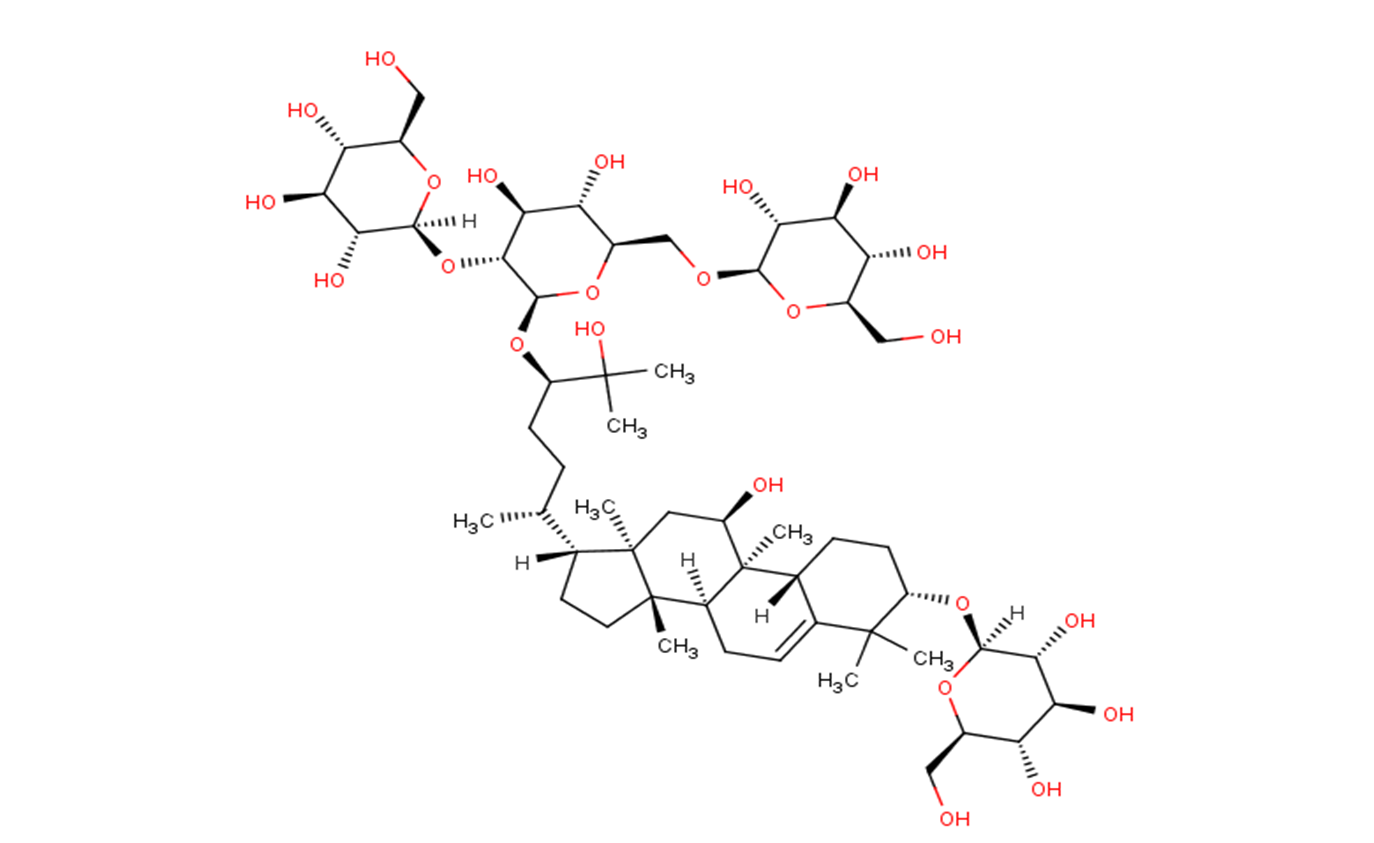
Siamenoside I
CAS No. 126105-12-2
Siamenoside I( —— )
Catalog No. M22822 CAS No. 126105-12-2
Siamenoside I is a natural product,and is one of the mogrosides that has several kinds of bioactivities, it exhibits maltase inhibitory effect with the IC50 value of 12 mM.
Purity : >98% (HPLC)
 COA
Datasheet
HNMR
HPLC
MSDS
Handing Instructions
COA
Datasheet
HNMR
HPLC
MSDS
Handing Instructions
| Size | Price / USD | Stock | Quantity |
| 1 mL x 10 mM in DMSO | 212 | In Stock |


|
| 5MG | 112 | In Stock |
|
| 10MG | 179 | In Stock |
|
| 25MG | 301 | In Stock |
|
| 50MG | 420 | In Stock |
|
| 100MG | 581 | In Stock |
|
| 200MG | Get Quote | In Stock |
|
| 500MG | Get Quote | In Stock |
|
| 1G | Get Quote | In Stock |
|
Biological Information
-
Product NameSiamenoside I
-
NoteResearch use only, not for human use.
-
Brief DescriptionSiamenoside I is a natural product,and is one of the mogrosides that has several kinds of bioactivities, it exhibits maltase inhibitory effect with the IC50 value of 12 mM.
-
DescriptionSiamenoside I is a natural product,and is one of the mogrosides that has several kinds of bioactivities, it exhibits maltase inhibitory effect with the IC50 value of 12 mM.Siamenoside I is the sweetest mogroside that has several kinds of bioactivities, and it is also a constituent of Siraitiae Fructus, a fruit and herb in China. In rats, siamenoside I was found to undergo deglycosylation, hydroxylation, dehydrogenation, deoxygenation, isomerization, and glycosylation reactions.
-
In Vitro——
-
In VivoIn rat, the metabolic reactions of siamenoside I include deglycosylation, hydroxylation, dehydrogenation, deoxygenation, isomerization, and glycosylation. Siamenoside I and its metabolites are mainly distributed to the intestines, stomach, kidneys, and brain.
-
Synonyms——
-
PathwayOthers
-
TargetOther Targets
-
RecptorOthers
-
Research Area——
-
Indication——
Chemical Information
-
CAS Number126105-12-2
-
Formula Weight1125.29
-
Molecular FormulaC54H92O24
-
Purity>98% (HPLC)
-
SolubilityIn Vitro:?DMSO : 100 mg/mL (88.87 mM)
-
SMILESC[C@@]([C@@](CC[C@H](O[C@]([C@@H]([C@@H](O)[C@@H]1O)O)([H])O[C@@H]1CO)C2(C)C)([H])C2=CC3)([C@@H](C[C@@]45C)O)[C@]3([H])[C@@]4(CC[C@]5([H])[C@H](C)CC[C@H](C(C)(O)C)O[C@H](O[C@H](CO[C@@H]([C@@H]([C@@H](O)[C@@H]6O)O)O[C@@H]6CO)[C@@H](O)[C@@H]7O)[C@@H]7O[C@]([C@@H]([C@@H](O)[C@@H]8O)O)([H])O[C@@H]8CO)C
-
Chemical Name——
Shipping & Storage Information
-
Storage(-20℃)
-
ShippingWith Ice Pack
-
Stability≥ 2 years
Reference
1.Sweet elements of Siraitia grosvenori inhibit oxidative modification of low-density lipoprotein.J Atheroscler Thromb. 2002;9(2):114-20.
molnova catalog



related products
-
Syntide 2 (TFA) (108...
Syntide 2 (TFA) is a Ca2+ and CaM dependent protein kinase II (CaMKII) substrate peptide that selectively inhibits the gibberellin (GA) response, leaving composition and slicoic acid regulatory events unaffected.
-
Aloe-emodin-3-(hydro...
Aloe-emodin-3-(hydroxymethyl)-O-beta-D-glucopyranoside is a natural product.
-
[Arg8]-Vasotocin
[Arg8]-Vasotocin is a hormone present in the neurohypophysis of nonmammalian vertebrates that is related to vasopressin and oxytocin.
