


 Cart
Cart
 sales@molnova.com


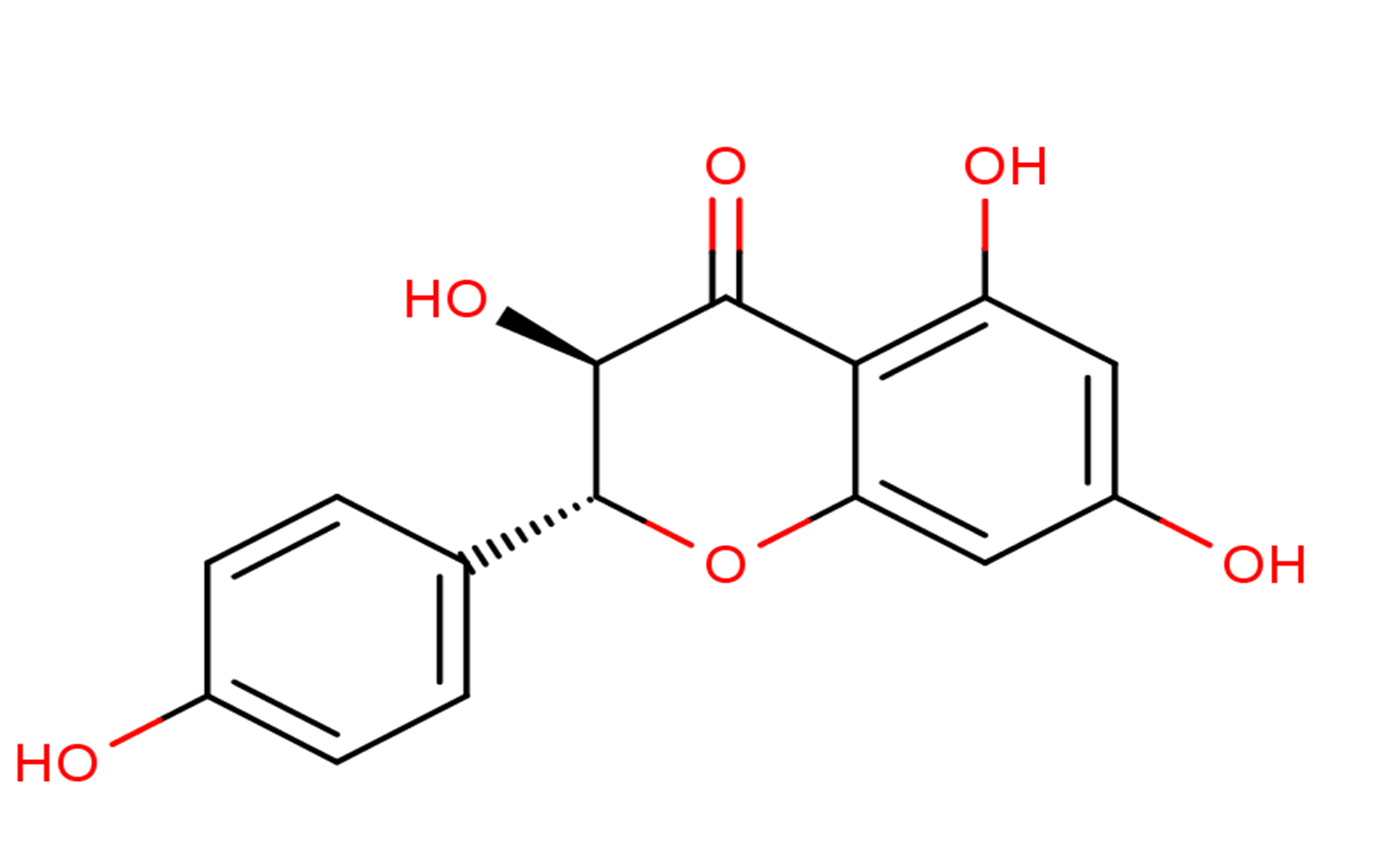
Aromadendrin
CAS No. 480-20-6
Aromadendrin( —— )
Catalog No. M22807 CAS No. 480-20-6
Aromadendrin is a natural product. It induces apoptosis and inhibits Bcl-2 and Bcl-xL expression, possesses anti-inflammatory, antioxidant, and anti-diabetic properties, it exhibits anti-inflammatory activityAromadendrin, a flavonol, has been reported to possess a variety of pharmacological activities such as anti-inflammatory, antioxidant, and anti-diabetic properties.
Purity : >98% (HPLC)
 COA
Datasheet
HNMR
HPLC
MSDS
Handing Instructions
COA
Datasheet
HNMR
HPLC
MSDS
Handing Instructions
| Size | Price / USD | Stock | Quantity |
| 1 mL x 10 mM in DMSO | 111 | In Stock |


|
| 5MG | 85 | In Stock |
|
| 10MG | 140 | In Stock |
|
| 25MG | 282 | In Stock |
|
| 50MG | 423 | In Stock |
|
| 100MG | Get Quote | In Stock |
|
| 200MG | Get Quote | In Stock |
|
| 500MG | Get Quote | In Stock |
|
| 1G | Get Quote | In Stock |
|
Biological Information
-
Product NameAromadendrin
-
NoteResearch use only, not for human use.
-
Brief DescriptionAromadendrin is a natural product. It induces apoptosis and inhibits Bcl-2 and Bcl-xL expression, possesses anti-inflammatory, antioxidant, and anti-diabetic properties, it exhibits anti-inflammatory activityAromadendrin, a flavonol, has been reported to possess a variety of pharmacological activities such as anti-inflammatory, antioxidant, and anti-diabetic properties.
-
DescriptionAromadendrin is a natural product. It induces apoptosis and inhibits Bcl-2 and Bcl-xL expression, possesses anti-inflammatory, antioxidant, and anti-diabetic properties, it exhibits anti-inflammatory activityAromadendrin, a flavonol, has been reported to possess a variety of pharmacological activities such as anti-inflammatory, antioxidant, and anti-diabetic properties. Aromadendrin significantly suppressed LPS-induced excessive production of pro-inflammatory mediators such as nitric oxide (NO) and PGE2. In accordance, aromadendrin attenuated LPSinduced overexpression iNOS and COX-2. In addition, aromadendrin significantly suppressed LPS-induced degradation of IκB, which sequesters NF-κB in cytoplasm, consequently inhibiting the nuclear translocation of pro-inflammatory transcription factor NF- κB. Aromadendrin significantly attenuated LPS-induced activation of JNK, but not ERK and p38, in a concentration-dependent manner. Aromadendrin exhibits anti-inflammatory activity through the suppression of nuclear translocation of NF-κB and phosphorylation of JNK in LPS-stimulated RAW 264.7 macrophage cells.
-
In VitroCell Proliferation Assay Cell Line:Normal synoviocyte cells; RA-FLS cells Concentration:0.3 μM, 3 μM, 30 μM, 300 μM Incubation Time:48 hours Result:Decreased the proliferation of RA-FLSs.Apoptosis Analysis Cell Line:RA-FLS cells Concentration:3 μM, 30 μM Incubation Time:48 hours Result:Induced apoptosis in RA-FLSs.Western Blot Analysis Cell Line:RA-FLS cells Concentration:3 μM, 30 μM Incubation Time:48 hours Result:Promoted Bax and Bad expression, increased the cleaved fragments of caspase-3, caspase-9 and cleaved PARP and inhibited Bcl-2 and Bcl-xL expression.
-
In Vivo——
-
Synonyms——
-
PathwayAngiogenesis
-
TargetBcl-2
-
RecptorBcl-2|Bcl-xL
-
Research Area——
-
Indication——
Chemical Information
-
CAS Number480-20-6
-
Formula Weight288.3
-
Molecular FormulaC15H12O6
-
Purity>98% (HPLC)
-
SolubilityDMSO:120 mg/mL (416.31 mM; Need ultrasonic); H2O:< 0.1 mg/mL (insoluble)
-
SMILESO=C1C2=C(O)C=C(O)C=C2O[C@H](C3=CC=C(O)C=C3)[C@H]1O
-
Chemical Name——
Shipping & Storage Information
-
Storage(-20℃)
-
ShippingWith Ice Pack
-
Stability≥ 2 years
Reference
1. Stimulation of glucose uptake and improvement of insulin resistance by aromadendrin.Pharmacology. 2011;88(5-6):266-74.
molnova catalog



related products
-
Lisaftoclax
Bcl-2/Bcl-xl inhibitor 1 is a dual Bcl-2 and Bcl-xl inhibitor (IC50s: 2 nM and 5.9 nM for Bcl-2 and Bcl-xl) with anti-tumor activity. It is extracted from patent WO2018027097A1.
-
HA14-1
HA14-1 a small molecule, nonpeptidic Bcl-2 antagonist that binds Bcl-2 surface pocket with binding IC50 of 9 uM.
-
Orobol
Orobol is an inhibitor of tyrosine-specific protein kinase and phosphatidylinositol turnover. Orobol inhibits PI3K isoforms with IC50s of 3.46-5.27 μM for PI3K α/β/γ/K/δ. Orobol exhibits anti-skin-aging and anti-obesity effects.
