


 Cart
Cart
 sales@molnova.com


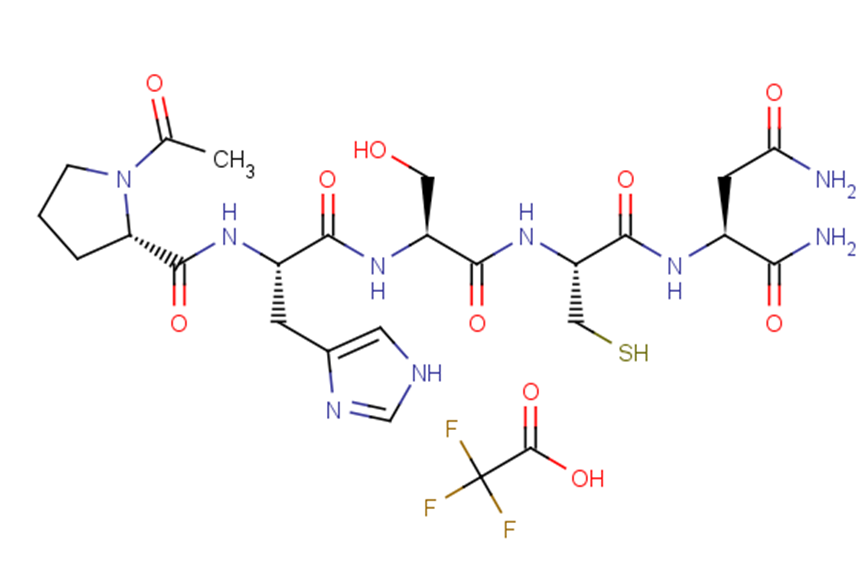
ATN-161 trifluoroacetate salt
CAS No. 904763-27-5
ATN-161 trifluoroacetate salt( ATN-161 TFA salt )
Catalog No. M22569 CAS No. 904763-27-5
ATN-161 trifluoroacetate salt is a novel integrin α5β1 antagonist that inhibits angiogenesis and growth of liver metastases in a murine model.The combination of ATN-161 plus 5-FU significantly reduces tumor cell proliferation compared to control and single-agent therapy.
Purity : >98% (HPLC)
 COA
Datasheet
HNMR
HPLC
MSDS
Handing Instructions
COA
Datasheet
HNMR
HPLC
MSDS
Handing Instructions
| Size | Price / USD | Stock | Quantity |
| 2MG | 51 | In Stock |


|
| 5MG | 85 | In Stock |
|
| 10MG | 122 | In Stock |
|
| 25MG | 225 | In Stock |
|
| 50MG | 369 | In Stock |
|
| 100MG | 548 | In Stock |
|
| 200MG | Get Quote | In Stock |
|
| 500MG | Get Quote | In Stock |
|
| 1G | Get Quote | In Stock |
|
Biological Information
-
Product NameATN-161 trifluoroacetate salt
-
NoteResearch use only, not for human use.
-
Brief DescriptionATN-161 trifluoroacetate salt is a novel integrin α5β1 antagonist that inhibits angiogenesis and growth of liver metastases in a murine model.The combination of ATN-161 plus 5-FU significantly reduces tumor cell proliferation compared to control and single-agent therapy.
-
DescriptionATN-161 trifluoroacetate salt is a novel integrin α5β1 antagonist that inhibits angiogenesis and growth of liver metastases in a murine model.The combination of ATN-161 plus 5-FU significantly reduces tumor cell proliferation compared to control and single-agent therapy. In addition, combination therapy leads to a significant increase of apoptotic (TUNEL-positive) tumor cells, whereas single-agent therapy does not increase in TUNEL-positive tumor cells. ATN-161 treatment leads to a significant reduction in EC number (21% decrease) after a 48 hr incubation time compared to control. ATN-161 inhibits VEGF-induced migration and capillary tube formation in hCECs, but did not inhibit proliferation. ATN-161 decreases the number of cells migrating in response to VEGF in a dose-dependent manner starting at 100 nM (P<0.001 vs. VEGF group).The preliminary experiments with α5β1-negative human colon cancer xenografts (HT29) show that treatment with ATN-161 significantly reduces tumor weight and vessel density. Injection of ATN-161 after laser photocoagulation inhibits choroidal neovascularization (CNV) leakage and neovascularization to an extent similar to AF564.
-
In Vitro——
-
In Vivo——
-
SynonymsATN-161 TFA salt
-
PathwayCell Cycle/DNA Damage
-
TargetIntegrin
-
RecptorIntegrin α5β1
-
Research AreaCancer
-
IndicationBrain and Central Nervous System Tumors
Chemical Information
-
CAS Number904763-27-5
-
Formula Weight711.67
-
Molecular FormulaC25H36F3N9O10S
-
Purity>98% (HPLC)
-
SolubilityDMSO:1 mg/mL (1.41 mM; Need ultrasonic)
-
SMILESOC(=O)C(F)(F)F.CC(=O)N1CCC[C@H]1C(=O)N[C@@H](Cc1c[nH]cn1)C(=O)N[C@@H](CO)C(=O)N[C@@H](CS)C(=O)N[C@@H](CC(N)=O)C(N)=O
-
Chemical Name——
Shipping & Storage Information
-
Storage(-20℃)
-
ShippingWith Ice Pack
-
Stability≥ 2 years
Reference



-
Cyclo(RGDyK)
Cyclo(RGDyK) (Cyclic Arg-Gly-Asp-D-Tyr-Lys) is a cyclic derivative of RGD, potent, selective αVβ3 integrin inhibitor with IC50 of 20 nM.
-
Lifitegrast
A potent LFA-1/ICAM-1 antagonist with IC50 of 9 nM in HuT78 cells; exhibits good in vitro safety profile and low potency on CYP3A4, CYP2C9 and hERG.
-
Fibronectin CS1 Pept...
he connecting segment 1 (CS-1) is a cell attachment domain located in the type III homology connecting segment (IIICS) of fibronectin. CS1 peptide of fibronectin, which lacks the Arg-Gly-Asp-containing domain, actively inhibits tumor metastases in spontaneous and experimental metastasis models. The use of Fibronectin CS1 Peptide might offer a promising therapeutic approach for combating and preventing cancer metastasis.
