


 Cart
Cart
 sales@molnova.com


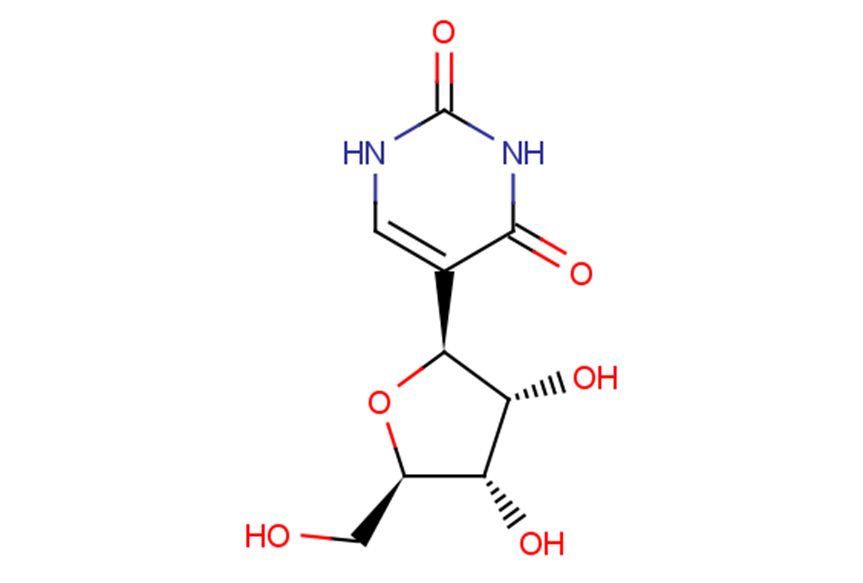
Pseudouridine
CAS No. 1445-07-4
Pseudouridine( —— )
Catalog No. M22506 CAS No. 1445-07-4
Pseudouridine is the most abundant modified nucleoside in non-coding RNAs. It enhances the function of transfer RNA and ribosomal RNA by stabilizing RNA structure.
Purity : >98% (HPLC)
 COA
Datasheet
HNMR
HPLC
MSDS
Handing Instructions
COA
Datasheet
HNMR
HPLC
MSDS
Handing Instructions
| Size | Price / USD | Stock | Quantity |
| 1 mL x 10 mM in DMSO | 30 | In Stock |


|
| 5MG | 29 | In Stock |
|
| 10MG | 46 | In Stock |
|
| 25MG | 88 | In Stock |
|
| 50MG | 137 | In Stock |
|
| 100MG | 222 | In Stock |
|
| 200MG | Get Quote | In Stock |
|
| 500MG | Get Quote | In Stock |
|
| 1G | Get Quote | In Stock |
|
Biological Information
-
Product NamePseudouridine
-
NoteResearch use only, not for human use.
-
Brief DescriptionPseudouridine is the most abundant modified nucleoside in non-coding RNAs. It enhances the function of transfer RNA and ribosomal RNA by stabilizing RNA structure.
-
DescriptionPseudouridine is the most abundant modified nucleoside in non-coding RNAs. It enhances the function of transfer RNA and ribosomal RNA by stabilizing RNA structure.
-
In Vitro——
-
In Vivo——
-
Synonyms——
-
PathwayProteasome/Ubiquitin
-
TargetEndogenous Metabolite
-
RecptorHuman Endogenous Metabolite
-
Research Area——
-
Indication——
Chemical Information
-
CAS Number1445-07-4
-
Formula Weight244.2
-
Molecular FormulaC9H12N2O6
-
Purity>98% (HPLC)
-
SolubilityDMSO:125 mg/mL (511.88 mM; Need ultrasonic)
-
SMILESOC[C@H]1O[C@H]([C@H](O)[C@@H]1O)c1c[nH]c(=O)[nH]c1=O
-
Chemical Name——
Shipping & Storage Information
-
Storage(-20℃)
-
ShippingWith Ice Pack
-
Stability≥ 2 years
Reference
1. Carlile TM, et al. Pseudouridine profiling reveals regulated mRNA pseudouridylation in yeast and human cells. Nature. 2014 Nov 6;515(7525):143-6.
molnova catalog



related products
-
Oxoadipic acid
Oxoadipic acid is a key metabolite of the essential amino acids tryptophan and lysine.Important metabolite between the TCA cycle and lysine biosynthesis. Of interest for research on mitochondrial metabolite transporters.
-
3-Oxopentanedioic ac...
3-oxoglutaric acid or acetonedicarboxylic acid is a simple carboxylic acid which may be used as a building block in organic chemistry. It has been found to be a microbial metabolite.
-
5,6-Dihydroxyindole
5,6-Dihydroxyindole (Dopamine lutine) is a melanin precursor and has a broad-spectrum antibacterial, antiviral, antifungal, antiparasitic activity.
