


 Cart
Cart
 sales@molnova.com


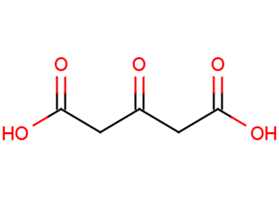
3-Oxopentanedioic acid
CAS No. 542-05-2
3-Oxopentanedioic acid( 13-Acetonedicarboxylic acid | 3-Oxoglutaric acid )
Catalog No. M20272 CAS No. 542-05-2
3-oxoglutaric acid or acetonedicarboxylic acid is a simple carboxylic acid which may be used as a building block in organic chemistry. It has been found to be a microbial metabolite.
Purity : >98% (HPLC)
 COA
Datasheet
HNMR
HPLC
MSDS
Handing Instructions
COA
Datasheet
HNMR
HPLC
MSDS
Handing Instructions
| Size | Price / USD | Stock | Quantity |
| 100MG | 38 | In Stock |


|
| 200MG | Get Quote | In Stock |
|
| 500MG | Get Quote | In Stock |
|
| 1G | Get Quote | In Stock |
|
Biological Information
-
Product Name3-Oxopentanedioic acid
-
NoteResearch use only, not for human use.
-
Brief Description3-oxoglutaric acid or acetonedicarboxylic acid is a simple carboxylic acid which may be used as a building block in organic chemistry. It has been found to be a microbial metabolite.
-
Description3-oxoglutaric acid or acetonedicarboxylic acid is a simple carboxylic acid which may be used as a building block in organic chemistry. It has been found to be a microbial metabolite.
-
In Vitro——
-
In Vivo——
-
Synonyms13-Acetonedicarboxylic acid | 3-Oxoglutaric acid
-
PathwayProteasome/Ubiquitin
-
TargetEndogenous Metabolite
-
RecptorHuman Endogenous Metabolite
-
Research Area——
-
Indication——
Chemical Information
-
CAS Number542-05-2
-
Formula Weight146.1
-
Molecular FormulaC5H6O5
-
Purity>98% (HPLC)
-
SolubilityDMSO:10 mM
-
SMILESOC(=O)CC(=O)CC(O)=O
-
Chemical Name——
Shipping & Storage Information
-
Storage(-20℃)
-
ShippingWith Ice Pack
-
Stability≥ 2 years
Reference
1.Sevcík Peter Misicák D Daniel. Carbon dioxide evolution in a Belousov-Zhabotinsky type oscillating reaction with acetonedicarboxylic acid.[J]. The Journal of Physical Chemistry A 2007 111(40):10050-10054.
molnova catalog



related products
-
Nα-Acetyl-L-asparagi...
N-Acetylasparagine also known as acasn belongs to the class of organic compounds known as asparagine and derivatives.
-
2,6-Dibromophenol
2,6-Dibromophenol is extracted from the skin and muscle of flatfish.
-
4-Methoxycinnamic ac...
4-Methoxycinnamic acid is an unusual phenylpropanoid involved in phenylphenalenone biosynthesis in Anigozanthos preissi.
