


 Cart
Cart
 sales@molnova.com


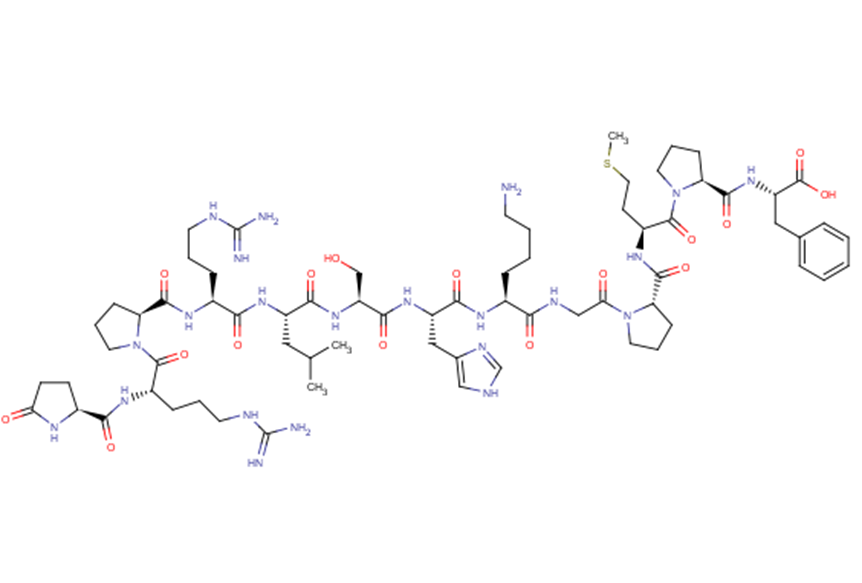
[Pyr1]-Apelin-13
CAS No. 217082-60-5
[Pyr1]-Apelin-13( [pGlu1]-Apelin-13 )
Catalog No. M22309 CAS No. 217082-60-5
[Pyr1]-Apelin-13 is a potent and selective endogenous Apelin receptor (APJ) agonist.[Pyr1]-apelin-13 encapsulation in lipoPEG particles (lipoPEG-PA13) results in sustained and extended drug release under physiological conditions[1].[Pyr1]-apelin-13 nanocarriers in a mouse model of pressure-overload induced heart failure demonstrate a sustainable long-term effect of [Pyr1]-apelin-13 in preventing cardiac dysfunction.
Purity : >98% (HPLC)
 COA
Datasheet
HNMR
HPLC
MSDS
Handing Instructions
COA
Datasheet
HNMR
HPLC
MSDS
Handing Instructions
| Size | Price / USD | Stock | Quantity |
| 5MG | 227 | In Stock |


|
| 10MG | 353 | In Stock |
|
| 25MG | 582 | In Stock |
|
| 50MG | 808 | In Stock |
|
| 100MG | 1088 | In Stock |
|
| 200MG | Get Quote | In Stock |
|
| 500MG | Get Quote | In Stock |
|
| 1G | Get Quote | In Stock |
|
Biological Information
-
Product Name[Pyr1]-Apelin-13
-
NoteResearch use only, not for human use.
-
Brief Description[Pyr1]-Apelin-13 is a potent and selective endogenous Apelin receptor (APJ) agonist.[Pyr1]-apelin-13 encapsulation in lipoPEG particles (lipoPEG-PA13) results in sustained and extended drug release under physiological conditions[1].[Pyr1]-apelin-13 nanocarriers in a mouse model of pressure-overload induced heart failure demonstrate a sustainable long-term effect of [Pyr1]-apelin-13 in preventing cardiac dysfunction.
-
Description[Pyr1]-Apelin-13 is a potent and selective endogenous Apelin receptor (APJ) agonist.[Pyr1]-apelin-13 encapsulation in lipoPEG particles (lipoPEG-PA13) results in sustained and extended drug release under physiological conditions[1].[Pyr1]-apelin-13 nanocarriers in a mouse model of pressure-overload induced heart failure demonstrate a sustainable long-term effect of [Pyr1]-apelin-13 in preventing cardiac dysfunction. [Pyr1] apelin-13 (1, 5 μg) improves locomotor activity and reduces pain symptoms, cavity size and caspase-3 levels in rats. [Pyr1] apelin-13 (1, 5 μg) significantly increases thermal paw withdrawal latency. [Pyr1] apelin-13 in 5 μg dose also produces significant attenuation in paw withdrawal threshold compared to SCI animals from the second week post SCI.
-
In Vitro——
-
In Vivo——
-
Synonyms[pGlu1]-Apelin-13
-
PathwayOthers
-
TargetOther Targets
-
Recptorendogenous apelin receptor
-
Research Area——
-
Indication——
Chemical Information
-
CAS Number217082-60-5
-
Formula Weight1533.8
-
Molecular FormulaC69H108N22O16S
-
Purity>98% (HPLC)
-
SolubilityH2O:50 mg/mL (32.60 mM)
-
SMILESCSCCC(NC(=O)C1CCCN1C(=O)CNC(=O)C(CCCCN)NC(=O)C(CC1=CNC=N1)NC(=O)C(CO)NC(=O)C(CC(C)C)NC(=O)C(CCCNC(N)=N)NC(=O)C1CCCN1C(=O)C(CCCNC(N)=N)NC(=O)C1CCC(=O)N1)C(=O)N1CCCC1C(=O)NC(CC1=CC=CC=C1)C(O)=O
-
Chemical Name——
Shipping & Storage Information
-
Storage(-20℃)
-
ShippingWith Ice Pack
-
Stability≥ 2 years
Reference
1.Serpooshan V, et al. [Pyr1]-Apelin-13 delivery via nano-liposomal encapsulation attenuates pressure overload-induced cardiac dysfunction. Biomaterials. 2015 Jan;37:289-98.
molnova catalog



related products
-
[Nle21,Tyr32] Cortic...
[Nle21,Tyr32] Corticotropin Releasing Factor, ovine
-
Beclamide
Beclamide is used as antiepiletics.
-
Sarolaner
Sarolaner is an orally active and broad-spectrum ectoparasiticide (LC80: 0.3 μg/mL against C. felis and an LC100: 0.003 μg/mL against O. turicata).
