


 Cart
Cart
 sales@molnova.com


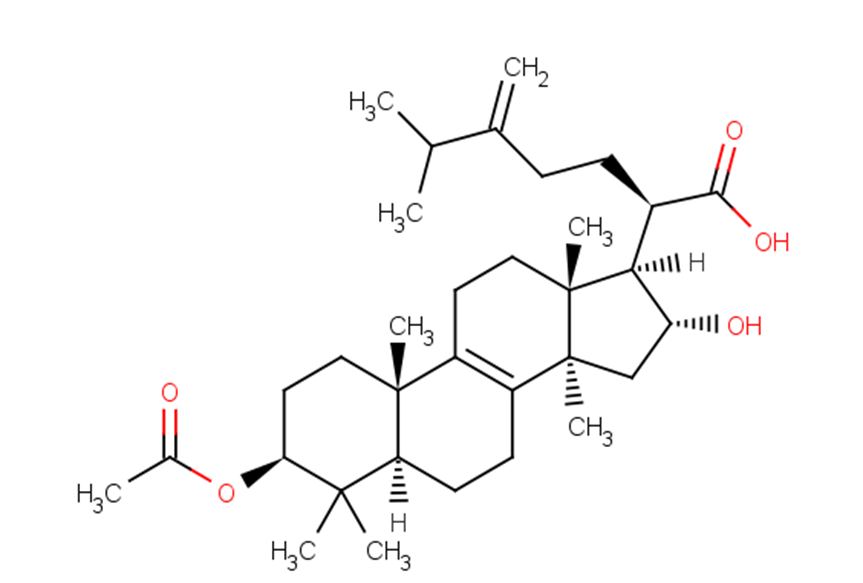
Pachymic acid
CAS No. 29070-92-6
Pachymic acid( 3-O-Acetyltumulosic acid )
Catalog No. M22084 CAS No. 29070-92-6
Pachymic acid is a natural product, and inhibits Akt and ERK signaling pathways.Pachymic acid(PA) exhibited anti-tumor effects in vitro accompanied by induction of G2/M phase arrest and apoptosis in NCI-H23 and NCI-H460 lung cancer cells.
Purity : >98% (HPLC)
 COA
Datasheet
HNMR
HPLC
MSDS
Handing Instructions
COA
Datasheet
HNMR
HPLC
MSDS
Handing Instructions
| Size | Price / USD | Stock | Quantity |
| 5MG | 159 | In Stock |


|
| 10MG | 249 | In Stock |
|
| 25MG | 474 | In Stock |
|
| 50MG | 686 | In Stock |
|
| 100MG | 963 | In Stock |
|
| 200MG | Get Quote | In Stock |
|
| 500MG | Get Quote | In Stock |
|
| 1G | Get Quote | In Stock |
|
Biological Information
-
Product NamePachymic acid
-
NoteResearch use only, not for human use.
-
Brief DescriptionPachymic acid is a natural product, and inhibits Akt and ERK signaling pathways.Pachymic acid(PA) exhibited anti-tumor effects in vitro accompanied by induction of G2/M phase arrest and apoptosis in NCI-H23 and NCI-H460 lung cancer cells.
-
DescriptionPachymic acid is a natural product, and inhibits Akt and ERK signaling pathways.Pachymic acid(PA) exhibited anti-tumor effects in vitro accompanied by induction of G2/M phase arrest and apoptosis in NCI-H23 and NCI-H460 lung cancer cells. Mechanistically, our data showed that PA induced reactive oxygen species (ROS) production, resulting in the activation of both c-Jun N-terminal kinase (JNK) and endoplasmic reticulum (ER) stress apoptotic pathways in lung cancer cells. Moreover, blockage of ROS production reversed PA-induced JNK and ER stress activation. Finally, PA inhibited the growth of NCI-H23 xenograft tumors without causing any host toxicity, and inhibited cell proliferation and induction of apoptosis of tumor cells in tumor xenograft tissues.PA significantly reduced cell growth in a dose- and time-dependent fashion. Meanwhile, cell cycle arrest at G0 phase was induced by PA. PA also significantly inhibited cancer cell migration, invasion in a dose-dependent manner. Interestingly,demonstrated that cancer cell adhesion ability was suppressed dose-dependently, which may contribute to the inhibition of cell invasion. Finally, showed that PA inhibited AKT and ERK signaling pathways. And oncoproteins, such as PCNA, ICAM-1 and RhoA which are involved intumorigenesis, were also downregulated by PA.
-
In Vitro——
-
In Vivo——
-
Synonyms3-O-Acetyltumulosic acid
-
PathwayCytoskeleton/Cell Adhesion Molecules
-
TargetAkt
-
RecptorAkt|ERK
-
Research Area——
-
Indication——
Chemical Information
-
CAS Number29070-92-6
-
Formula Weight528.77
-
Molecular FormulaC33H52O5
-
Purity>98% (HPLC)
-
SolubilityDMSO:7 mg/mL (13.24 mM; Need ultrasonic)
-
SMILES[H][C@]1([C@@H](CCC(=C)C(C)C)C(O)=O)[C@H](O)C[C@@]2(C)C3=C(CC[C@]12C)[C@@]1(C)CC[C@H](OC(C)=O)C(C)(C)[C@]1([H])CC3
-
Chemical Name——
Shipping & Storage Information
-
Storage(-20℃)
-
ShippingWith Ice Pack
-
Stability≥ 2 years
Reference
1. Ma J, et al. Pachymic acid induces apoptosis via activating ROS-dependent JNK and ER stress pathways in lung cancer cells. Cancer Cell Int. 2015 Aug 5;15:78.
molnova catalog



related products
-
PHT-427
PHT-427 is a small-molecule Akt inhibitor that binds selectively to the PH domain of AKT with Ki of 2.4 uM.
-
Ipatasertib dihydroc...
Ipatasertib dihydrochloride is a highly selective and ATP-competitive inhibitor of pan-Akt (IC50s: 5, 18 and 8 nM for Akt1, Akt2 and Akt3, respectively).
-
(E)-Akt inhibitor-IV
(E)-Akt inhibitor-IV? ((E)-AKTIV) is an inhibitor of PI3K-Akt.
