


 Cart
Cart
 sales@molnova.com


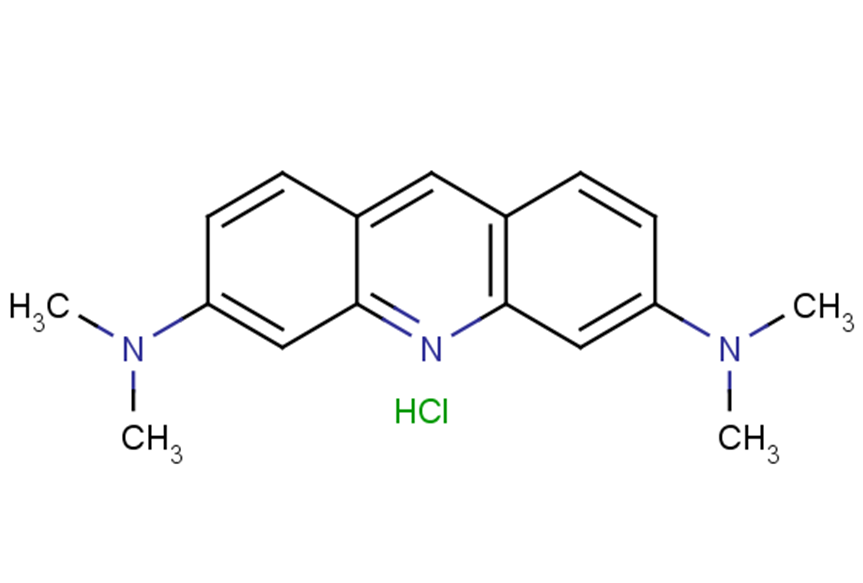
Acridine Orange hydrochloride
CAS No. 65-61-2
Acridine Orange hydrochloride( —— )
Catalog No. M22066 CAS No. 65-61-2
Acridine Orange hydrochloride is a fluorescent dye of cell-permeable. It binds to nucleic acids, resulting in an altered spectral emission.
Purity : >98% (HPLC)
 COA
Datasheet
HNMR
HPLC
MSDS
Handing Instructions
COA
Datasheet
HNMR
HPLC
MSDS
Handing Instructions
| Size | Price / USD | Stock | Quantity |
| 50MG | 33 | In Stock |


|
| 100MG | 44 | In Stock |
|
| 200MG | Get Quote | In Stock |
|
| 500MG | 98 | In Stock |
|
| 1G | 141 | In Stock |
|
Biological Information
-
Product NameAcridine Orange hydrochloride
-
NoteResearch use only, not for human use.
-
Brief DescriptionAcridine Orange hydrochloride is a fluorescent dye of cell-permeable. It binds to nucleic acids, resulting in an altered spectral emission.
-
DescriptionAcridine Orange hydrochloride is a fluorescent dye of cell-permeable. It binds to nucleic acids, resulting in an altered spectral emission.It is used as a supravital stain and in fluorescence cytochemistry. It may cause mutations in microorganisms.
-
In Vitro——
-
In Vivo——
-
Synonyms——
-
PathwayOthers
-
TargetOther Targets
-
RecptorOthers
-
Research Area——
-
Indication——
Chemical Information
-
CAS Number65-61-2
-
Formula Weight301.81
-
Molecular FormulaC17H20ClN3
-
Purity>98% (HPLC)
-
SolubilityH2O:50 mg/mL (165.67 mM; Need ultrasonic and warming); DMSO:30 mg/mL (99.40 mM; Need ultrasonic)
-
SMILESCl.CN(C)C1=CC2=NC3=C(C=CC(=C3)N(C)C)C=C2C=C1
-
Chemical Name——
Shipping & Storage Information
-
Storage(-20℃)
-
ShippingWith Ice Pack
-
Stability≥ 2 years
Reference
1. McMaster GK, et al. Analysis of single- and double-stranded nucleic acids on polyacrylamide and agarosegels by using glyoxal and acridine orange. Proc Natl Acad Sci U S A. 1977 Nov;74(11):4835-8.2. Traganos F, et al. Simultaneous staining of ribonucleic and deoxyribonucleic acids in unfixed cells using acridine orange in a flow cytofluorometric system. J Histochem Cytochem. 1977 Jan;25(1):46-56.
molnova catalog



related products
-
β- Amyloid (16-23)
β- Amyloid (16-23)
-
Gap 27
Gap 27 is a peptide(Ser-Arg-Pro-Thr-Glu-Lys-Thr-Ile-Phe-Ile-Ile) derived from connexin 43 that is a selective gap junction blocker.
-
Diastase
A diastase is any one of a group of enzymes which catalyses the breakdown of starch into maltose.
