


 Cart
Cart
 sales@molnova.com


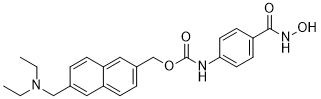
Givinostat
CAS No. 497833-27-9
Givinostat( —— )
Catalog No. M21887 CAS No. 497833-27-9
Givinostat or gavinostat, aslo known as ITF2357, is a potent and orally active histone deacetylase inhibitor with potential anti-inflammatory, anti-angiogenic, and antineoplastic activities.
Purity : >98% (HPLC)
 COA
Datasheet
HNMR
HPLC
MSDS
Handing Instructions
COA
Datasheet
HNMR
HPLC
MSDS
Handing Instructions
| Size | Price / USD | Stock | Quantity |
| 1 mL x 10 mM in DMSO | 76 | In Stock |


|
| 5MG | 70 | In Stock |
|
| 10MG | 125 | In Stock |
|
| 25MG | 276 | In Stock |
|
| 50MG | 432 | In Stock |
|
| 100MG | 647 | In Stock |
|
| 200MG | Get Quote | In Stock |
|
| 500MG | Get Quote | In Stock |
|
| 1G | Get Quote | In Stock |
|
Biological Information
-
Product NameGivinostat
-
NoteResearch use only, not for human use.
-
Brief DescriptionGivinostat or gavinostat, aslo known as ITF2357, is a potent and orally active histone deacetylase inhibitor with potential anti-inflammatory, anti-angiogenic, and antineoplastic activities.
-
DescriptionGivinostat or gavinostat, aslo known as ITF2357, is a potent and orally active histone deacetylase inhibitor with potential anti-inflammatory, anti-angiogenic, and antineoplastic activities. It is a hydroxamate used in the form of its hydrochloride. Inhibition of HDAC activity by ITF2357 ameliorates joint inflammation and prevents cartilage and bone destruction in experimental arthritis.ITF2357 reduces cytokines and protects islet β cells in vivo and in vitro. ITF2357 decreases surface CXCR4 and CCR5 expression on CD4(+) T-cells and monocytes and is superior to valproic acid for latent HIV-1 expression in vitro.
-
In VitroGivinostat (ITF2357) suppresses total LPS-induced IL-1β production robustly compared with the reduction by ITF3056. At 25, 50, and 100 nM, Givinostat reduced IL-1β secretion more than 70%. Givinostat (ITF-2357) suppresses the production of IL-6 in PBMCs stimulated with TLR agonists as well as the combination of IL-12 plus IL-18. IL-6 secretion decreases to 50% at 50 nM Givinostat, but at 100 and 200 nM, there is no reduction. As shown by the CCK-8 assay, Givinostat (ITF-2357) inhibits JS-1 cell proliferation in a concentration-dependent manner. Treatment with Givinostat ≥500 nM is associated with significant inhibition of JS-1 cell proliferation (P<0.01). Also, the cell inhibition rate significantly differs between the group cotreated with Givinostat ≥250 nM plus LPS and the group without LPS treatment (same Givinostat concentration) (P<0.05).
-
In VivoGivinostat (ITF2357) at 10 mg/kg is used as a positive control and, as expected, reduced serum TNFα by 60%. Strikingly, pretreatment of ITF3056 starting at 0.1 mg/kg significantly reduces the circulating TNFα by nearly 90%. To achieve a significant increase in serum IL-1β production, a higher dose of LPS is injected (10 mg/kg), and blood is collected after 4 h. Similarly, when pretreated with lower doses of Givinostat (ITF-2357) (1 or 5 mg/kg), there is a 22% reduction for 1 mg/kg and 40% for 5 mg/kg.
-
Synonyms——
-
PathwayCell Cycle/DNA Damage
-
TargetHDAC
-
Recptor——
-
Research Area——
-
Indication——
Chemical Information
-
CAS Number497833-27-9
-
Formula Weight421.49
-
Molecular FormulaC24H27N3O4
-
Purity>98% (HPLC)
-
SolubilityIn Vitro:?DMSO : 250 mg/mL (593.13 mM)
-
SMILESO=C(OCC1=CC=C2C=C(CN(CC)CC)C=CC2=C1)NC3=CC=C(C(NO)=O)C=C3
-
Chemical Name(6-((diethylamino)methyl)naphthalen-2-yl)methyl (4-(hydroxycarbamoyl)phenyl)carbamate
Shipping & Storage Information
-
Storage(-20℃)
-
ShippingWith Ice Pack
-
Stability≥ 2 years
Reference
1.Givinostat inhibition of hepatic stellate cell proliferation and protein acetylation.Wang YG, et al. World J Gastroenterol. 2015 Jul 21;21(27):8326-39. PMID: 26217084.
2.The histone deacetylase inhibitor ITF2357 reduces production of pro-inflammatory cytokines in vitro and systemic inflammation in vivo.Leoni F, et al. Mol Med. 2005 Jan-Dec;11(1-12):1-15. PMID: 16557334.
molnova catalog



related products
-
M 344
M344 is a potent HDAC inhibitor with IC50 of 100 nM and able to induce cell differentiation.
-
Remetinostat
Remetinostat is a hydroxamic acid-based inhibitor of histone deacetylase enzymes.
-
HDAC-IN-40
HDAC-IN-40 is a potent alkoxyamide-based HDAC inhibitor with a Ki of 60 nM for HDAC2 and 30 nM for HDAC6, exhibiting antitumor effects.
