


 Cart
Cart
 sales@molnova.com


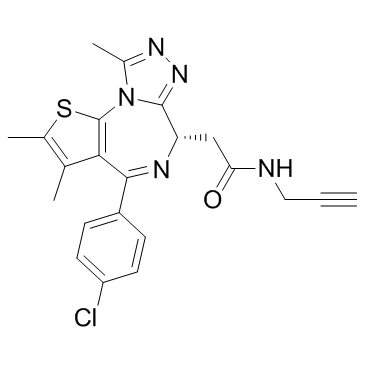
(+)-JQ1 PA
CAS No. 2115701-93-2
(+)-JQ1 PA ( —— )
Catalog No. M21743 CAS No. 2115701-93-2
(+)-JQ1 PA is a derivative of the Bromodomain and extra-terminal (BET) inhibitor JQ1, with an IC50 of 10.4 nM.
Purity : >98% (HPLC)
 COA
Datasheet
HNMR
HPLC
MSDS
Handing Instructions
COA
Datasheet
HNMR
HPLC
MSDS
Handing Instructions
| Size | Price / USD | Stock | Quantity |
| 5MG | 93 | In Stock |


|
| 10MG | 144 | In Stock |
|
| 25MG | 264 | In Stock |
|
| 50MG | 368 | In Stock |
|
| 100MG | 554 | In Stock |
|
| 200MG | Get Quote | In Stock |
|
| 500MG | Get Quote | In Stock |
|
| 1G | Get Quote | In Stock |
|
Biological Information
-
Product Name(+)-JQ1 PA
-
NoteResearch use only, not for human use.
-
Brief Description(+)-JQ1 PA is a derivative of the Bromodomain and extra-terminal (BET) inhibitor JQ1, with an IC50 of 10.4 nM.
-
Description(+)-JQ1 PA is a derivative of the Bromodomain and extra-terminal (BET) inhibitor JQ1, with an IC50 of 10.4 nM.
-
In Vitro——
-
In Vivo——
-
Synonyms——
-
PathwayOthers
-
TargetOther Targets
-
Recptor——
-
Research Area——
-
Indication——
Chemical Information
-
CAS Number2115701-93-2
-
Formula Weight437.95
-
Molecular FormulaC??H??ClN?OS
-
Purity>98% (HPLC)
-
SolubilityIn Vitro:?Ethanol : 50 mg/mL (114.17 mM)
-
SMILESO=C(NCC#C)C[C@H]1C2=NN=C(C)N2C3=C(C(C)=C(C)S3)C(C4=CC=C(Cl)C=C4)=N1
-
Chemical Name——
Shipping & Storage Information
-
Storage(-20℃)
-
ShippingWith Ice Pack
-
Stability≥ 2 years
Reference
1. Tyler DS, et al. Click chemistry enables preclinical evaluation of targeted epigenetic therapies. Science. 2017 Jun 30;356(6345):1397-1401.
molnova catalog



related products
-
AA41612
AA41612 is a novel antagonist of melanopsin-mediated phototransduction.
-
4-Bromo-2-(2,6-dioxo...
4-Bromo-2-(2,6-dioxopiperidin-3-yl)isoindoline-1,3-dione is a chemical compound.
-
(S)-Ebalzotan
(S)-Ebalzotan is the S configuration of Ebalzotan.Ebalzotan is a 5-HT1A receptor agonist that is used in the study of depression.
