


 Cart
Cart
 sales@molnova.com


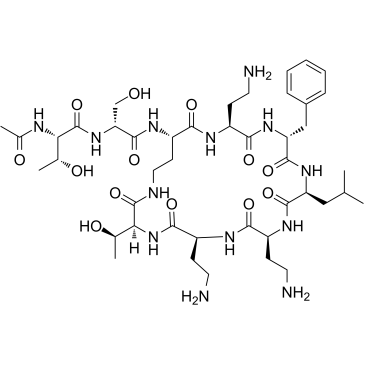
SPR741
CAS No. 1179330-52-9
SPR741( NAB741 )
Catalog No. M21717 CAS No. 1179330-52-9
SPR741, formerly NAB741 (12), is a cationic peptide derived from polymyxin B and is one such potentiator molecule that is under development for the treatment of serious Gram-negative bacterial infections.
Purity : >98% (HPLC)
 COA
Datasheet
HNMR
HPLC
MSDS
Handing Instructions
COA
Datasheet
HNMR
HPLC
MSDS
Handing Instructions
| Size | Price / USD | Stock | Quantity |
| 25MG | 488 | In Stock |


|
| 100MG | Get Quote | In Stock |
|
| 200MG | Get Quote | In Stock |
|
| 500MG | Get Quote | In Stock |
|
| 1G | Get Quote | In Stock |
|
Biological Information
-
Product NameSPR741
-
NoteResearch use only, not for human use.
-
Brief DescriptionSPR741, formerly NAB741 (12), is a cationic peptide derived from polymyxin B and is one such potentiator molecule that is under development for the treatment of serious Gram-negative bacterial infections.
-
DescriptionSPR741, formerly NAB741 (12), is a cationic peptide derived from polymyxin B and is one such potentiator molecule that is under development for the treatment of serious Gram-negative bacterial infections.
-
In VitroSPR741 potentiates antibiotics that are substrates of the AcrAB-TolC efflux pump in E. coli, effectively circumventing the contribution of this pump to intrinsic antibiotic resistance. The intrinsic resistance of E. coli to certain antibiotics that is mediated by both the outer membrane and the AcrAB-TolC efflux system can be overcome, or circumvented, by combining the antibiotic with SPR741 but that potentiation of intrinsic resistance due primarily to efflux may be limited.SPR741 lacks significant antibacterial activity as a stand-alone agent but interacts with the outer membrane of Gram-negative bacteria to increase permeability and thereby improve the accumulation of coadministered antibiotics inside the pathogen.
-
In VivoSPR741 has the ability to permeabilize the outer membrane of Gram-negative bacteria, thus sensitizing them to hydrophobic antibiotics. SPR741 has a significantly safety profile of compared to that of polymyxin B, which suffers severe, dose-limiting nephrotoxicity in humans. In multiday rodent and nonhuman primate studies, polymyxin B exhibited nephrotoxicity at a far-lower exposure-normalized dose than SPR741.
-
SynonymsNAB741
-
PathwayOthers
-
TargetOther Targets
-
Recptor——
-
Research Area——
-
Indication——
Chemical Information
-
CAS Number1179330-52-9
-
Formula Weight992.13
-
Molecular FormulaC??H??N??O??
-
Purity>98% (HPLC)
-
Solubility——
-
SMILESC[C@H]([C@H]1C(=O)NCC[C@@H](C(=O)N[C@H](C(=O)N[C@@H](C(=O)N[C@H](C(=O)N[C@H](C(=O)N[C@H](C(=O)N1)CCN)CCN)CC(C)C)CC2=CC=CC=C2)CCN)NC(=O)[C@@H](CO)NC(=O)[C@H]([C@@H](C)O)NC(=O)C)O
-
Chemical Name——
Shipping & Storage Information
-
Storage(-20℃)
-
ShippingWith Ice Pack
-
Stability≥ 2 years
Reference
molnova catalog



related products
-
Milbemycin oxime
Milbemycin oxime is a veterinary drug from the group of milbemycins, used as a broad spectrum antiparasitic.
-
Beclobrate
Beclobrate (Sgd 24774) is a novel orally available fibric acid derivative that has shown significant lipid and cholesterol-lowering activity in rodents and may be used in the study of primary hyperlipoproteinemia.
-
Chiirirhamnin
Chiirirhamnin is a natural product from Aconitum chiisanense.
