


 Cart
Cart
 sales@molnova.com


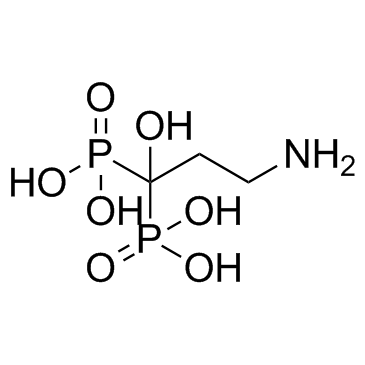
Pamidronic acid
CAS No. 40391-99-9
Pamidronic acid( —— )
Catalog No. M21602 CAS No. 40391-99-9
Pamidronic acid Leads to Bone Necrosis via Suppression of Wnt/β-Catenin Signaling in Human Bone Marrow Mesenchymal Stem Cells.
Purity : >98% (HPLC)
 COA
Datasheet
HNMR
HPLC
MSDS
Handing Instructions
COA
Datasheet
HNMR
HPLC
MSDS
Handing Instructions
| Size | Price / USD | Stock | Quantity |
| 25MG | 29 | In Stock |


|
| 50MG | 45 | In Stock |
|
| 100MG | 73 | In Stock |
|
| 200MG | 105 | In Stock |
|
| 500MG | Get Quote | In Stock |
|
| 1G | Get Quote | In Stock |
|
Biological Information
-
Product NamePamidronic acid
-
NoteResearch use only, not for human use.
-
Brief DescriptionPamidronic acid Leads to Bone Necrosis via Suppression of Wnt/β-Catenin Signaling in Human Bone Marrow Mesenchymal Stem Cells.
-
DescriptionPamidronic acid Leads to Bone Necrosis via Suppression of Wnt/β-Catenin Signaling in Human Bone Marrow Mesenchymal Stem Cells.(In Vitro):Osteosarcoma cell viability decreases significantly in a concentration- and time-dependent manner at pamidronate concentrations ranging from 100 to 1000 μM, most consistently after 48 and 72 hours' exposure. In treated osteosarcoma cells, the lowest percentage cell viability is 34% (detected after 72 hours' exposure to 1000μM pamidronate). Pamidronate disodium inhibits Wnt and β-catenin signaling, which controls osteogenic differentiation in BMMSCs. Wnt3a, a Wnt and β-catenin signaling activator, reverses the negative effects caused by pamidronate disodium to salvage the osteogenic defect in BMMSCs.(In Vivo):Pamidronic acid can significantly inhibit and even reverse early osteoarthritic subchondral bone loss, thus alleviating the process of cartilaginous degeneration. The mechanisms involved may be associated with the upregulation of OPG expression, and downregulation of RANKL, MMP-9 and TLR-4 expression.
-
In VitroOsteosarcoma cell viability decreases significantly in a concentration- and time-dependent manner at pamidronate concentrations ranging from 100 to 1000 μM, most consistently after 48 and 72 hours' exposure. In treated osteosarcoma cells, the lowest percentage cell viability is 34% (detected after 72 hours' exposure to 1000μM pamidronate). Pamidronate disodium inhibits Wnt and β-catenin signaling, which controls osteogenic differentiation in BMMSCs. Wnt3a, a Wnt and β-catenin signaling activator, reverses the negative effects caused by pamidronate disodium to salvage the osteogenic defect in BMMSCs.
-
In VivoPamidronic acid can significantly inhibit and even reverse early osteoarthritic subchondral bone loss, thus alleviating the process of cartilaginous degeneration. The mechanisms involved may be associated with the upregulation of OPG expression, and downregulation of RANKL, MMP-9 and TLR-4 expression.
-
Synonyms——
-
PathwayWnt/Notch/Hedgehog
-
TargetWnt/beta/catenin
-
Recptorβ-catenin|Wnt
-
Research AreaInflammation/Immunology
-
IndicationAnkylosing Spondylitis
Chemical Information
-
CAS Number40391-99-9
-
Formula Weight235.07
-
Molecular FormulaC3H11NO7P2
-
Purity>98% (HPLC)
-
SolubilityH2O:6 mg/mL (25.52 mM; Need ultrasonic and warming)
-
SMILESNCCC(O)(P(O)(O)=O)P(O)(O)=O
-
Chemical Name——
Shipping & Storage Information
-
Storage(-20℃)
-
ShippingWith Ice Pack
-
Stability≥ 2 years
Reference
1.Pamidronate Disodium Leads to Bone Necrosis via Suppression of Wnt/β-Catenin Signaling in Human Bone Marrow Mesenchymal Stem Cells In Vitro. J Oral Maxillofac Surg. 2017 Mar 22.
molnova catalog



related products
-
NRX-252114 B
NRX-252114 (NRX252114) induces degradation of mutant β-catenin NRX-252114 is a potent enhancer of the interaction of β-catenin with the homologous E3 ligase SCFβ-TrCP, and is able to enhance the binding of pSer33/S37A β-catenin to β-TrCP with an EC50 of 6.5 nM and a Kd of 0.4 nM. Kd is 0.4 nM.
-
TNIK-IN-7
TNIK-IN-7 is a potent and selective Traf2 and Nck interacting kinase (TNIK) inhibitor (IC50: 11 nM) with antitumor activity for studying signaling and proliferation in colorectal cancer cells.
-
JW74
JW74 antagonizes LiCl-induced activation of the canonical Wnt signaling (IC50: 420 nM).
