


 Cart
Cart
 sales@molnova.com


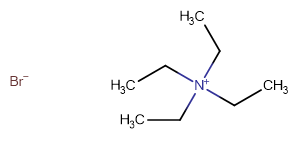
Tetraethylammonium bromide
CAS No. 71-91-0
Tetraethylammonium bromide( TEAB | TEA bromide )
Catalog No. M21589 CAS No. 71-91-0
Tetraethylammonium bromide can selectively block potassium channels.
Purity : >98% (HPLC)
 COA
Datasheet
HNMR
HPLC
MSDS
Handing Instructions
COA
Datasheet
HNMR
HPLC
MSDS
Handing Instructions
| Size | Price / USD | Stock | Quantity |
| 10MG | 45 | Get Quote |


|
| 25MG | 64 | Get Quote |
|
| 50MG | 96 | Get Quote |
|
| 100MG | 144 | Get Quote |
|
| 200MG | Get Quote | Get Quote |
|
| 500MG | Get Quote | Get Quote |
|
| 1G | Get Quote | Get Quote |
|
Biological Information
-
Product NameTetraethylammonium bromide
-
NoteResearch use only, not for human use.
-
Brief DescriptionTetraethylammonium bromide can selectively block potassium channels.
-
DescriptionTetraethylammonium bromide can selectively block potassium channels.
-
In Vitro——
-
In Vivo——
-
SynonymsTEAB | TEA bromide
-
PathwayCell Cycle/DNA Damage
-
TargetPotassium Channel
-
RecptorPotassium Channel
-
Research Area——
-
Indication——
Chemical Information
-
CAS Number71-91-0
-
Formula Weight210.16
-
Molecular FormulaC8H20BrN
-
Purity>98% (HPLC)
-
Solubility——
-
SMILES[Br-].CC[N+](CC)(CC)CC
-
Chemical Name——
Shipping & Storage Information
-
Storage(-20℃)
-
ShippingWith Ice Pack
-
Stability≥ 2 years
Reference
1.Barbara Paw?owskaet al.Evaluation of the Effect of Tetraethylammonium Bromide and Chloride on the Growth and Development of Terrestrial Plants.Chemosphere. 2016 Apr;149:24-33.
molnova catalog



related products
-
Charybdotoxin
Specific inhibitor of the big conductance Ca2+-activated K+ channel.
-
AM-92016 hydrochlori...
AM-92016 is a specific blocker of rectifier potassium current. AM-92016 delays rectifier potassium channel and repolarizes the membrane thereby restricting the duration of the nerve impulse.
-
Nicorandil
Nicorandil(Ikorel)is potassium channel activator. It acts by relaxing the smooth muscle of the blood vessels, especially those of the venous system.
