


 Cart
Cart
 sales@molnova.com


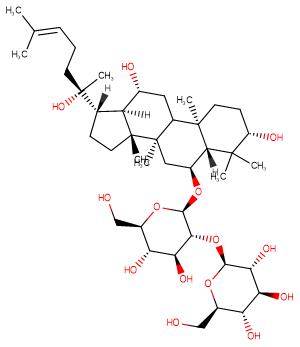
Ginsenoside-Rf
CAS No. 52286-58-5
Ginsenoside-Rf( Panaxoside Rf )
Catalog No. M21460 CAS No. 52286-58-5
Ginsenoside Rf is a trace component of ginseng root. Ginsenoside Rf inhibits N-type Ca2+ channel.
Purity : >98% (HPLC)
 COA
Datasheet
HNMR
HPLC
MSDS
Handing Instructions
COA
Datasheet
HNMR
HPLC
MSDS
Handing Instructions
| Size | Price / USD | Stock | Quantity |
| 1 mL x 10 mM in DMSO | 140 | In Stock |


|
| 2MG | 58 | In Stock |
|
| 5MG | 91 | In Stock |
|
| 10MG | 159 | In Stock |
|
| 25MG | 275 | In Stock |
|
| 50MG | 423 | In Stock |
|
| 100MG | Get Quote | In Stock |
|
| 200MG | Get Quote | In Stock |
|
| 500MG | Get Quote | In Stock |
|
| 1G | Get Quote | In Stock |
|
Biological Information
-
Product NameGinsenoside-Rf
-
NoteResearch use only, not for human use.
-
Brief DescriptionGinsenoside Rf is a trace component of ginseng root. Ginsenoside Rf inhibits N-type Ca2+ channel.
-
DescriptionGinsenoside Rf is a trace component of ginseng root. Ginsenoside Rf inhibits N-type Ca2+ channel.
-
In VitroGinsenoside Rf is a saponin, which is present in only trace amounts within ginseng. At saturating concentrations, Ginsenoside Rf rapidly and reversibly inhibits N-type, and other high-threshold, Ca2+ channels in rat sensory neurons to the same degree as a maximal dose of opioids. The effect is dose-dependent (half-maximal inhibition: 40 μM) and it is virtually eliminated by pretreatment of the neurons with pertussis toxin, an inhibitor of G(o) and Gi GTP-binding proteins. Ginsenoside Rf also inhibits Ca2+ channels in the hybrid F-11 cell line.
-
In VivoSince inhibition of Ca2+ channels in sensory neurons contributes to antinociception by opioids, analgesic actions of Ginsenoside Rf are tested. Dose-dependent antinociception is found by systemic administration of Ginsenoside Rf in mice using two separate assays of tonic pain: in the acetic acid abdominal constriction test, the ED50 is 56±9 mg/kg, a concentration similar to those reported for aspirin and acetaminophen in the same assay; in the tonic phase of the biphasic formalin test, the ED50 is 129±32 mg/kg.
-
SynonymsPanaxoside Rf
-
PathwayGPCR/G Protein
-
TargetCalcium Channel
-
RecptorN-type Ca2+ channel
-
Research Area——
-
Indication——
Chemical Information
-
CAS Number52286-58-5
-
Formula Weight801.01
-
Molecular FormulaC42H72O14
-
Purity>98% (HPLC)
-
SolubilityEthanol:5 mg/mL (62.42 mM)
-
SMILES[H][C@@]1(CC[C@]2(C)[C@]1([H])[C@H](O)CC1[C@@]3(C)CC[C@H](O)C(C)(C)[C@]3([H])[C@H](C[C@@]21C)O[C@@H]1O[C@H](CO)[C@@H](O)[C@H](O)[C@H]1O[C@@H]1O[C@H](CO)[C@@H](O)[C@H](O)[C@H]1O)[C@@](C)(O)CC\C=C(\C)C
-
Chemical Name——
Shipping & Storage Information
-
Storage(-20℃)
-
ShippingWith Ice Pack
-
Stability≥ 2 years
Reference
1.Nah SY et al. A trace component of ginseng that inhibits Ca
molnova catalog



related products
-
CDN1163
CDN1163 (CDN-1163) is a small molecule, allosteric activator of SERCA2.
-
Efonidipine hydrochl...
Efonidipine (NZ-105) is a potent, dual T-type and L-type calcium channel blocker.
-
CALP3
Cell-permeable calmodulin (CaM) agonist that binds to the EF-hand/Ca2+-binding site. Activates phosphodiesterase in the absence of Ca2+ and inhibits Ca2+-mediated cytotoxicity and apoptosis (IC50 = 33 μM).
