


 Cart
Cart
 sales@molnova.com


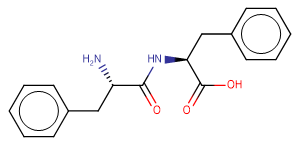
H-Phe-Phe-OH
CAS No. 2577-40-4
H-Phe-Phe-OH( —— )
Catalog No. M21422 CAS No. 2577-40-4
H-Phe-Phe-OH is a peptide made of two phenylalanine molecules; Phenylalanine is an essential amino acid and the precursor for the amino acid tyrosine.
Purity : >98% (HPLC)
 COA
Datasheet
HNMR
HPLC
MSDS
Handing Instructions
COA
Datasheet
HNMR
HPLC
MSDS
Handing Instructions
| Size | Price / USD | Stock | Quantity |
| 100MG | Get Quote | In Stock |


|
| 200MG | 32 | In Stock |
|
| 500MG | Get Quote | In Stock |
|
| 1G | Get Quote | In Stock |
|
Biological Information
-
Product NameH-Phe-Phe-OH
-
NoteResearch use only, not for human use.
-
Brief DescriptionH-Phe-Phe-OH is a peptide made of two phenylalanine molecules; Phenylalanine is an essential amino acid and the precursor for the amino acid tyrosine.
-
DescriptionH-Phe-Phe-OH is a peptide made of two phenylalanine molecules; Phenylalanine is an essential amino acid and the precursor for the amino acid tyrosine.
-
In VitroH-Phe-Phe-OH (Phe-Phe) is a peptide made of two phenylalanine molecules. Phenylalanine is an essential amino acid and the precursor for the amino acid tyrosine. It is the precursor of catecholamines in the body. The psychotropic drugs also have phenylalanine as a constituent. The H-Phe-Phe-OH recognition motif of the Alzheimer's Abeta peptide is the smallest peptide able to assemble into higher -order structures.
-
In Vivo——
-
Synonyms——
-
PathwayProteasome/Ubiquitin
-
TargetEndogenous Metabolite
-
RecptorHuman Endogenous Metabolite
-
Research Area——
-
Indication——
Chemical Information
-
CAS Number2577-40-4
-
Formula Weight312.36
-
Molecular FormulaC18H20N2O3
-
Purity>98% (HPLC)
-
SolubilityIn Vitro:?80% Acetic acid/water : 50 mg/)
-
SMILESN[C@@H](Cc1ccccc1)C(N[C@@H](Cc1ccccc1)C(O)=O)=O
-
Chemical Name——
Shipping & Storage Information
-
Storage(-20℃)
-
ShippingWith Ice Pack
-
Stability≥ 2 years
Reference
1.de Groot NS et al. Ile-phe dipeptide self-assembly: clues to amyloid formation. Biophys J. 2007 Mar 1;92(5):1732-41.
molnova catalog



related products
-
2-Ketoglutaric acid
2-Ketoglutaric acid is a key molecule in the tricarboxylic acid cycleis also connected to glutamic acid and glutamine metabolisms through the transamination reactions.
-
Butyric acid
Butyric acid is a fatty acid isolated from many dairy products that exhibits anticancer activity. Butyric acid inhibits histone deacetylases (HDACs) and induces apoptosis and G1 phase cell cycle arrest in glioma cells.
-
2'-Deoxycytidine-5'-...
2′-Deoxycytidine 5′-diphosphate (dCDP) is used as a substrate of CDP (nucleoside diphosphate) kinase (2.7.4.6) for the production of dCTP to support DNA biosynthesis and reverse transcription.
