


 Cart
Cart
 sales@molnova.com


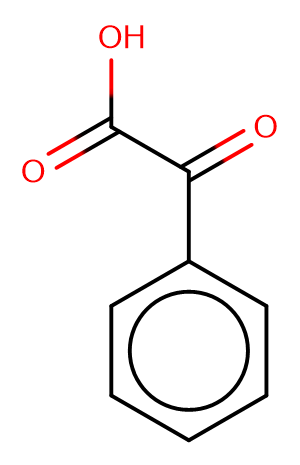
Phenylglyoxylic acid
CAS No. 611-73-4
Phenylglyoxylic acid( Benzoyl formate | Phenylglyoxalic acid | Phenylglyoxylate )
Catalog No. M21366 CAS No. 611-73-4
Phenylglyoxylic acid is a metabolite of ethylbenzene and styrene.
Purity : >98% (HPLC)
 COA
Datasheet
HNMR
HPLC
MSDS
Handing Instructions
COA
Datasheet
HNMR
HPLC
MSDS
Handing Instructions
| Size | Price / USD | Stock | Quantity |
| 1 mL x 10 mM in DMSO | 28 | In Stock |


|
| 100MG | Get Quote | In Stock |
|
| 200MG | Get Quote | In Stock |
|
| 500MG | Get Quote | In Stock |
|
| 1G | 27 | In Stock |
|
Biological Information
-
Product NamePhenylglyoxylic acid
-
NoteResearch use only, not for human use.
-
Brief DescriptionPhenylglyoxylic acid is a metabolite of ethylbenzene and styrene.
-
DescriptionPhenylglyoxylic acid is a metabolite of ethylbenzene and styrene.
-
In Vitro——
-
In Vivo——
-
SynonymsBenzoyl formate | Phenylglyoxalic acid | Phenylglyoxylate
-
PathwayOthers
-
TargetOther Targets
-
RecptorOthers
-
Research Area——
-
Indication——
Chemical Information
-
CAS Number611-73-4
-
Formula Weight150.13
-
Molecular FormulaC8H6O3
-
Purity>98% (HPLC)
-
SolubilityDMSO:3 mg/mL (199.82 mM)
-
SMILESOC(C(c1ccccc1)=O)=O
-
Chemical Name——
Shipping & Storage Information
-
Storage(-20℃)
-
ShippingWith Ice Pack
-
Stability≥ 2 years
Reference
1.Capella K M Roland K Geldner N et al. Ethylbenzene and styrene exposure in the United States based on urinary mandelic acid and phenylglyoxylic acid: NHANES 2005-2006 and 2011-2012[J]. Environmental research 2019 171(APR.):101-110.
molnova catalog



related products
-
11-Oxomogroside IIIE
11-Oxomogroside IIIE is a natural product.
-
Ascr#2
Ascr#2 (asc-C6-MK) is a glycoside analogue in Cryptococcus hidradii that promotes dauer formation.Ascr#2 mixtures with ascr#3 at low concentrations act as a male elicitor and can be used to detect population density.
-
MW01-2-151SRM
MW01-2-151SRM is a novel small molecule inhibitor of microglia activation that crosses the blood-brain barrier, has anti-neuroinflammatory effects, attenuates the up-regulation of glial cytokines in models of neuroinflammation, and can be used in studies of traumatic brain injury, Alzheimer's disease, and alginate toxicity.
