


 Cart
Cart
 sales@molnova.com


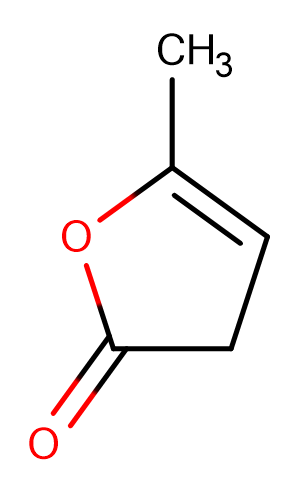
Alpha-Angelica Lactone
CAS No. 591-12-8
Alpha-Angelica Lactone( —— )
Catalog No. M21296 CAS No. 591-12-8
Alpha-Angelica Lactone has cardiotonic activity may exert their effects by providing an increased contraction-dependent calcium pool to be released upon systolic depolarization.
Purity : >98% (HPLC)
 COA
Datasheet
HNMR
HPLC
MSDS
Handing Instructions
COA
Datasheet
HNMR
HPLC
MSDS
Handing Instructions
| Size | Price / USD | Stock | Quantity |
| 1 mL x 10 mM in DMSO | 28 | Get Quote |


|
| 100MG | Get Quote | Get Quote |
|
| 200MG | 27 | Get Quote |
|
| 500MG | Get Quote | Get Quote |
|
| 1G | Get Quote | Get Quote |
|
Biological Information
-
Product NameAlpha-Angelica Lactone
-
NoteResearch use only, not for human use.
-
Brief DescriptionAlpha-Angelica Lactone has cardiotonic activity may exert their effects by providing an increased contraction-dependent calcium pool to be released upon systolic depolarization.
-
DescriptionAlpha-Angelica Lactone has cardiotonic activity may exert their effects by providing an increased contraction-dependent calcium pool to be released upon systolic depolarization.
-
In Vitro——
-
In Vivo——
-
Synonyms——
-
PathwayOthers
-
TargetOther Targets
-
RecptorOthers
-
Research Area——
-
Indication——
Chemical Information
-
CAS Number591-12-8
-
Formula Weight98.1
-
Molecular FormulaC5H6O2
-
Purity>98% (HPLC)
-
SolubilityIn Vitro:?DMSO : 100 mg/mL (1019.37 mM)
-
SMILESCC1=CCC(=O)O1
-
Chemical Name——
Shipping & Storage Information
-
Storage(-20℃)
-
ShippingWith Ice Pack
-
Stability≥ 2 years
Reference
1.Wattenberg L W Lam L K Fladmoe A V . Inhibition of chemical carcinogen-induced neoplasia by coumarins and alpha-angelicalactone.[J]. cancer research 1979 39(5):1651-1654.
molnova catalog



related products
-
UNC8153 TFA
UNC8153 TFA is a selective and potent NSD2 protein degrader with anticancer activity.UNC8153 TFA induces NSD2 degradation in MM.1S multiple myeloma cells and inhibits the proliferation of MM.1S cells.
-
Dodecylphosphocholin...
Dodecylphosphocholine is a substrate-type inhibitor of pancreas phospholipase A2. Dodecylphosphocholine is a detergent.
-
Mal-PEG2-C2-Boc
Mal-PEG2-C2-Boc is a PEG-based PROTAC linker that can be used in the synthesis of PROTACs.
