


 Cart
Cart
 sales@molnova.com


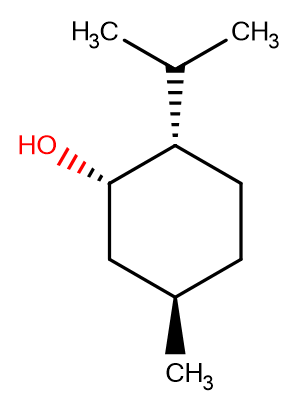
d-Neomenthol
CAS No. 2216-52-6
d-Neomenthol( (1S2S5R)-2-Isopropyl-5-Methylcyclohexanol | (+)-Neomenthol )
Catalog No. M21234 CAS No. 2216-52-6
d-Neomenthol is a natural product.
Purity : >98% (HPLC)
 COA
Datasheet
HNMR
HPLC
MSDS
Handing Instructions
COA
Datasheet
HNMR
HPLC
MSDS
Handing Instructions
| Size | Price / USD | Stock | Quantity |
| 100MG | Get Quote | In Stock |


|
| 200MG | Get Quote | In Stock |
|
| 500MG | 33 | In Stock |
|
| 1G | Get Quote | In Stock |
|
Biological Information
-
Product Named-Neomenthol
-
NoteResearch use only, not for human use.
-
Brief Descriptiond-Neomenthol is a natural product.
-
Descriptiond-Neomenthol is a natural product.
-
In Vitro——
-
In Vivo——
-
Synonyms(1S2S5R)-2-Isopropyl-5-Methylcyclohexanol | (+)-Neomenthol
-
PathwayOthers
-
TargetOther Targets
-
RecptorOthers
-
Research Area——
-
Indication——
Chemical Information
-
CAS Number2216-52-6
-
Formula Weight156.26
-
Molecular FormulaC10H20O
-
Purity>98% (HPLC)
-
SolubilityIn Vitro:?DMSO : 100 mg/mL (639.92 mM)
-
SMILESCC(C)[C@H](CC[C@@H](C)C1)[C@H]1O
-
Chemical Name——
Shipping & Storage Information
-
Storage(-20℃)
-
ShippingWith Ice Pack
-
Stability≥ 2 years
Reference
1.Williams R T . Studies in detoxication: The biological reduction of l-menthone to d-neomenthol and of d-isomenthone to d-isomenthol in the rabbit. The conjugation of d-neomenthol with glucuronic acid.[J]. Biochemical Journal 1940 34(5):690.
molnova catalog



related products
-
Epigambogellic acid
Epigambogellic acid has antitumor activity and inhibits SMMC-7221 cells and A549 cells.
-
TRH (free acid)
TRH (free acid)
-
Cinepazide maleate
A cerebral vasodilator that acts as a calcium blocker; protect neuronal cells against OGD injury by suppressing OGD-induced oxidative stress and preserving mitochondrial functions.
