


 Cart
Cart
 sales@molnova.com


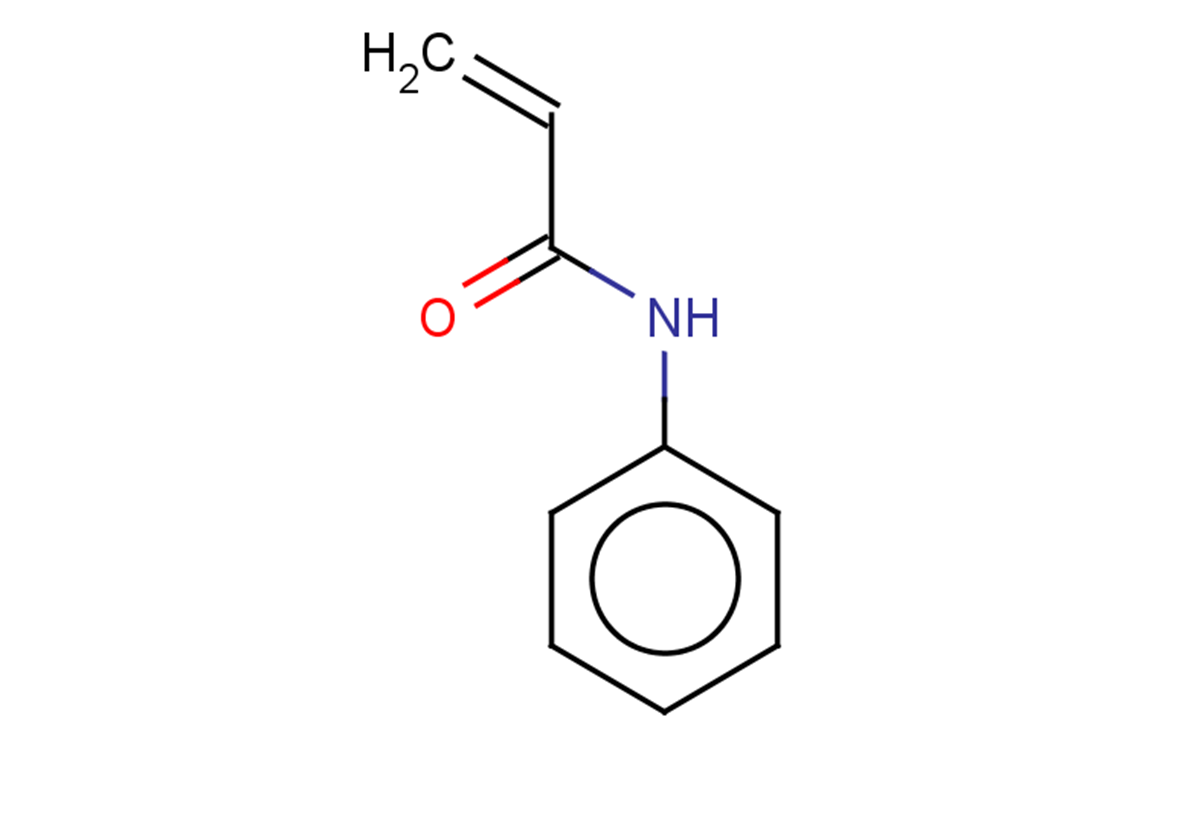
N-Phenylacrylamide
CAS No. 2210-24-4
N-Phenylacrylamide( —— )
Catalog No. M23998 CAS No. 2210-24-4
N-Phenylacrylamide inhibit human recombinant TGM2 by fluorescent transamidation assay.
Purity : >98% (HPLC)
 COA
Datasheet
HNMR
HPLC
MSDS
Handing Instructions
COA
Datasheet
HNMR
HPLC
MSDS
Handing Instructions
| Size | Price / USD | Stock | Quantity |
| 1 mL x 10 mM in DMSO | 29 | In Stock |


|
| 100MG | Get Quote | In Stock |
|
| 200MG | Get Quote | In Stock |
|
| 500MG | Get Quote | In Stock |
|
| 1G | 38 | In Stock |
|
Biological Information
-
Product NameN-Phenylacrylamide
-
NoteResearch use only, not for human use.
-
Brief DescriptionN-Phenylacrylamide inhibit human recombinant TGM2 by fluorescent transamidation assay.
-
DescriptionN-Phenylacrylamide inhibit human recombinant TGM2 by fluorescent transamidation assay.
-
In Vitro——
-
In Vivo——
-
Synonyms——
-
PathwayOthers
-
TargetOther Targets
-
RecptorTGM2
-
Research Area——
-
Indication——
Chemical Information
-
CAS Number2210-24-4
-
Formula Weight147.17
-
Molecular FormulaC9H9NO
-
Purity>98% (HPLC)
-
SolubilityIn Vitro:?DMSO : 100 mg/mL (679.49 mM)
-
SMILESC=CC(Nc1ccccc1)=O
-
Chemical Name——
Shipping & Storage Information
-
Storage(-20℃)
-
ShippingWith Ice Pack
-
Stability≥ 2 years
Reference
molnova catalog



related products
-
Gentiopicrin
Gentiopicroside, a naturally occurring iridoid glycoside, extracted from Gentiana manshurica Kitag, inhibits P450 activity, with an IC50 and a Ki of 61 μM and 22.8 μM for CYP2A6.
-
gp100 (570-579)
gp100 (570-579)
-
MGH-CP1
MGH-CP1 is a potent and selective inhibitor TEAD palmitoylation. It exhibits dose-dependent and potent inhibition of TEAD2/4 auto-palmitoylation in vitro with IC50 of 710 nM and 672 nM, respectively.
