


 Cart
Cart
 sales@molnova.com


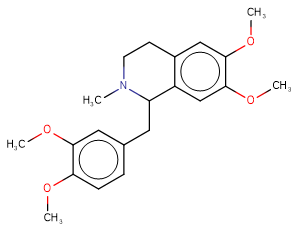
Laudanosine
CAS No. 1699-51-0
Laudanosine( DL-LAUDANOSINE )
Catalog No. M21227 CAS No. 1699-51-0
Laudanosine is a recognized metabolite of atracurium and cisatracurium.
Purity : >98% (HPLC)
 COA
Datasheet
HNMR
HPLC
MSDS
Handing Instructions
COA
Datasheet
HNMR
HPLC
MSDS
Handing Instructions
| Size | Price / USD | Stock | Quantity |
| 1 mL x 10 mM in DMSO | 52 | In Stock |


|
| 5MG | 40 | In Stock |
|
| 10MG | 56 | In Stock |
|
| 25MG | 88 | In Stock |
|
| 50MG | 126 | In Stock |
|
| 100MG | 183 | In Stock |
|
| 200MG | Get Quote | In Stock |
|
| 500MG | Get Quote | In Stock |
|
| 1G | Get Quote | In Stock |
|
Biological Information
-
Product NameLaudanosine
-
NoteResearch use only, not for human use.
-
Brief DescriptionLaudanosine is a recognized metabolite of atracurium and cisatracurium.
-
DescriptionLaudanosine is a recognized metabolite of atracurium and cisatracurium.
-
In Vitro——
-
In VivoDL-Laudanosine (Laudanosine) appears to be unique in its ability to produce cerebral stimulation in lightly anaesthetized animals and it is reported to cause arousal from anaesthesia in subconvulsive doses. Animal Model:Male CFLP mice weighing 18-25 g, and male Wistar rats weighing 120-150 g .Dosage:10-20 mg/kg.Administration:IV.Result:Caused convulsions and hind limb extensions.
-
SynonymsDL-LAUDANOSINE
-
PathwayOthers
-
TargetOther Targets
-
RecptorOthers
-
Research Area——
-
Indication——
Chemical Information
-
CAS Number1699-51-0
-
Formula Weight357.4
-
Molecular FormulaC21H27NO4
-
Purity>98% (HPLC)
-
SolubilityIn Vitro:?DMSO : 100 mg/mL (279.77 mM)
-
SMILESCN(CCc1c2)C(Cc(cc3)cc(OC)c3OC)c1cc(OC)c2OC
-
Chemical Name1-(34-dimethoxybenzyl)-67-dimethoxy-2-methyl-1234-tetrahydroisoquinoline
Shipping & Storage Information
-
Storage(-20℃)
-
ShippingWith Ice Pack
-
Stability≥ 2 years
Reference
1.Shi W Z Fahey M R Fisher D M et al. Laudanosine (A Metabolite of Atracurium) Increases the Minimum Alveolar Concentration of Halothane in Rabbits[J]. Anesthesiology 1985 63(6):584-588.
molnova catalog



related products
-
TH-263
TH-263 is inactive toward both LIMK1 and LIMK2 and thus can be used as negative control for TH-257, and is a diaryl sulfonamide derivative.
-
UCPH-101
UCPH-101 is an?inhibitor of excitatory amino acid transporter subtype 1?(EAAT1) with an?IC50?of 0.66 μM.
-
Pseudobaptigenin
Pseudobaptigenin (Psi-baptigenin) is an isoflavone, a flavonoid lipid molecule that is a natural product found in Pterocarpus marsupium, Dalbergia spruceana.
