


 Cart
Cart
 sales@molnova.com


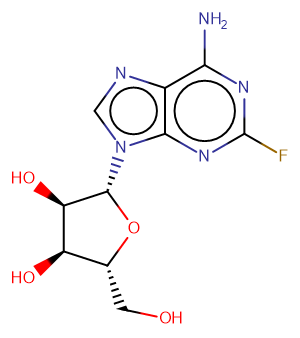
2-Fluoroadenosine
CAS No. 146-78-1
2-Fluoroadenosine( —— )
Catalog No. M21224 CAS No. 146-78-1
2-Fluoroadenosine is a potent inhibitor of lymphocyte-mediated cytolysis.
Purity : >98% (HPLC)
 COA
Datasheet
HNMR
HPLC
MSDS
Handing Instructions
COA
Datasheet
HNMR
HPLC
MSDS
Handing Instructions
| Size | Price / USD | Stock | Quantity |
| 1 mL x 10 mM in DMSO | 28 | In Stock |


|
| 100MG | 27 | In Stock |
|
| 200MG | Get Quote | In Stock |
|
| 500MG | Get Quote | In Stock |
|
| 1G | Get Quote | In Stock |
|
Biological Information
-
Product Name2-Fluoroadenosine
-
NoteResearch use only, not for human use.
-
Brief Description2-Fluoroadenosine is a potent inhibitor of lymphocyte-mediated cytolysis.
-
Description2-Fluoroadenosine is a potent inhibitor of lymphocyte-mediated cytolysis.
-
In Vitro——
-
In Vivo——
-
Synonyms——
-
PathwayOthers
-
TargetOther Targets
-
RecptorOthers
-
Research Area——
-
Indication——
Chemical Information
-
CAS Number146-78-1
-
Formula Weight285.23
-
Molecular FormulaC10H12FN5O4
-
Purity>98% (HPLC)
-
Solubility——
-
SMILESNc1nc(F)nc2n(cnc12)[C@@H]1O[C@H](CO)[C@@H](O)[C@H]1O
-
Chemical Name——
Shipping & Storage Information
-
Storage(-20℃)
-
ShippingWith Ice Pack
-
Stability≥ 2 years
Reference
1.Zimmerman T P Rideout J L Wolberg G et al. 2-Fluoroadenosine 3':5'-monophosphate. A metabolite of 2-fluoroadenosine in mouse cytotoxic lymphocytes.[J]. journal of biological chemistry 1976 251(21):6757-6766.
molnova catalog



related products
-
C3d Peptide P16
C3d Peptide P16
-
Acetyl-(Cys4,D-Phe7,...
Acetyl-(Cys4,D-Phe7,Cys10)-α-MSH (4-13)
-
X-GAL
X-GAL is a widely used substrate of chromogenic β-galactosidase. β-galactosidase cleaves X-GAL and produces an insoluble blue compound.
