


 Cart
Cart
 sales@molnova.com


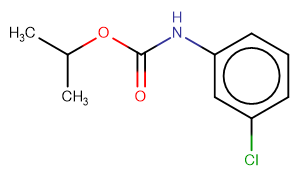
Chlorpropham
CAS No. 101-21-3
Chlorpropham( —— )
Catalog No. M21111 CAS No. 101-21-3
Chlorpropham acts as a plant growth regulator and herbicide.
Purity : >98% (HPLC)
 COA
Datasheet
HNMR
HPLC
MSDS
Handing Instructions
COA
Datasheet
HNMR
HPLC
MSDS
Handing Instructions
| Size | Price / USD | Stock | Quantity |
| 1 mL x 10 mM in DMSO | 28 | In Stock |


|
| 100MG | Get Quote | In Stock |
|
| 200MG | Get Quote | In Stock |
|
| 500MG | Get Quote | In Stock |
|
| 1G | 29 | In Stock |
|
Biological Information
-
Product NameChlorpropham
-
NoteResearch use only, not for human use.
-
Brief DescriptionChlorpropham acts as a plant growth regulator and herbicide.
-
DescriptionChlorpropham acts as a plant growth regulator and herbicide.
-
In VitroChlorpropham (1-20 μM; 6 d) inhibits cell division of D. salina cultures.Chlorpropham (10 or 20 μM; 6 d) shows increasement of phytoene in D. salina cultures under red LED light.
-
In Vivo——
-
Synonyms——
-
PathwayOthers
-
TargetOther Targets
-
RecptorOthers
-
Research Area——
-
Indication——
Chemical Information
-
CAS Number101-21-3
-
Formula Weight213.66
-
Molecular FormulaC10H12ClNO2
-
Purity>98% (HPLC)
-
Solubility——
-
SMILESCC(C)OC(=O)Nc1cccc(Cl)c1
-
Chemical NameCarbamic acid (3-chlorophenyl)- 1-methylethyl ester
Shipping & Storage Information
-
Storage(-20℃)
-
ShippingWith Ice Pack
-
Stability≥ 2 years
Reference
1.Tanaka T. Reproductive and Neurobehavioral Effects of Chlorpropham Administered to Mice in the Diet[J]. Toxicology & Industrial Health 1997 13(6):715-726.
molnova catalog



related products
-
Cilazapril Monohydra...
Cilazapril Monohydrate is an angiotensin-converting enzyme (ACE) inhibitor used for the treatment of hypertension and congestive heart failure.
-
Ephedrannin D1
The herbs of Daemonorops draco.
-
Euphorbiasteroid
Euphorbiasteroid (25-50 μM) decreased differentiation of 3T3-L1 cells via reduction of intracellular triglyceride (TG) accumulation.
