


 Cart
Cart
 sales@molnova.com


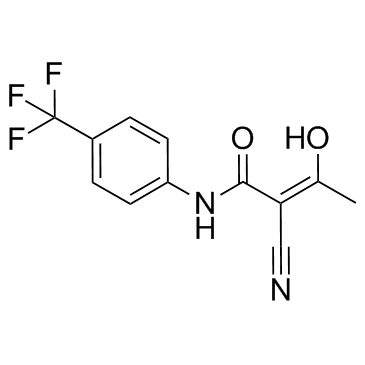
Teriflunomide(b)
CAS No. 163451-81-8
Teriflunomide(b)( A 77-1726 )
Catalog No. M20895 CAS No. 163451-81-8
Teriflunomide is the principal active metabolite of leflunomide an approved therapy for rheumatoid arthritis and multiple sclerosis.
Purity : >98% (HPLC)
 COA
Datasheet
HNMR
HPLC
MSDS
Handing Instructions
COA
Datasheet
HNMR
HPLC
MSDS
Handing Instructions
| Size | Price / USD | Stock | Quantity |
| 10MG | 43 | In Stock |


|
| 50MG | 54 | In Stock |
|
| 100MG | 84 | In Stock |
|
| 200MG | Get Quote | In Stock |
|
| 500MG | 138 | In Stock |
|
| 1G | Get Quote | In Stock |
|
Biological Information
-
Product NameTeriflunomide(b)
-
NoteResearch use only, not for human use.
-
Brief DescriptionTeriflunomide is the principal active metabolite of leflunomide an approved therapy for rheumatoid arthritis and multiple sclerosis.
-
DescriptionTeriflunomide is the principal active metabolite of leflunomide an approved therapy for rheumatoid arthritis and multiple sclerosis.(In Vitro):Teriflunomide primarily acts as an inhibitor of dihydroorotate dehydrogenase (DHODH), a key mitochondrial enzyme involved in the de novo synthesis of pyrimidines in rapidly proliferating cells. By reducing the activity of high-avidity proliferating T lymphocytes and B lymphocytes, teriflunomide likely attenuates the inflammatory response to autoantigens in MS. Thus, teriflunomide can be considered a cytostatic rather than a cytotoxic drug to leukocytes.(In Vivo):Teriflunomide has demonstrated beneficial effects in two independent animal models of demyelinating disease. In the dark agouti rat model of experimental autoimmune encephalitis (EAE), teriflunomide administration results in clinical, histopathological, and electrophysiological evidence of efficacy both as a prophylactic and therapeutic agent. Similarly, in the female Lewis rat model of EAE, teriflunomide administration results in beneficial prophylactic and therapeutic clinical effects, with a delay in disease onset and symptom severity.
-
In VitroTeriflunomide primarily acts as an inhibitor of dihydroorotate dehydrogenase (DHODH), a key mitochondrial enzyme involved in the de novo synthesis of pyrimidines in rapidly proliferating cells. By reducing the activity of high-avidity proliferating T lymphocytes and B lymphocytes, teriflunomide likely attenuates the inflammatory response to autoantigens in MS. Thus, teriflunomide can be considered a cytostatic rather than a cytotoxic drug to leukocytes.
-
In VivoTeriflunomide has demonstrated beneficial effects in two independent animal models of demyelinating disease. In the dark agouti rat model of experimental autoimmune encephalitis (EAE), teriflunomide administration results in clinical, histopathological, and electrophysiological evidence of efficacy both as a prophylactic and therapeutic agent. Similarly, in the female Lewis rat model of EAE, teriflunomide administration results in beneficial prophylactic and therapeutic clinical effects, with a delay in disease onset and symptom severity.
-
SynonymsA 77-1726
-
PathwayOthers
-
TargetOther Targets
-
RecptorOthers
-
Research AreaNeurological Disease
-
Indicationmultiple sclerosis (MS)
Chemical Information
-
CAS Number163451-81-8
-
Formula Weight270.21
-
Molecular FormulaC12H9F3N2O2
-
Purity>98% (HPLC)
-
SolubilityDMSO:26 mg/mL (96.22 mM)
-
SMILESC/C(O)=C(\C#N)C(=O)Nc1ccc(C(F)(F)F)cc1
-
Chemical Name——
Shipping & Storage Information
-
Storage(-20℃)
-
ShippingWith Ice Pack
-
Stability≥ 2 years
Reference
1.Paul O Oh . An update of teriflunomide for treatment of multiple sclerosis[J]. Therapeutics and Clinical Risk Management 2013:177-.
molnova catalog



related products
-
(R,S) AMPA
AMPA is the definitive agonist of the AMPA glutamatergic ionotropic receptor
-
S-allyl-L-cysteine
S-Allyl cysteine (SAC) is an organic compound that is a natural constituent of fresh garlic. It is a derivative of the amino acid cysteine in which an allyl group has been added to the sulfur atom.
-
TriacetonaMine
Triacetonamine protects the activitis of superoxide dismutase(SOD) and creatine phos-phate kinase (CPK); it also inhibits CaCl2 induced agglomeration of thromocyte. Triacetonamine can improve the constructile function of heart mus-cles of acute anemia and decrease the content of malodialdehyde (MDA) in the heart muscles.
