


 Cart
Cart
 sales@molnova.com


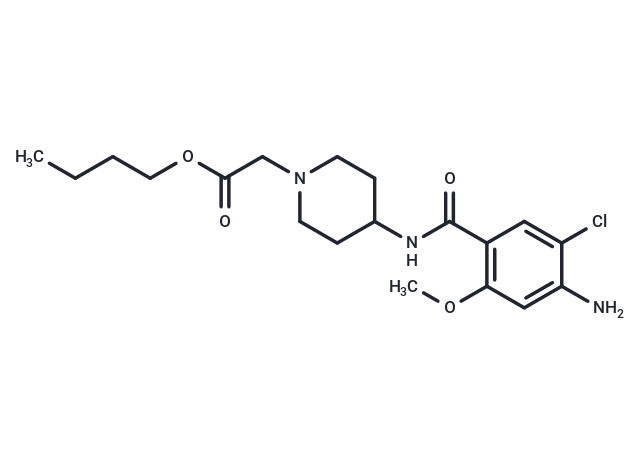
AU-224
CAS No. 287399-47-7
AU-224( —— )
Catalog No. M33244 CAS No. 287399-47-7
AU-224 is an orally available benzamide derivative that is a potent gastrointestinal prokinetic.
Purity : >98% (HPLC)
 COA
Datasheet
HNMR
HPLC
MSDS
Handing Instructions
COA
Datasheet
HNMR
HPLC
MSDS
Handing Instructions
| Size | Price / USD | Stock | Quantity |
| 5MG | 411 | In Stock |


|
| 10MG | 562 | In Stock |
|
| 25MG | 866 | In Stock |
|
| 100MG | Get Quote | In Stock |
|
| 200MG | Get Quote | In Stock |
|
| 500MG | Get Quote | In Stock |
|
| 1G | Get Quote | In Stock |
|
Biological Information
-
Product NameAU-224
-
NoteResearch use only, not for human use.
-
Brief DescriptionAU-224 is an orally available benzamide derivative that is a potent gastrointestinal prokinetic.
-
DescriptionAU-224 is a benzamide derivative used as a promising gastrointestinal prokinetic agent without significant side effects.
-
In Vitro——
-
In VivoAU-224 has excellent effect of promoting digestive motion while showing little side effect and can be orally administered. AU-224 shows only weak gastrointestinal prokinetic activity after oral administration due to its low lipophilicity.
-
Synonyms——
-
PathwayOthers
-
TargetOther Targets
-
RecptorOthers
-
Research Area——
-
Indication——
Chemical Information
-
CAS Number287399-47-7
-
Formula Weight397.9
-
Molecular FormulaC19H28ClN3O4
-
Purity>98% (HPLC)
-
Solubility——
-
SMILESO=C(OCCCC)CN1CCC(NC(=O)C=2C=C(Cl)C(N)=CC2OC)CC1
-
Chemical Name——
Shipping & Storage Information
-
Storage(-20℃)
-
ShippingWith Ice Pack
-
Stability≥ 2 years
Reference
1. WO/2000/046201A1
molnova catalog



related products
-
Sarecycline free bas...
Sarecycline free base is a tetracycline-derived, narrow-spectrum antibiotic.
-
Benzoylphenylalanine
Benzoylphenylalanine can be used as a photoaffinity peptide inactivator.
-
CDDO-3P-Im
CDDO-3P-Im, an analog of CDDO-Imidazolide, has a chemopreventive effect. It can reduce the size and severity of the lung tumors in the mouse lung cancer model.
