


 Cart
Cart
 sales@molnova.com


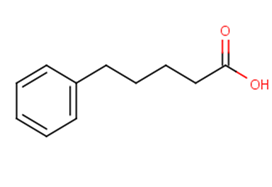
5-Phenylvaleric Acid
CAS No. 2270-20-4
5-Phenylvaleric Acid( Benzenepentanoic acid | Phenylpentanoic acid | Phenylvaleric Acid )
Catalog No. M20840 CAS No. 2270-20-4
5-Phenylvaleric acid is a pentanoic acid of bacterial origin occasionally found in human biofluids.
Purity : >98% (HPLC)
 COA
Datasheet
HNMR
HPLC
MSDS
Handing Instructions
COA
Datasheet
HNMR
HPLC
MSDS
Handing Instructions
| Size | Price / USD | Stock | Quantity |
| 1 mL x 10 mM in DMSO | 28 | In Stock |


|
| 10MG | 29 | In Stock |
|
| 25MG | 42 | In Stock |
|
| 50MG | 48 | In Stock |
|
| 100MG | 60 | In Stock |
|
| 200MG | Get Quote | In Stock |
|
| 500MG | 144 | In Stock |
|
| 1G | Get Quote | In Stock |
|
Biological Information
-
Product Name5-Phenylvaleric Acid
-
NoteResearch use only, not for human use.
-
Brief Description5-Phenylvaleric acid is a pentanoic acid of bacterial origin occasionally found in human biofluids.
-
Description5-Phenylvaleric acid is a pentanoic acid of bacterial origin occasionally found in human biofluids.
-
In Vitro——
-
In Vivo——
-
SynonymsBenzenepentanoic acid | Phenylpentanoic acid | Phenylvaleric Acid
-
PathwayProteasome/Ubiquitin
-
TargetEndogenous Metabolite
-
RecptorHuman Endogenous Metabolite
-
Research Area——
-
Indication——
Chemical Information
-
CAS Number2270-20-4
-
Formula Weight178.23
-
Molecular FormulaC11H14O2
-
Purity>98% (HPLC)
-
SolubilityDMSO:35 mg/mL(196.38mM)
-
SMILESO=C(O)CCCCc1ccccc1
-
Chemical Name——
Shipping & Storage Information
-
Storage(-20℃)
-
ShippingWith Ice Pack
-
Stability≥ 2 years
Reference
1.Ho I C Yang S P Chiu W Y et al. Structure and polymer form of poly-3-hydroxyalkanoates produced by Pseudomonas oleovorans grown with mixture of sodium octanoate/undecylenic acid and sodium octanoate/5-phenylvaleric acid[J]. International Journal of Biological Macromolecules 2007 40(2):0-118.
molnova catalog



related products
-
Indole-3-carboxaldeh...
1H-Indole-3-carboxaldehyde also known as 3-formylindole or 3-indolealdehyde belongs to the class of organic compounds known as indoles. Indoles are compounds containing an indole moiety which consists of pyrrole ring fused to benzene to form 23-benzopyrrole.
-
Oleoylcarnitine
Oleoylcarnitine (Oleoyl-L-carnitine) inhibits adenine nucleotide translocase (AdNT) activity with an ic50 of 14 μM.Oleoylcarnitine is an important indicator of neurodegeneration.
-
2,4-Dihydroxybenzald...
2,4-Dihydroxybenzaldehyde is a resorcinol derivative with potent antioxidant and antibacterial activity. 2,4-Dihydroxybenzaldehyde is an endogenous metabolite.
