


 Cart
Cart
 sales@molnova.com


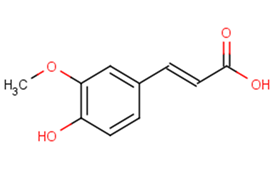
trans-Ferulic acid
CAS No. 537-98-4
trans-Ferulic acid( (E)-Coniferic acid )
Catalog No. M20346 CAS No. 537-98-4
Trans-Ferulic acid causes the phosphorylation of β-catenin resulting in proteasomal degradation of β-catenin and increases the expression of pro-apoptotic factor Bax and decreases the expression of pro-survival factor survivin.trans-Ferulic acid exert both anti-proliferation and anti-migration effects in the human lung cancer cell line H1299.
Purity : >98% (HPLC)
 COA
Datasheet
HNMR
HPLC
MSDS
Handing Instructions
COA
Datasheet
HNMR
HPLC
MSDS
Handing Instructions
| Size | Price / USD | Stock | Quantity |
| 1 mL x 10 mM in DMSO | 28 | In Stock |


|
| 100MG | Get Quote | In Stock |
|
| 200MG | Get Quote | In Stock |
|
| 500MG | 27 | In Stock |
|
| 1G | Get Quote | In Stock |
|
Biological Information
-
Product Nametrans-Ferulic acid
-
NoteResearch use only, not for human use.
-
Brief DescriptionTrans-Ferulic acid causes the phosphorylation of β-catenin resulting in proteasomal degradation of β-catenin and increases the expression of pro-apoptotic factor Bax and decreases the expression of pro-survival factor survivin.trans-Ferulic acid exert both anti-proliferation and anti-migration effects in the human lung cancer cell line H1299.
-
DescriptionTrans-Ferulic acid causes the phosphorylation of β-catenin resulting in proteasomal degradation of β-catenin and increases the expression of pro-apoptotic factor Bax and decreases the expression of pro-survival factor survivin.trans-Ferulic acid exert both anti-proliferation and anti-migration effects in the human lung cancer cell line H1299.
-
In VitroCell Proliferation Assay Cell Line:H1299 Concentration:0.03-0.6 mM Incubation Time:24 h, 48 h Result:Low dose had no significant cytotoxic effect, but cytotoxicity was observed with 0.3 and 0.6 mM for 48 h.Apoptosis Analysis Cell Line:H1299 Concentration:0.03-0.6 mMIncubation Time: 48 h Result:Caused the arrest of the cell cycle at G0/G1 and a decrease in the percentage of the G2/M phase. And induced a significant increase in apoptotic populations. with 0.6 mM Cell Migration Assay Cell Line:H1299 Concentration:0.03-0.6 mM Incubation Time:16 h, (48 h)Result:Inhibited cell migration and invasion. by reducing the activity of MMP?2 and MMP?9 and increased β-catenin phosphorylation at Thr41/Ser45 but did not affect β-catenin protein levels.
-
In VivoAnimal Model:Male Wister Albino Rat model Dosage: 100 mg/kg Administration:i.g, once a day for 21 daysResult:Decreased tamoxifen-induced elevated enzyme activities of AST, ALT, and ALP and ameliorated the decrease in the hepatic enzyme activities.
-
Synonyms(E)-Coniferic acid
-
PathwayAngiogenesis
-
TargetBcl-2
-
RecptorBax
-
Research Area——
-
Indication——
Chemical Information
-
CAS Number537-98-4
-
Formula Weight194.18
-
Molecular FormulaC10H10O4?
-
Purity>98% (HPLC)
-
SolubilityIn Vitro:?DMSO : 100 mg/mL (514.99 mM)
-
SMILESCOc1cc(\C=C\C(O)=O)ccc1O
-
Chemical Name——
Shipping & Storage Information
-
Storage(-20℃)
-
ShippingWith Ice Pack
-
Stability≥ 2 years
Reference
1.Fong Y Tang C C Hu H T et al. Inhibitory effect oftrans-ferulic acid on proliferation and migration of human lung cancer cells accompanied with increased endogenous reactive oxygen species and β-catenin instability[J]. Chinese Medicine 2016 11(1):45.
molnova catalog



related products
-
Sabutoclax
Sabutoclax (BI-97C1) is a potent, pan Bcl-2 family proteins inhibitor.
-
BAM7
BAM 7 is a direct and selective activator of proapoptotic Bax with EC50 of 3.3 μM.
-
HA14-1
HA14-1 a small molecule, nonpeptidic Bcl-2 antagonist that binds Bcl-2 surface pocket with binding IC50 of 9 uM.
