


 Cart
Cart
 sales@molnova.com


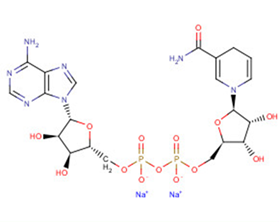
NADH disodium salt hydrate
CAS No. 606-68-8
NADH disodium salt hydrate( Disodium NADH | NADH disodium salt )
Catalog No. M19981 CAS No. 606-68-8
NADH is the reduced form of nicotinamide adenine dinucleotide (NAD) that can donate electrons as part of a reducing reaction. In that process NADH becomes oxidized to produce NAD+. A variety of enzymes use NADH plus H+ to reduce substrates generating NAD+ as well as the reduced product.
Purity : >98% (HPLC)
 COA
Datasheet
HNMR
HPLC
MSDS
Handing Instructions
COA
Datasheet
HNMR
HPLC
MSDS
Handing Instructions
| Size | Price / USD | Stock | Quantity |
| 100MG | Get Quote | In Stock |


|
| 200MG | Get Quote | In Stock |
|
| 500MG | 42 | In Stock |
|
| 1G | 52 | In Stock |
|
Biological Information
-
Product NameNADH disodium salt hydrate
-
NoteResearch use only, not for human use.
-
Brief DescriptionNADH is the reduced form of nicotinamide adenine dinucleotide (NAD) that can donate electrons as part of a reducing reaction. In that process NADH becomes oxidized to produce NAD+. A variety of enzymes use NADH plus H+ to reduce substrates generating NAD+ as well as the reduced product.
-
DescriptionNADH is the reduced form of nicotinamide adenine dinucleotide (NAD) that can donate electrons as part of a reducing reaction. In that process NADH becomes oxidized to produce NAD+. A variety of enzymes use NADH plus H+ to reduce substrates generating NAD+ as well as the reduced product.
-
In Vitro——
-
In VivoAnimal Model:Male ICR mice Dosage:5 μmol/mouse Administration:Intraperitoneal injection or oral administration, once Result:Produced significant increases in urinary excretions of nicotinamide (Nam) with intraperitoneal injection. Oral administration did not produce any increases in Nam or its metabolites.Animal Model:Male C57BL/6J mice Dosage:500 mg/kg Administration:Intragastric administration, 15 min before ethanol administration Result:Significantly increased blood acetaldehyde levels in mice administered with alcohol between 30 min and two hours. Significantly reduced the acetaldehyde in the blood after two hours. Inhibited the decrease of NAD+/NADH redox ratio in hepatocytes.
-
SynonymsDisodium NADH | NADH disodium salt
-
PathwayOthers
-
TargetOther Targets
-
RecptorOthers
-
Research Area——
-
Indication——
Chemical Information
-
CAS Number606-68-8
-
Formula Weight709.4
-
Molecular FormulaC21H27N7Na2O14P2
-
Purity>98% (HPLC)
-
SolubilityDMSO:42.3 mM
-
SMILES[Na+].[Na+].NC(=O)C1=CN(C=CC1)[C@@H]1O[C@H](COP([O-])(=O)OP([O-])(=O)OC[C@H]2O[C@H]([C@H](O)[C@@H]2O)n2cnc3c(N)ncnc23)[C@@H](O)[C@H]1O
-
Chemical Name——
Shipping & Storage Information
-
Storage(-20℃)
-
ShippingWith Ice Pack
-
Stability≥ 2 years
Reference
1.Kim MS et al. Enzymatic properties of the membrane-bound NADH oxidase system in the aerobic respiratory chain of Bacillus cereus. J Biochem Mol Biol. 2004 Nov 30;37(6):753-6.
molnova catalog



related products
-
D-altrofurano-heptul...
D-altrofurano-heptulose-3 is isolated from the rhizomes of Actinidia kolomikta (Rupr. & Maxim.) Maxim., Actinidiaceae.
-
2-methyl-3,5,6-trihy...
2-methyl-3,5,6-trihydroxyanthraquinone
-
Shikonofuran A
Shikonofuran A is a natural product isolated from Lithosperraum erythrorhizon Sieb.
