


 Cart
Cart
 sales@molnova.com


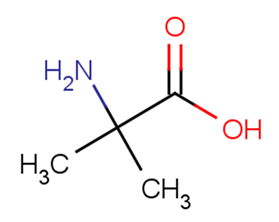
2-Aminoisobutyric acid
CAS No. 62-57-7
2-Aminoisobutyric acid( α-Aminoisobutanoic acid | NSC 16590 | αα-Dimethylglycine )
Catalog No. M19646 CAS No. 62-57-7
Aminoisobutyric acid is a nonprotein amino acid (is an end product of pyrimidine metabolism) excreted in the urine of about 5% of healthy individuals and high excretion is an autosomal recessive phenotype.
Purity : >98% (HPLC)
 COA
Datasheet
HNMR
HPLC
MSDS
Handing Instructions
COA
Datasheet
HNMR
HPLC
MSDS
Handing Instructions
| Size | Price / USD | Stock | Quantity |
| 100MG | Get Quote | In Stock |


|
| 200MG | Get Quote | In Stock |
|
| 500MG | 28 | In Stock |
|
| 1G | 39 | In Stock |
|
Biological Information
-
Product Name2-Aminoisobutyric acid
-
NoteResearch use only, not for human use.
-
Brief DescriptionAminoisobutyric acid is a nonprotein amino acid (is an end product of pyrimidine metabolism) excreted in the urine of about 5% of healthy individuals and high excretion is an autosomal recessive phenotype.
-
DescriptionAminoisobutyric acid is a nonprotein amino acid (is an end product of pyrimidine metabolism) excreted in the urine of about 5% of healthy individuals and high excretion is an autosomal recessive phenotype.
-
In VitroNSC 16590 (α-Aminoisobutyric acid , AIB) inhibits the production of endogenous ethylene in the cotyledonary segments of cocklebur (Xanthium pennsylvanicum Wallr.) seeds most strongly. NSC 16590 at 4 mM inhibits the formation of ethylene by about 50%, although the O2 uptake of the segments is not affected even at 20 mM. NSC 16590 also inhibits ethylene formation in the stem segments of etiolated pea (Pisum satiuum L. cv. Alaska) seedlings. Kinetic analysis with cell free extracts from etiolated pea shoots reveals that NSC 16590 competitively inhibits the conversion of ACC into ethylene.
-
In Vivo——
-
Synonymsα-Aminoisobutanoic acid | NSC 16590 | αα-Dimethylglycine
-
PathwayOthers
-
TargetOther Targets
-
RecptorOthers
-
Research Area——
-
Indication——
Chemical Information
-
CAS Number62-57-7
-
Formula Weight103.12
-
Molecular FormulaC4H9NO2
-
Purity>98% (HPLC)
-
SolubilityH2O:33.33 mg/mL (323.22 mM; Need ultrasonic)
-
SMILESCC(C)(N)C(O)=O
-
Chemical Name——
Shipping & Storage Information
-
Storage(-20℃)
-
ShippingWith Ice Pack
-
Stability≥ 2 years
Reference
1.Sreekumar A Poisson L M Rajendiran T M et al. Corrigendum: Metabolomic profiles delineate potential role for sarcosine in prostate cancer progression[J]. Nature 2009 457(7231):910-914.
molnova catalog



related products
-
Cetylpyridinium chlo...
Cetylpyridinium chloride (CPC) is a cationic quaternary ammonium compound used in some types of mouthwashes, toothpastes, lozenges, throat sprays, breath sprays, and nasal sprays.
-
Type A Allatostatin ...
Type A Allatostatin I b
-
[Des-Tyr1]- g-Endorp...
[Des-Tyr1]-gamma-Endorphin is a neuropeptide, which can be found in human cerebrospinal fluid. [Des-Tyr1]-gamma-Endorphin exhibits antidepressant efficacy, facilitates the extinction of active avoidance and attenuates the passive avoidance behavior in rats.
