


 Cart
Cart
 sales@molnova.com


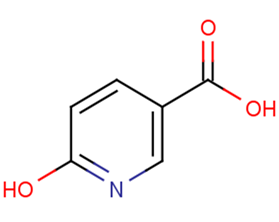
6-Hydroxypyridine-3-carboxylic acid
CAS No. 5006-66-6
6-Hydroxypyridine-3-carboxylic acid( 2-Hydroxy-5-pyridinecarboxylic acid | 6-Hydroxynicotinic acid )
Catalog No. M19612 CAS No. 5006-66-6
6-hydroxynicotinic acid (6-OHNA) is exploited in the use of NMR spectroscopy or gas chromatography--mass spectrometry for the diagnosis of Pseudomonas aeruginosa in urinary tract infection.
Purity : >98% (HPLC)
 COA
Datasheet
HNMR
HPLC
MSDS
Handing Instructions
COA
Datasheet
HNMR
HPLC
MSDS
Handing Instructions
| Size | Price / USD | Stock | Quantity |
| 1 mL x 10 mM in DMSO | 28 | In Stock |


|
| 100MG | Get Quote | In Stock |
|
| 200MG | Get Quote | In Stock |
|
| 500MG | Get Quote | In Stock |
|
| 1G | 27 | In Stock |
|
Biological Information
-
Product Name6-Hydroxypyridine-3-carboxylic acid
-
NoteResearch use only, not for human use.
-
Brief Description6-hydroxynicotinic acid (6-OHNA) is exploited in the use of NMR spectroscopy or gas chromatography--mass spectrometry for the diagnosis of Pseudomonas aeruginosa in urinary tract infection.
-
Description6-hydroxynicotinic acid (6-OHNA) is exploited in the use of NMR spectroscopy or gas chromatography--mass spectrometry for the diagnosis of Pseudomonas aeruginosa in urinary tract infection. Among the common bacteria causing urinary infection only P. aeruginosa produces 6-hydroxynicotinic acid from nicotinic acid.
-
In Vitro——
-
In Vivo——
-
Synonyms2-Hydroxy-5-pyridinecarboxylic acid | 6-Hydroxynicotinic acid
-
PathwayOthers
-
TargetOther Targets
-
RecptorOthers
-
Research Area——
-
Indication——
Chemical Information
-
CAS Number5006-66-6
-
Formula Weight139.11
-
Molecular FormulaC6H5NO3
-
Purity>98% (HPLC)
-
SolubilityDMSO:33.3 mM
-
SMILESOC(=O)c1ccc(O)nc1
-
Chemical Name——
Shipping & Storage Information
-
Storage(-20℃)
-
ShippingWith Ice Pack
-
Stability≥ 2 years
Reference
1.Shiraishi S et al. Availability of 6-hydroxynicotinic acid for rapid identification of Pseudomonas aeruginosa and Serratia marcescens. J Chromatogr. 1985 Feb 27;338(1):51-9.
molnova catalog



related products
-
U-54461
Bropirimine (U-54461) is a biological response modifier that is thought to act through the induction of lymphokines.
-
Cy5.5
Cy5.5 is a near-infrared fluorescent dye for labeling biomolecules such as peptides, proteins and oligonucleotides (Ex=673 nm, Em=707 nm).
-
IWP-L6
IWP-L6 is an extremely effective Porcn inhibitor (EC50: 0.5 nM).
