


 Cart
Cart
 sales@molnova.com


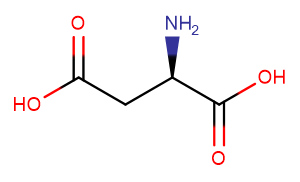
D-Aspartic acid
CAS No. 1783-96-6
D-Aspartic acid( D-(-)-Aspartic acid | L-Homoproline | (R)-Aspartic acid | Asp | Aminosuccinic acid | asparagic acid )
Catalog No. M19571 CAS No. 1783-96-6
D-Aspartic acid (D-Asp) is an endogenous amino acid existing in invertebrates and vertebrates. It can regulate testosterone synthesis and is an agonist of NMDA receptor.
Purity : >98% (HPLC)
 COA
Datasheet
HNMR
HPLC
MSDS
Handing Instructions
COA
Datasheet
HNMR
HPLC
MSDS
Handing Instructions
| Size | Price / USD | Stock | Quantity |
| 100MG | Get Quote | In Stock |


|
| 200MG | Get Quote | In Stock |
|
| 500MG | 38 | In Stock |
|
| 1G | Get Quote | In Stock |
|
Biological Information
-
Product NameD-Aspartic acid
-
NoteResearch use only, not for human use.
-
Brief DescriptionD-Aspartic acid (D-Asp) is an endogenous amino acid existing in invertebrates and vertebrates. It can regulate testosterone synthesis and is an agonist of NMDA receptor.
-
DescriptionD-Aspartic acid (D-Asp) is an endogenous amino acid existing in invertebrates and vertebrates. It can regulate testosterone synthesis and is an agonist of NMDA receptor.
-
In Vitro——
-
In Vivo——
-
SynonymsD-(-)-Aspartic acid | L-Homoproline | (R)-Aspartic acid | Asp | Aminosuccinic acid | asparagic acid
-
PathwayMembrane Transporter/Ion Channel
-
TargetNMDAR
-
RecptorNMDA receptor
-
Research Area——
-
Indication——
Chemical Information
-
CAS Number1783-96-6
-
Formula Weight133.1
-
Molecular FormulaC4H7NO4
-
Purity>98% (HPLC)
-
Solubility1eq. NaOH:100 mM;Ethanol:Insoluble;Water:Insoluble
-
SMILESN[C@H](CC(O)=O)C(O)=O
-
Chemical Name——
Shipping & Storage Information
-
Storage(-20℃)
-
ShippingWith Ice Pack
-
Stability≥ 2 years
Reference
1.Santillo A et al. D-Aspartate Induces Proliferative Pathways in Spermatogonial GC-1 Cells.J Cell Physiol. 2016 Feb;231(2):490-5.
molnova catalog



related products
-
D-AP5
D-AP5 is a NMDA receptor antagonist.
-
ALDH3A1-IN-1
ALDH3A1-IN-1 (Compound 18) is a potent ALDH3A1 inhibitor with an IC 50 of 1.61 μM. It is more effective than DEAB against patient-derived primary prostate tumor epithelial cells, both as a single agent and in combination with docetaxel .
-
Quininic acid
Quinic acid is an organic acid extracted from the bark of Eucalyptus, Cinchona and other plants in the Asteraceae family.
