


 Cart
Cart
 sales@molnova.com


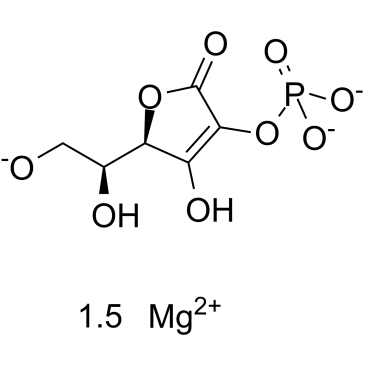
L-Ascorbic acid 2-phosphate magnesium
CAS No. 113170-55-1
L-Ascorbic acid 2-phosphate magnesium( —— )
Catalog No. M19384 CAS No. 113170-55-1
L-Ascorbic acid 2-phosphate magnesium (2-Phospho-L-ascorbic acid magnesium) is a long-acting vitamin C derivative that can stimulate collagen formation and expression.
Purity : >98% (HPLC)
 COA
Datasheet
HNMR
HPLC
MSDS
Handing Instructions
COA
Datasheet
HNMR
HPLC
MSDS
Handing Instructions
| Size | Price / USD | Stock | Quantity |
| 100MG | Get Quote | In Stock |


|
| 200MG | Get Quote | In Stock |
|
| 500MG | 38 | In Stock |
|
| 1G | Get Quote | In Stock |
|
Biological Information
-
Product NameL-Ascorbic acid 2-phosphate magnesium
-
NoteResearch use only, not for human use.
-
Brief DescriptionL-Ascorbic acid 2-phosphate magnesium (2-Phospho-L-ascorbic acid magnesium) is a long-acting vitamin C derivative that can stimulate collagen formation and expression.
-
DescriptionL-Ascorbic acid 2-phosphate magnesium (2-Phospho-L-ascorbic acid magnesium) is a long-acting vitamin C derivative that can stimulate collagen formation and expression. L-Ascorbic acid 2-phosphate magnesium (2-Phospho-L-ascorbic acid magnesium) can be used as a culture medium supplement for the osteogenic differentiation of human adipose stem cells (hASCs). L-Ascorbic acid 2-phosphate magnesium (2-Phospho-L-ascorbic acid magnesium) increases alkaline phosphatase (ALP) activity and expression of runx2A in hASCs during the osteogenic differentiation.(In Vitro):L-Ascorbic acid 2-phosphate (0.1-1.5 mM; 2 to 3 weeks with medium exchange every 2 to 3 days) significantly stimulates cell growth, whereas addition of l-Ascorbic acid (Asc) achieves only weak growth stimulation. A combination of Asc-2P and bFGF significantly increases cell growth, but supplementation with EGF and/or insulin does not have any additional effect .L-Ascorbic acid 2-phosphate (50 μM-250 μM) is needed for the effective osteogenic differentiation of human adipose stem cells (hASCs), and higher concentrations of AsA2-P results in increased runx2 expression and ALP activity. The highest proliferation, ALP activity and runx2 expression is achieved with 150 μM AsA2-P and 10 nM dexamethasone (Dex), and 250 μM AsA2-P and 5 nM Dex.
-
In VitroL-Ascorbic acid 2-phosphate (0.1-1.5 mM; 2 to 3 weeks with medium exchange every 2 to 3 days) significantly stimulates cell growth, whereas addition of l-Ascorbic acid (Asc)?achieves only weak growth stimulation. A combination of Asc-2P and bFGF significantly increases cell growth, but supplementation withEGF and/or insulin does not have any additional effect?.L-Ascorbic?acid?2-phosphate (50 μM-250 μM) is needed for the effective osteogenic differentiation of human adipose stem cells (hASCs), and higher concentrations of AsA2-P results in increased runx2 expression and ALP activity. The highest proliferation, ALP activity and runx2 expression is achieved with 150 μM AsA2-P and 10 nM dexamethasone (Dex), and 250 μM AsA2-P and 5 nM Dex. Cell Viability Assay Cell Line: Human?corneal?endothelial?cells?(HCECs)?Concentration:0.1 mM; 0.3 mM; 1.5 mM Incubation Time:2 to 3 weeks with medium exchange every 2 to 3 days Result:Stimulated HCEC cells growth.
-
In Vivo——
-
Synonyms——
-
PathwayMetabolic Enzyme/Protease
-
TargetPhosphatase
-
RecptorIC50: alkaline phosphatase (ALP)| collagen formation| runx2A
-
Research Area——
-
Indication——
Chemical Information
-
CAS Number113170-55-1
-
Formula Weight292.56
-
Molecular FormulaC?H?O?P.?/?Mg
-
Purity>98% (HPLC)
-
SolubilitySoluble in DMSO
-
SMILESOC([C@H](O1)[C@H](C[O-])O)=C(OP([O-])([O-])=O)C1=O.[1.5].[Mg+2]
-
Chemical Name——
Shipping & Storage Information
-
Storage(-20℃)
-
ShippingWith Ice Pack
-
Stability≥ 2 years
Reference
1. Shima N et al.Invest Ophthalmol Vis Sci. 2011 Nov 7;52(12):8711-7.
2. Kurata S et al.J Biol Chem. 1991 May 25;266(15):9997-10003.
molnova catalog



related products
-
Raphin1 acetate
Raphin1 acetate is a selective and orally bioavailable regulatory phosphatase PPP1R15B (R15B) inhibitor.Raphin1, a selective inhibitor of R15B.?In cells, Raphin1 caused a rapid and transient accumulation of its phosphorylated substrate, resulting in a transient attenuation of protein synthesis.?
-
CPDA
CPDA is a new potent inhibitor of SH2 domain-containing inositol phosphatase 2 (SHIP2).
-
LFHP-1c
LFHP-1c is a novel PGAM5 inhibitor that shows neuroprotective activity in an ischemic stroke model, preventing BBB destruction after transient middle cerebral artery occlusion (tMCAO) in rats.LFHP-1c can be used to study cerebral ischemic stroke.
