


 Cart
Cart
 sales@molnova.com


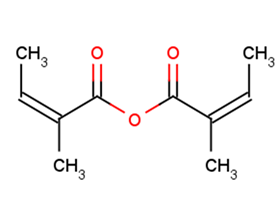
Angelic anhydride
CAS No. 94487-74-8
Angelic anhydride( —— )
Catalog No. M19279 CAS No. 94487-74-8
Angelic Anhydride is a reagent in the improved synthesis of angelate esters, which are the active chemical behind the strong pain-relieving and spasmolytic action of extracts from the plant butterbur.
Purity : >98% (HPLC)
 COA
Datasheet
HNMR
HPLC
MSDS
Handing Instructions
COA
Datasheet
HNMR
HPLC
MSDS
Handing Instructions
| Size | Price / USD | Stock | Quantity |
| 1 mL x 10 mM in DMSO | 48 | In Stock |


|
| 25MG | 83 | In Stock |
|
| 50MG | 118 | In Stock |
|
| 100MG | Get Quote | In Stock |
|
| 200MG | Get Quote | In Stock |
|
| 500MG | Get Quote | In Stock |
|
| 1G | Get Quote | In Stock |
|
Biological Information
-
Product NameAngelic anhydride
-
NoteResearch use only, not for human use.
-
Brief DescriptionAngelic Anhydride is a reagent in the improved synthesis of angelate esters, which are the active chemical behind the strong pain-relieving and spasmolytic action of extracts from the plant butterbur.
-
DescriptionAngelic Anhydride is a reagent in the improved synthesis of angelate esters, which are the active chemical behind the strong pain-relieving and spasmolytic action of extracts from the plant butterbur.
-
In Vitro——
-
In Vivo——
-
Synonyms——
-
PathwayOthers
-
TargetOther Targets
-
RecptorOthers
-
Research Area——
-
Indication——
Chemical Information
-
CAS Number94487-74-8
-
Formula Weight182.21
-
Molecular FormulaC10H14O3
-
Purity>98% (HPLC)
-
Solubility——
-
SMILESCC=C(C)C(=O)OC(=O)C(=CC)C
-
Chemical Name——
Shipping & Storage Information
-
Storage(-20℃)
-
ShippingWith Ice Pack
-
Stability≥ 2 years
Reference
molnova catalog



related products
-
Aschantin
Aschantin, a bisepoxylignan, can be isolated from Magnolia biondii. Aschantin has antiplasmodial, Ca2+-antagonistic, platelet activating factor-antagonistic, and chemopreventive activities. Aschantin is a mTOR kinase inhibitor. Aschantin is also an inhibitor of Cytochrome P450 and UGT enzyme.
-
Phenyl-benzothiazole
Phenyl-benzothiazole is an azole for proteomics research.
-
Fantofarone
Fantofarone is a highly potent Calcium Channel antagonist.
