


 Cart
Cart
 sales@molnova.com


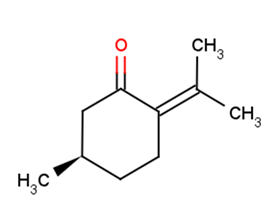
Pulegone
CAS No. 89-82-7
Pulegone( Pulegone | NSC 15334 | NSC15334 | D-Pulegone )
Catalog No. M19240 CAS No. 89-82-7
Pulegone has cytotoxicity followed by regenerative cell proliferation is the MOA for Pulegone-induced urothelial tumors in female rats.
Purity : >98% (HPLC)
 COA
Datasheet
HNMR
HPLC
MSDS
Handing Instructions
COA
Datasheet
HNMR
HPLC
MSDS
Handing Instructions
| Size | Price / USD | Stock | Quantity |
| 1 mL x 10 mM in DMSO | 28 | In Stock |


|
| 100MG | Get Quote | In Stock |
|
| 200MG | Get Quote | In Stock |
|
| 500MG | Get Quote | In Stock |
|
| 1G | 29 | In Stock |
|
Biological Information
-
Product NamePulegone
-
NoteResearch use only, not for human use.
-
Brief DescriptionPulegone has cytotoxicity followed by regenerative cell proliferation is the MOA for Pulegone-induced urothelial tumors in female rats.
-
DescriptionPulegone has cytotoxicity followed by regenerative cell proliferation is the MOA for Pulegone-induced urothelial tumors in female rats. Pulegone induces a verapamil-sensitive psychostimulant effect that appears to independ on the opening of L-type calcium channels. Pulegone has negative reinforcing properties and seems to possess anxiolytic-like actions unrelated to the benzodiazepine site of the γ-aminobutyric acid type A (GABAA) receptor.
-
In Vitro——
-
In Vivo——
-
SynonymsPulegone | NSC 15334 | NSC15334 | D-Pulegone
-
PathwayTyrosine Kinase
-
TargetSrc
-
RecptorL-type calcium channel
-
Research AreaOthers-Field
-
Indication——
Chemical Information
-
CAS Number89-82-7
-
Formula Weight152.23
-
Molecular FormulaC10H16O
-
Purity>98% (HPLC)
-
SolubilityIn Vitro:?DMSO : ≥ 270 mg/mL (1773.63 m)
-
SMILESCC1CCC(=C(C)C)C(=O)C1
-
Chemical NameCyclohexanone, 5-methyl-2-(1-methylethylidene)-, (R)-
Shipping & Storage Information
-
Storage(-20℃)
-
ShippingWith Ice Pack
-
Stability≥ 2 years
Reference
molnova catalog



related products
-
1-Naphthyl PP1
1-Naphthyl PP1 is a selective src inhibitor(v-Src and c-Fyn, c-Abl, CDK2 and CAMK II with IC50s of 1.0, 0.6, 0.6, 18 and 22 μM, respectively)
-
DGY-06-116
DGY-06-116 is an selective and irreversible covalent inhibitor of Src and FGFR1 with IC50 value of 3nM and 8340 nM, respectively.
-
KX1-004
KX1-004 is a potent small molecule inhibitor of Src-PTK as a potential protective drug for NIHL.
