


 Cart
Cart
 sales@molnova.com


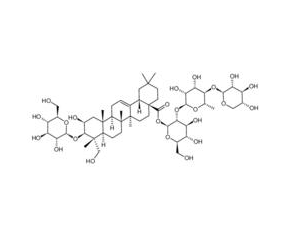
Polygalasaponin F
CAS No. 882664-74-6
Polygalasaponin F( —— )
Catalog No. M19225 CAS No. 882664-74-6
Polygalasaponin F has anti-neuroinflammatory activity, can inhibit the release of inflammatory cytokines TNF-α and NO induced by lipopolysaccharides (LPS) and reduce the expression of inducible nitric oxide synthases.
Purity : >98% (HPLC)
 COA
Datasheet
HNMR
HPLC
MSDS
Handing Instructions
COA
Datasheet
HNMR
HPLC
MSDS
Handing Instructions
| Size | Price / USD | Stock | Quantity |
| 1 mL x 10 mM in DMSO | 114 | In Stock |


|
| 2MG | 31 | In Stock |
|
| 5MG | 48 | In Stock |
|
| 10MG | 67 | In Stock |
|
| 25MG | 107 | In Stock |
|
| 50MG | 152 | In Stock |
|
| 100MG | 222 | In Stock |
|
| 200MG | Get Quote | In Stock |
|
| 500MG | Get Quote | In Stock |
|
| 1G | Get Quote | In Stock |
|
Biological Information
-
Product NamePolygalasaponin F
-
NoteResearch use only, not for human use.
-
Brief DescriptionPolygalasaponin F has anti-neuroinflammatory activity, can inhibit the release of inflammatory cytokines TNF-α and NO induced by lipopolysaccharides (LPS) and reduce the expression of inducible nitric oxide synthases.
-
DescriptionPolygalasaponin F has anti-neuroinflammatory activity, can inhibit the release of inflammatory cytokines TNF-α and NO induced by lipopolysaccharides (LPS) and reduce the expression of inducible nitric oxide synthases. Polygalasaponin F can significantly inhibit the cytotoxicity of conditioned medium prepared by LPS-stimulated BV-2 microglia (LPS conditioned media) to neuronal PC12 cells and improve cell viability. Polygalasaponin F can induce long-term potentiation in hippocampal dentate gyrus in anesthetized rats via NMDAR activation mediated by Ca(2+)/calmodulin-dependent kinase II, extracellular signal-regulated kinase and cAMP response element-binding protein signaling pathway. PS-F inhibits the secretions of neuroinflammatory cytokines by the regulation of the NF-kB-signaling pathway.
-
In Vitro——
-
In Vivo——
-
Synonyms——
-
PathwayOthers
-
TargetOther Targets
-
RecptorNF-κB
-
Research AreaOthers-Field
-
Indication——
Chemical Information
-
CAS Number882664-74-6
-
Formula Weight1091.3
-
Molecular FormulaC53H86O23
-
Purity>98% (HPLC)
-
SolubilityIn Vitro:?DMSO : 100 mg/mL (91.64 mM)
-
SMILESC1C(CC[C@@]2(CC[C@]3([C@@]4(CC[C@H]5[C@]([C@H]([C@H](C[C@@]5([C@H]4CC=C3[C@H]12)C)O)O[C@H]1[C@@H]([C@H]([C@@H]([C@H](O1)CO)O)O)O)(C)CO)C)C)C(=O)O[C@H]1[C@@H]([C@H]([C@@H]([C@H](O1)CO)O)O)O[C@H]1[C@@H]([C@@H]([C@H]([C@@H](O1)C)O[C@H]1[C@@H]([C@H]([C@@H](CO1)O)O)O)O)O)(C)C
-
Chemical Name——
Shipping & Storage Information
-
Storage(-20℃)
-
ShippingWith Ice Pack
-
Stability≥ 2 years
Reference
1. Zhou W,et al. Quantification of polygalasaponin F in rat plasma using liquid chromatography-tandem mass spectrometry and its pharmacokinetics application. Biomed Chromatogr. 2015 Sep;29(9):1388-92.
molnova catalog



related products
-
Maleic acid disodium...
Maleic acid disodium salt is a pharmaceutical intermediate used in the synthesis of other active compounds.
-
3,4-Dihydro-3,4-dihy...
3,4-Dihydro-3,4-dihydroxynaphthalen-1(2H)-one is a natural product for research related to life sciences.
-
HET0016
HET0016 is a potent and selective 20-HETE synthase inhibitor (IC50s: 17.7 nM, 12.1 nM, and 20.6 nM for recombinant CYP4A1-, CYP4A2-, and CYP4A3-catalyzed 20-HETE synthesis) and a selective CYP450 inhibitor, shown to inhibit angiogenesis and tumor growth.
